Educare CEO Alex Onyia Alleges Major CBT Glitch in WAEC 2026 WASSCE Results, Threatens Legal Action
Key Takeaways
- •Educare CEO Alex Onyia alleged a serious glitch in the 2026 WASSCE results affecting CBT candidates and demanded immediate withdrawal and correction under threat of legal action.
- •WAEC reported that 1,200,514 candidates, or 61.54% of those who sat the exam, obtained credits in at least five subjects including English and Mathematics, a 1.42 percentage-point decline from 2025.
- •Nearly 1.96 million candidates from 24,207 schools across Nigeria, Benin Republic, Côte d'Ivoire, and Equatorial Guinea registered for the examination held from April 21 to June 19.
- •WAEC expanded Computer-Based Testing adoption from fewer than 40 schools in 2025 to approximately 450 schools in 2026, its most aggressive single-year CBT expansion on record.
- •WAEC has not yet publicly responded to the glitch allegations despite their 2025 pledge that serialisation issues leading to a temporary results withdrawal would not be repeated.
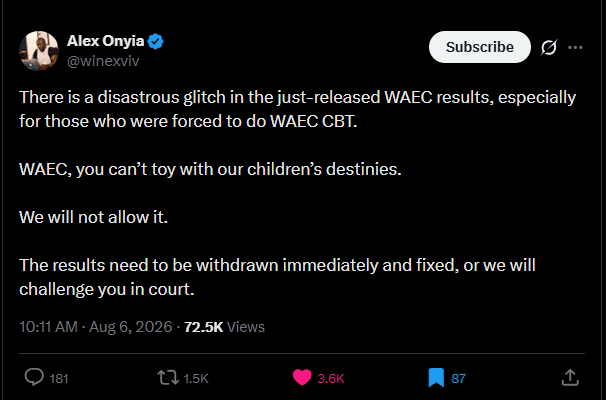
Shortly after the West African Examinations Council (WAEC) released the 2026 West African Senior School Certificate Examination (WASSCE) results, Educare CEO Alex Onyia took to X to allege a serious glitch affecting the results, particularly for candidates who sat the Computer-Based Testing (CBT) option.
"WAEC, you can't toy with our children's destinies," Onyia wrote, demanding that the results be withdrawn and corrected immediately or face a court challenge. Within three hours, his post drew thousands of views and dozens of replies, many from parents and students echoing similar concerns. The stakes are considerable: the WASSCE is the principal secondary-school-leaving qualification across West Africa, and a candidate's performance directly shapes university admission prospects and access to scholarship opportunities in Nigeria and beyond.
WAEC announced on Wednesday that 1,200,514 candidates — representing 61.54% of those who sat the exam — obtained credits in at least five subjects, including English Language and Mathematics, marking a 1.42 percentage-point decline from 2025. Close to 1.96 million candidates from 24,207 schools across Nigeria, the Benin Republic, Côte d'Ivoire, and Equatorial Guinea registered for the exam, which ran from April 21 to June 19.
The results release comes months after WAEC's National Office head, Dr. Amos Josiah Dangut, promised there would be no repeat of the glitches that forced the council to temporarily withdraw the 2025 WASSCE results over a flawed paper-serialisation system. Dangut stated that the identified issues had been corrected and disclosed that CBT adoption grew from fewer than 40 schools in 2025 to approximately 450 in 2026. That tenfold-plus increase, while still covering a small fraction of the 24,207 participating schools, represents one of the most aggressive single-year expansions of computer-based testing in the council's history. WAEC has not yet publicly responded to Onyia's latest allegation.
A Familiar Fight for Alex Onyia
This is not the first time Onyia has challenged a Nigerian examination body over alleged system failures. During the 2025 UTME crisis, he publicly disputed the Joint Admissions and Matriculation Board's (JAMB) characterization of widespread score anomalies as a mere "glitch," arguing instead that a flawed fraud-detection algorithm was responsible and pointing to candidates whose scores swung wildly between sittings. He also reported hearing from over 100 students who described suicidal thoughts over their results, an account that prompted JAMB to establish a probe covering thousands of affected candidates. JAMB's subsequent review vindicated several of his concerns.
Onyia's track record of amplifying student grievances into institutional pressure — and his proven accuracy on the JAMB matter — likely contributed to the rapid spread of his latest post among parents and candidates. Whether WAEC's 2026 CBT rollout has in fact produced errors on the scale he describes remains to be independently verified.
