Why the US May Reflag Gulf Tankers Again
Key Takeaways
- •The Strait of Hormuz crisis has caused at least 17 damaged merchant ships, two captured vessels, and 12 seafarers killed or missing since February 2026.
- •Roughly one-fifth of global oil consumption and all of Qatar’s LNG exports normally move through the Strait of Hormuz.
- •Washington is already using limited measures, including the Tanker Security Program, Operation Project Freedom escorts, and proposed war-risk insurance support.
- •A formal reflagging program could give insurers and shipowners clearer legal protection, but it would also put US warships in a contested waterway where Iran has shown willingness to mine and strike.
- •The US remains a net crude oil importer, bringing in about 6.2 million barrels a day and exporting about 4 million barrels a day in 2025.
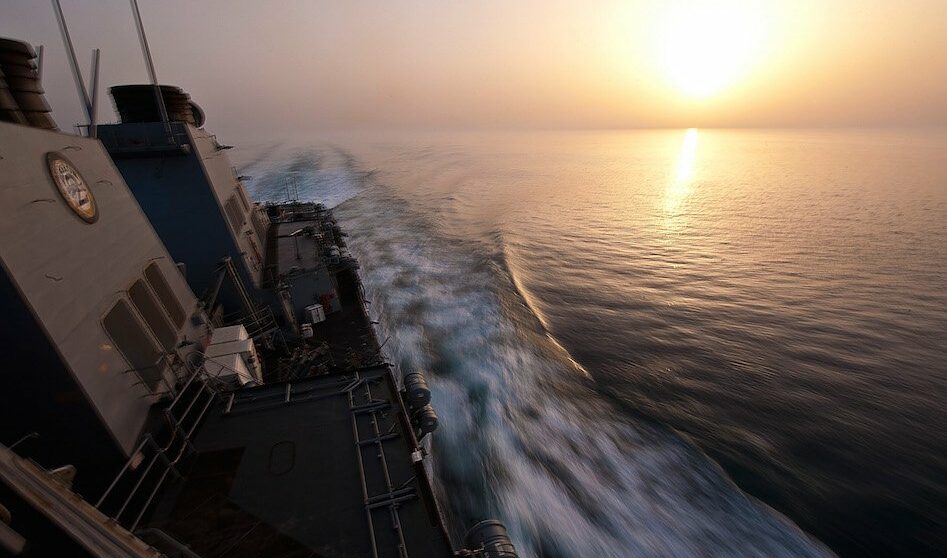
The United States is no longer as dependent on Gulf oil as it was in the late 1980s, but risks to global energy prices and shipping may still push Washington toward formalizing an expanding escort operation in the region, Punit Oza writes.
In 1987, the US reflagged Kuwaiti oil tankers and escorted them through the Gulf under Operation Earnest Will. The mission was a response to the so-called tanker war between Iran and Iraq, not to Iraq's later invasion of Kuwait, which occurred three years later. That distinction remains important: Earnest Will was a limited, single-purpose escort operation attached to a war being fought by others. The issue now is whether Washington can use the same playbook in a conflict in which it is already directly involved.
A harder operation to repeat
Iran's military capabilities have expanded far beyond the small boats, mines and Silkworm missiles it relied on in 1987. Its arsenal now includes long-range missiles and drone swarms, and those capabilities are being used in an active air and naval war rather than in a more contained tanker conflict. The Strait of Hormuz crisis that has been running since February 2026 has already resulted in at least seventeen damaged merchant ships, two captured vessels, and twelve seafarers killed or missing. That toll is worse than anything seen during Operation Earnest Will, even though the US Navy is much stronger today.
The stakes extend well beyond the vessels directly involved. Roughly a fifth of global oil consumption normally passes through the Strait of Hormuz on any given day, and Qatar — one of the world's largest liquefied natural gas exporters — ships its entire LNG output through the same waterway. Any sustained disruption would cascade into both crude and gas markets simultaneously, affecting energy-importing economies from Europe to South Asia that have no direct stake in the conflict itself.
The broader strategic setting is also different. In 1987, Washington could remain outside the wider war while escorting tankers through it. The current crisis began with a direct US-Israeli strike campaign, after which Iran retaliated against Israel, US bases, and Gulf states. Reflagging vessels today would not place the US adjacent to someone else's war; it would widen a war in which the US is already a combatant.
Nor does a US flag necessarily guarantee the restraint it once appeared to offer. In February 2026, Iranian gunboats approached and nearly boarded the US-flagged tanker Stena Imperative before a US warship intervened. Reflagging dozens of Gulf tankers would multiply those points of exposure many times over. Allied backing is also less straightforward than it was in 1987. France is developing its own European escort coalition, while Oman has opened an independent transit route, both of which indicate that a unilateral US program would be more difficult to sell than the reflagging arrangement requested by a threatened Kuwait nearly four decades ago.
Why Washington may still move ahead
In practice, Washington is already operating a smaller, improvised version of Operation Earnest Will. The Tanker Security Program keeps US-flagged tankers on standby in the Gulf, Operation Project Freedom has already escorted merchant shipping through the strait, and President Trump has proposed Navy escorts and war-risk insurance for "all maritime trade."
The argument for making the arrangement formal is that ambiguity may now carry greater risks than commitment. Partial measures give Iran room to continue testing limits, while a declared reflagging regime could provide insurers and shipowners with the legal clarity needed to return stranded tonnage to the strait. In practice, marine war-risk premiums in the Gulf have already climbed sharply since the crisis began, and some underwriters have withdrawn coverage for transits entirely, leaving shipowners to choose between idling vessels or sailing uninsured. Formal US escorts could reduce that ambiguity enough to bring laid-up tonnage back into service. The emerging Persian Gulf Strait Authority could also offer multilateral cover, reducing the appearance that Washington is pursuing a unilateral claim over Gulf shipping.
The exporter complication
The clearest argument against reflagging is that the US no longer depends on Gulf oil as it did in 1987. That is only partly true. The US exports more refined product than it imports, but it remains a net importer of crude oil itself, bringing in roughly 6.2m barrels a day and exporting about 4m barrels a day in 2025. That imbalance exists because US refineries are largely configured for lighter, sweeter crude than much of what the Gulf produces.
More importantly, Washington's core interest was never solely about barrels bound for the US. It was also about the global price shock that any closure of the Strait of Hormuz would create. Today, China is the buyer most exposed to that shock, giving Washington a strategic lever it may have more reason to use now rather than less.
The likely course
A full reflagging program would carry significant risks. It would place US warships inside a strait that Iran has shown a willingness to mine and strike, at a time when Washington is not a neutral escorting power but an active participant in the conflict. The domestic case is also weaker because US dependence on Gulf oil appears less direct than it once did.
Even so, the trajectory of events points less to a single clean decision than to a gradual expansion of what is already underway: more Tanker Security Program vessels, more escort operations, and more insurance guarantees, framed through the multilateral language of the new Strait Authority. In the current environment, ambiguity rather than commitment may prove to be the costlier option. How Gulf insurers, regional partners, and Iran each respond to each incremental step will shape whether that expansion stabilizes the waterway or deepens the conflict.

