BNY Mellon Unit Joins MiCA Register as ESMA Adds 15 Crypto-Asset Service Providers
Key Takeaways
- •ESMA’s latest MiCA update added 15 crypto-asset service providers, raising the interim CASP register total to 309.
- •Four banking institutions were among the new entries, including BNY SA/NV, the Belgian subsidiary of BNY Mellon.
- •Germany and Denmark led the latest round with three newly registered CASPs each.
- •Registers for asset-referenced token issuers, e-money token issuers, crypto assets and non-compliant entities did not change in this update.
- •Industry concerns remain that the cost of maintaining a MiCA license could pressure smaller firms over time.
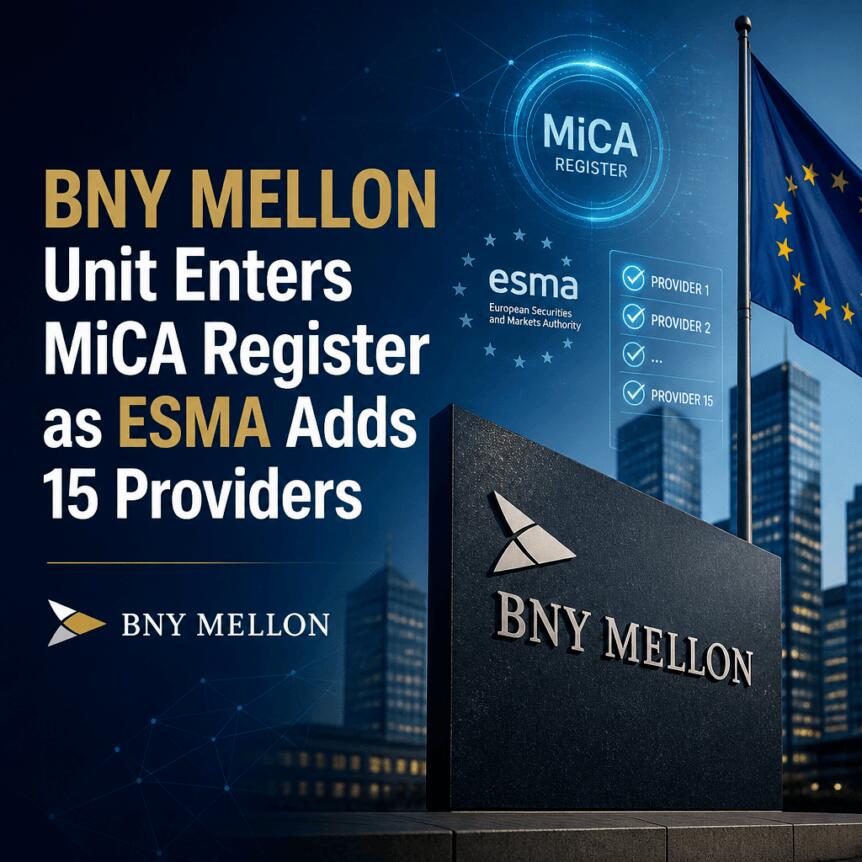
European regulators have added 15 firms to the public register of crypto-asset service providers operating under the European Union’s Markets in Crypto-Assets framework, known as MiCA, in the latest update from the European Securities and Markets Authority after the July 1 transitional deadline.
According to ESMA, the interim MiCA register now includes 309 licensed crypto-asset service providers, or CASPs. The newly listed entities include several banks and digital asset platforms such as BitPay, Coinify and Bleap.
ESMA expands MiCA register after transitional deadline
The update, published on Friday, marks another step in the gradual expansion of MiCA licensing since the July 1 deadline for firms to transition into the regulatory framework. MiCA is intended to establish the EU’s first unified regime for crypto-asset services, replacing varied national rules with a standardized supervisory structure across member states.
In ESMA’s third register update after the deadline, the interim list of regulated providers increased by 15 CASPs. Four banking institutions were among the additions, including BNY SA/NV, which ESMA identified as the Belgian subsidiary of BNY Mellon.
The latest update brings the total number of licensed CASPs on the interim register to 309. Banking groups represented a significant share of the new entrants, with multiple German banks included alongside BNY SA/NV.
Germany and Denmark lead new registrations
The geographic distribution of the additions shows licensing activity continuing across several European jurisdictions. ESMA reported that Germany and Denmark contributed the largest number of new registrations in the latest update, with three newly listed CASPs in each country.
Bulgaria and Latvia each added two providers. Belgium, Cyprus, Liechtenstein and the Netherlands each recorded one new CASP in this round, reflecting a broader but uneven rollout across Europe.
The German entries include cooperative institutions and a regional bank: Spar-und Kreditbank Rheinstetten, VR-Bank Augsburg-Ostallgäu and Raiffeisenbank Falkenstein-Wörth. Denmark’s new registrations include SafeLynx Technologies and Januar, described as a digital asset infrastructure company.
Other providers named in ESMA’s update include Bulgaria’s Altcoins BG and Digital Assist, along with Latvia-registered firms Bleap and Nodu Digital. Digital asset platforms also appear among the new CASPs, including BitPay, Coinify and Bleap.
Other MiCA registers unchanged in latest update
The latest expansion follows ESMA’s second post-deadline register update, when the regulator added 14 CASPs after July 1. Earlier reporting from Cointelegraph said some major industry participants were included in those previous additions, including Ripple Payments Europe.
Although the CASP list grew again, ESMA said the latest update did not change other MiCA-related registers. Those include registers for authorized issuers of asset-referenced tokens, or ARTs, and e-money tokens, or EMTs, as well as registers covering crypto assets and non-compliant entities.
The distinction is material because the CASP register applies to entities providing regulated services, while token issuer categories are tracked separately. As a result, MiCA implementation may progress at different speeds across different parts of the crypto sector. Service providers can reach licensing milestones while authorization processes for token issuers and specific issuer categories follow separate timelines and documentation requirements.
Compliance costs remain a concern for smaller firms
The expanding CASP register indicates that licensing activity is continuing beyond the announcement stage and into operational authorization across European markets. For users and market participants, the growing number of MiCA-licensed CASPs may provide clearer regulatory expectations for custody, exchange services and other crypto-asset activities, provided firms continue to meet their obligations under the framework.
At the same time, ESMA’s ongoing updates show that MiCA implementation remains an active process after the July 1 transitional deadline. The register continues to change as companies complete licensing procedures in different jurisdictions, making subsequent updates an important reference point for tracking which firms have entered the EU’s regulated crypto-services perimeter.
Compliance costs remain a concern for parts of the industry. Earlier reporting from Cointelegraph cited Gate Europe CEO Giovanni Cunti as warning that the cost of maintaining a MiCA license could weigh on smaller firms, potentially making it more difficult for them to sustain the resources needed for compliance over the long term.
Future ESMA updates will show whether the CASP roster continues to expand and whether changes begin appearing in token issuer registers covering ARTs, EMTs and other crypto-asset categories. Such updates would reflect further movement in MiCA implementation beyond service providers and into other parts of the crypto value chain.

