AI Data Center Construction Spending Surges 46% Year-Over-Year to $68 Billion Annual Rate as Hyperscalers Raise Capex Guidance
Key Takeaways
- •U.S. data center construction spending reached a seasonally adjusted annual rate of $68 billion in June, representing 46% year-over-year growth and a more than 500% increase since January 2022.
- •Census Bureau construction spending figures exclude the costliest data center components, including servers, networking equipment, and electrical power supply infrastructure.
- •Alphabet, Meta, and Microsoft have collectively guided 2026 capital expenditures into a range of approximately $500 to $540 billion, primarily directed at AI infrastructure.
- •The data center expansion is producing shortages across specialized labor, high-bandwidth memory semiconductors, power generation equipment, and grid electricity capacity.
- •Escalating AI infrastructure costs are diverting resources from other sectors of the economy and have started to pass through into consumer prices.
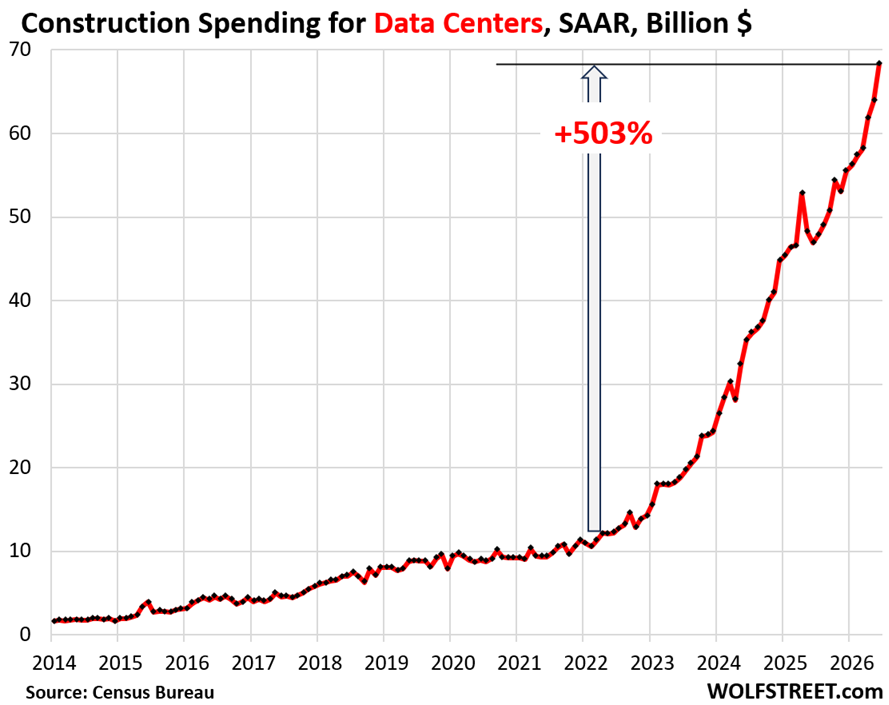
Data center construction spending in the United States surged 7.0% month-over-month and 46% year-over-year in June, reaching a seasonally adjusted annual rate of $68 billion, according to construction data released by the Census Bureau. Since the beginning of 2022, monthly construction spending on data centers has climbed by more than 500%, with the trajectory resembling a near-exponential growth curve. Data centers have become one of the fastest-growing categories in the Census Bureau's private nonresidential construction series, which tracks spending across office, retail, manufacturing, and other commercial buildings.
These figures, however, capture only a portion of total data center investment. They reflect the construction costs of the building itself, surrounding site improvements, and equipment integrated into the structure, such as HVAC systems. The most expensive components of a functioning data center are not included in these numbers: the servers, the racks, the networking equipment that connects servers to the internet, the electrical power supply infrastructure, backup power generators, and transmission lines. Once a data-center building is completed, substantial additional investment is required to transform the concrete structure into a fully operational facility.
Corporate Capital Expenditure Guidance Continues to Climb
Corporate announcements of capital expenditures have been consistently revised higher, with spending growing on what appears to be an exponential curve. Among the hyperscale technology companies, capital expenditure commitments involve enormous sums directed primarily at AI infrastructure:
- Alphabet raised its full-year 2026 capital expenditure guidance to a range of $195–205 billion, up from $91 billion in the prior year.
- Meta increased its full-year 2026 capital expenditure guidance to a range of $130–145 billion.
- Microsoft lifted its 2026 capital expenditure guidance to a range of $175–190 billion.
Hundreds of billions of dollars in corporate cash flow that would previously have been allocated to share buybacks or Treasury securities are now being channeled into AI infrastructure. Beyond cash flow, companies have issued new shares at near-record-high prices, borrowed substantial amounts, and committed even larger sums—with a significant portion structured off-balance-sheet—to accelerate the AI infrastructure buildout as rapidly as possible.
Supply Chain Constraints and Economic Ripple Effects
The rapid expansion of data center construction is generating shortages across multiple sectors:
- Specialized labor, including electricians and technicians skilled in high-voltage power systems and industrial-scale cooling, is in short supply.
- Semiconductors, particularly high-bandwidth memory (HBM) used in AI accelerators and other memory chips, are experiencing shortages as demand for data center electronic equipment surges, and prices have risen sharply.
- Electricity required to power new facilities—where a single large AI data center can demand hundreds of megawatts, comparable to the load of a small city—is straining the power grid and contributing to higher electricity prices.
- Power generation equipment, including transformers, switchgear, and backup generators, is also in short supply, with industry lead times for some components extending well beyond historical norms.
The list of constraints extends across the broader economy. Because AI-related spending appears to prioritize rapid execution over cost discipline, the construction boom is pulling resources away from other economic activities. Costs continue to escalate, and some of those increases have begun to filter into consumer prices.
Corporate spending growth of this magnitude and velocity is historically uncommon. Such steep trajectories typically encounter limits well before continuing indefinitely. However, based on current Census Bureau data and corporate guidance, that inflection point has not yet been reached.

