ZetaChain Holders Vote 99.4% to Sunset Layer 1 as ZETA Moves to Solana
Key Takeaways
- •Proposal 68 passed with 99.4% support and 58% turnout, well above the 40% quorum, authorizing the shutdown of ZetaChain's Layer 1 and the reissuance of ZETA on Solana.
- •ZETA will convert at a 1:1 ratio into a native Solana SPL token with its ticker, total supply, and vesting schedules unchanged, while decimal precision drops from 18 to 9; tokens on Ethereum and BNB Chain are excluded.
- •A follow-up vote will set the balance snapshot height and shutdown block, but no date is set as ZetaChain awaits exchange swap confirmations, and the future of staking rewards on Solana remains unresolved.
- •The pivot centers on Anuma, a private multi-model AI app launched in February that ZetaChain says has attracted more than 300,000 users and over 1 million requests across 35 AI models.
- •The vote follows a difficult security stretch including an April hack of the GatewayZEVM contract and recent attacks on six Cosmos EVM chains, and ZETA jumped about 64% to roughly $0.063 in 24 hours.
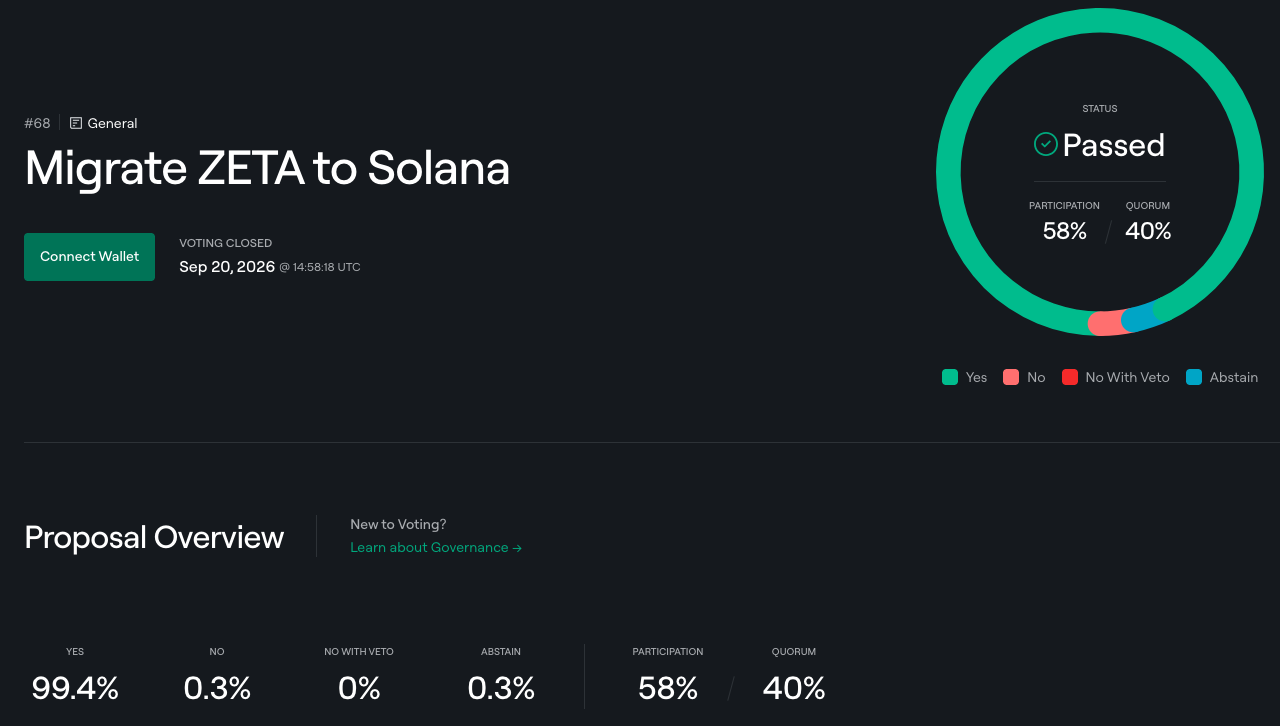
ZetaChain token holders have approved a plan to wind down the project's own Layer 1 blockchain and reissue the ZETA token on Solana, marking a shift away from the cross-chain infrastructure pitch that defined the project's early years.
The governance measure, Proposal 68, passed with 99.4% support and closed on Sunday, September 20, at 10:58 a.m. ET, according to the project's governance portal. Turnout reached 58%, well above the 40% quorum — the minimum participation required for the result to stand — with "no" and "abstain" votes each drawing 0.3%. No shutdown date has been set.
Three years ago, ZetaChain raised $27 million to build a network for connecting blockchains. It is now dropping that pitch to focus on Anuma, a private multi-model AI application the team launched in February. In effect, the project will stop running the infrastructure it was funded to build and instead depend on a network operated by others.
The migration plan
Under the approved plan, ZETA will be converted into a native Solana SPL token — the standard token format on that chain — at a 1:1 rate. The ticker and total supply remain unchanged, as do vesting schedules and their original dates. Token decimal precision will be reduced from 18 to 9.
ZETA issued on Ethereum or BNB Chain is not included in the migration, and ZetaChain's guidance says most holders should not need to do anything.
The proposal keeps the existing Layer 1 up and running while contributors work out the mechanics. A second, follow-up vote will set the block height for a balance snapshot and name the shutdown block. It will also publish how holders claim tokens and how assets are pulled from connected chains — the steps that remain before a shutdown block can even be named.
No date has been set for the second vote, as ZetaChain waits for exchanges to confirm swap agreements. Staking on the current chain continues in the meantime. In a September 17 announcement, the team said it was still working out how staking and rewards would function on Solana, leaving the future of holder rewards unresolved until then.
The pivot to consumer AI
Anuma is the driving force behind the decision. ZetaChain claims the app has attracted more than 300,000 users and more than 1 million requests across 35 AI models. ZETA holders can lock tokens to earn credits that can be spent on AI usage, a mechanism that ties the token's utility to the app the team now treats as its core product.
"What Solana's AI stack still lacks is the application layer: an app people use every day, with memory that belongs to them and travels across models, apps, and agents," the ZetaChain team wrote in its announcement.
In the proposal, the team describes operating its own chain as overhead, since every Cosmos SDK patch — an update to the framework the chain runs on — must be coordinated across dozens of validators. According to the team, AI tools make bugs easier to find — as an August 25 patch showed — and more patches are expected. Retiring the chain would remove that coordination burden altogether.
Security backdrop and market reaction
The vote follows a difficult stretch for the network. Last month, Cosmos Labs announced attacks against six Cosmos EVM chains, though ZetaChain was not among them, and attackers cashed out about $5.7 million. ZetaChain had earlier halted cross-chain transfers after its GatewayZEVM smart contract was hacked in April.
ZETA jumped about 64% in the past 24 hours, trading at roughly $0.063 on Monday, according to CoinGecko.

