Zcash Price Faces First Test After 285% Rally as $1,070 Support Holds
Key Takeaways
- •ZEC rebounded above $1,100 after testing the $1,070 support area, but support has not yet been confirmed.
- •A daily close below $1,070 could shift attention to $930, while sustained recovery above $1,200-$1,220 could put the $1,297 peak back in focus.
- •ZEC’s 14-day RSI has declined to 65 from overbought levels but remains above 50, while the token stays well above its major moving averages.
- •DCG International Investments exchanged 85,705.33 ZEC for about $100 million of ZCSH shares using tokens it already held, rather than making an equivalent spot-market purchase.
- •The NU7 poll closes on September 14, followed by the Federal Reserve meeting on September 15-16, creating upcoming governance and macroeconomic events for traders to monitor.
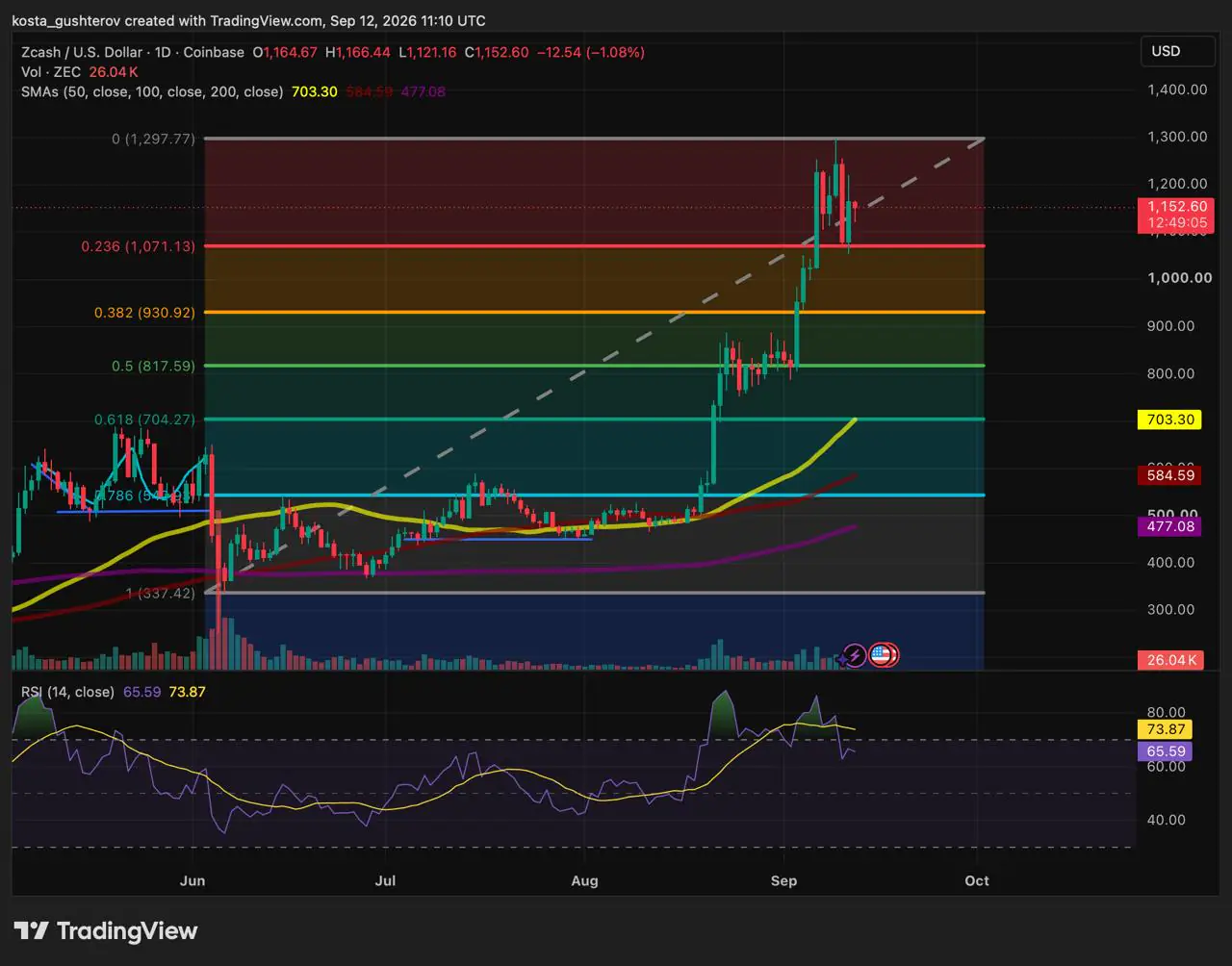
Zcash has entered its first significant test after a 285% rally, with traders watching whether the $1,070 area can hold as support.
ZEC retreats after a 285% advance
ZEC rallied from a June low near $337 to a September peak close to $1,297 before pulling back. The token traded near $1,150 on September 12, about 11% below its recent high.
The retreat followed ZEC’s move above $1,000, which was examined in Coindoo’s previous Zcash price analysis. Attention has now shifted to $1,070, the 23.6% Fibonacci retracement of the advance from June to September and the first clear support reference during the pullback.
ZEC tested the $1,070 area while declining from $1,297, and buyers pushed the price back above $1,100. That recovery has left the higher-low structure intact for now, although an intraday rebound does not confirm that support has formed.
A close above $1,070 followed by continued trading above the level would strengthen that case. Conversely, a daily close below $1,070 could bring the next retracement near $930 into focus. A brief wick below the level would carry less significance if buyers recovered it before the session ended.
Momentum has cooled from its recent extreme
The 14-day Relative Strength Index has fallen to 65 from overbought readings recorded during the strongest part of the rally. Its moving average remains higher at 73.8. The change indicates that momentum has cooled after ZEC approached $1,300, but RSI is still above 50. That keeps the daily trend constructive without confirming that the correction has ended.
ZEC also remains well above its major moving averages. The 50-day simple moving average is near $703, while the 100-day and 200-day averages are around $584 and $477, respectively. The nearest major moving average is roughly $450 below the current price.
As a result, there is a broad area without comparable daily trend support between $1,070 and the 50-day average near $700. Fibonacci levels may therefore serve as more useful reference points if the pullback extends.
The levels below are the main areas to monitor if $1,070 fails to hold:
- $1,070: The 23.6% retracement and immediate support.
- $930: The 38.2% retracement and the next level below $1,000.
- $817: The midpoint of the measured advance, near the early-September consolidation area.
- $704: The 61.8% retracement, nearly aligned with the 50-day average.
A daily close below $1,070 would weaken the immediate setup and could bring $930 back into focus. It would not erase the entire advance from June because ZEC would still be trading well above its longer-term moving averages.
On the upside, the bullish alternative requires buyers to reclaim the most recent supply area rather than merely prevent a deeper decline. ZEC would first need to recover the $1,200-$1,220 range, where sellers recently appeared. A sustained move through that zone could put the $1,297 peak back in focus.
The $100 million ZCSH creation was not $100 million of spot buying
A September 8 SEC filing confirmed that DCG International Investments exchanged 85,705.33 ZEC for approximately $100 million of shares in The Zcash ETF, which trades under the ticker ZCSH. The SEC filing values the contributed ZEC at roughly $1,167 per token, close to ZEC’s trading area at the time.
The transaction provides context but is not evidence of a $100 million spot-market purchase. DCG, an affiliate of Grayscale and the fund, received ZCSH shares through an authorized participant in exchange for tokens it already held.
In its accompanying press release, Grayscale said ZCSH had recorded more than $70 million of cumulative inflows during its first two weeks, excluding DCG’s $100 million contribution. The product’s assets under management had exceeded $500 million, and options began trading on NYSE Arca on September 8.
Those figures are not interchangeable. Net inflows are a better measure of new investor demand, while assets under management also reflect the value of ZEC held by the fund. The affiliate transaction increased the fund’s size but did not create equivalent spot-market demand.
The effect on price depends on how authorized participants obtain the ZEC used to create new shares. Cash inflows can add to spot demand when participants must buy tokens in the market. They may have little immediate effect, however, when creations are funded with existing inventory or contributed tokens, as in DCG’s transaction.
NU7 vote and Federal Reserve meeting are next
The fund data matters most if it is followed by continued demand from outside investors. The next catalysts will test that demand from two directions: Zcash governance and macroeconomic policy.
The NU7 community poll closes on September 14 at 19:00 UTC. The NU7 poll will not alter the network by itself, but it can indicate whether the community supports the direction of the next upgrade. The proposals include reducing block time from 75 seconds to 25 seconds, changing ZEC’s issuance schedule and establishing a timetable for retiring older Sprout transactions.
After the poll closes, attention will shift from a Zcash-specific event to the broader market. The Federal Reserve is scheduled to meet on September 15-16, with its statement, projections and press conference due on September 16, according to the Federal Reserve calendar.
Markets increased their expectations for an interest-rate increase after the latest US inflation report. It is not possible to know in advance how ZEC or the broader cryptocurrency market will respond, or how much of the expected decision is already reflected in prices.
Traders will need to assess the Fed’s projections and comments about later meetings alongside the immediate market response, rather than treating the rate decision alone as a clear directional signal. Following such a rapid advance, a broader risk-off move could make ZEC more sensitive to selling pressure even if the NU7 outlook remains unchanged.
The pullback is testing the quality of ZEC demand
ZEC’s rally has produced two types of demand that need to be distinguished. ZCSH’s non-affiliate inflows point to outside investor interest, while DCG’s $100 million token-for-shares transaction increased fund assets without generating equivalent spot buying.
That distinction is more important now that ZEC has begun to retrace. A large assets-under-management figure alone does not show how much independent demand is prepared to absorb selling pressure.
The $1,070 area is therefore more than a Fibonacci level. It is the first point at which the market can test whether demand built during the rally is strong enough to support ZEC through both the governance vote and a potentially volatile Federal Reserve decision. If the level holds, it would improve the case that the rally is developing a base. If it fails, the market may need to find that demand at lower levels instead.
This article is provided for informational purposes only and does not constitute financial or investment advice.
Source: Coindoo
