XRP Rally Drives Upbit to $3.81 Billion Daily Volume as South Korean Traders Return
Key Takeaways
- •Upbit processed roughly $830 million within a single hour on Saturday and about $3.81 billion over 24 hours, with XRP representing 32.20% of turnover, the largest share of any asset on the exchange.
- •XRP traded near $1.50 after gaining approximately 50% over seven days, outperforming the wider cryptocurrency market during that period.
- •The rebound began on August 21, when Upbit's daily volume surged 273% to $1.84 billion, its busiest day since mid-March, while Bithumb's volume climbed 132.9% and Coinone processed $172 million.
- •Jeonbuk Bank became South Korea's first regional bank to deploy Ripple Payments, marking Ripple's third South Korean partnership of 2026 following deals with Kbank and Kyobo Life Insurance.
- •Kalshi traders assigned probabilities of 61%, 37%, and 26% to XRP exceeding $2, $2.50, and $3 respectively by year-end.
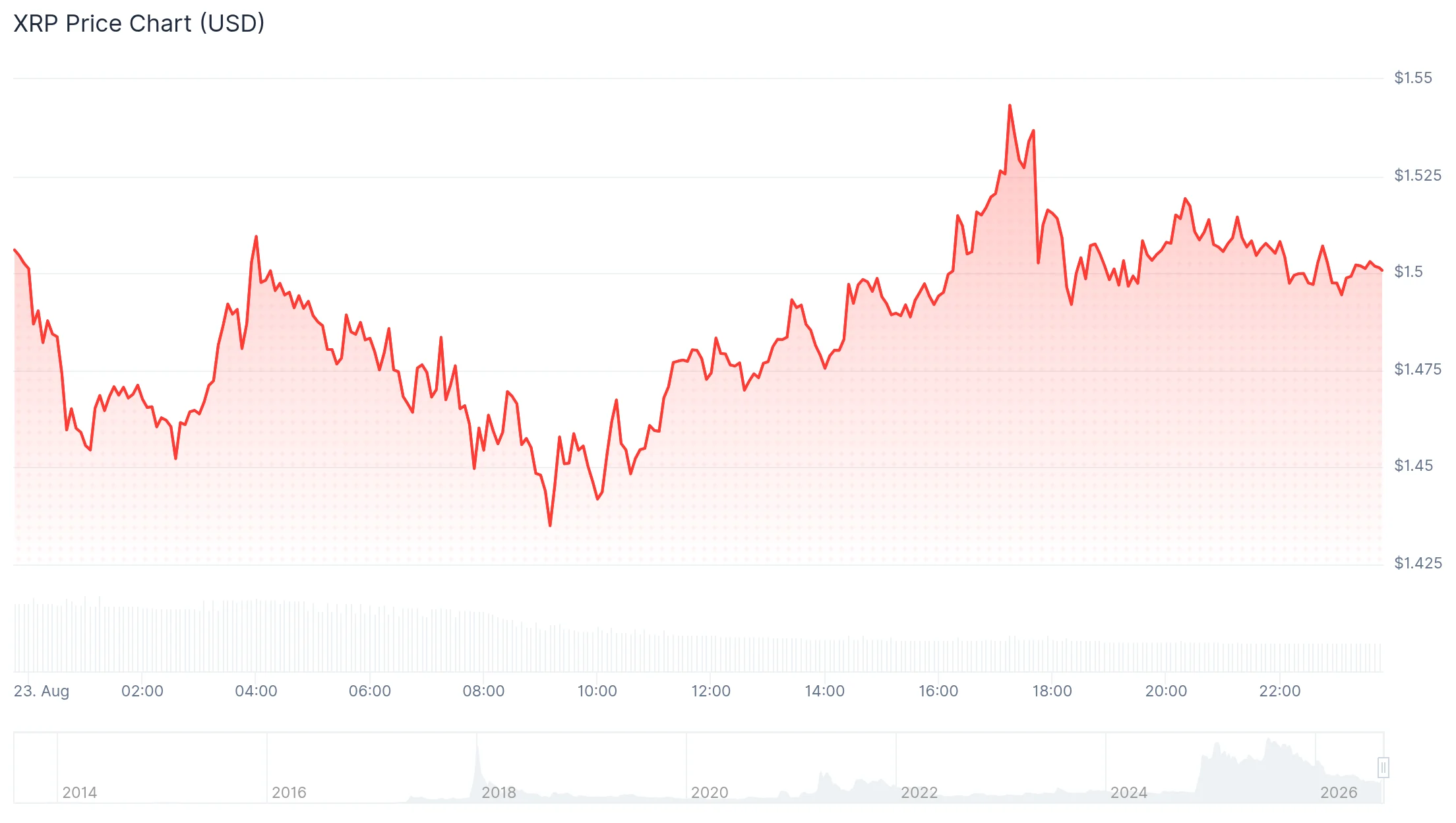
South Korea has moved back to the center of cryptocurrency trading as an XRP rally draws heavy retail flow into the country’s largest exchange. Upbit processed roughly $830 million within a single hour on Saturday, and its 24-hour turnover later reached about $3.81 billion. XRP accounted for 32.20% of that activity, the largest share of any asset on the platform. Coingecko data shows XRP trading near $1.50 after a 50% gain over seven days.
Bitcoin helped revive broader risk appetite, but Korean traders concentrated their positioning in XRP. The move extends a sharp rebound that began on August 21, when Upbit’s daily volume jumped 273% to $1.84 billion, the exchange’s busiest day since mid-March. Bithumb recorded a triple-digit increase in daily turnover over the same period.
XRP Commands Upbit as Korean Volumes Rebound
XRP generated the largest share of Upbit turnover during the burst. TRUMP ranked second with 10.93%, USDT held 8.39%, and Ethereum and Bitcoin followed with 5.44% and 5.40%, respectively. The breakdown points to a concentrated rotation rather than a uniform market rebound: XRP drew roughly three times TRUMP’s share and almost six times Bitcoin’s. The rally coincided with XRP outperforming the wider crypto market over the past seven days.
Commentator Digital Asset Investor highlighted the Korean flow, saying "XRP is smoking everything else" during the move, and linked the pattern to earlier bull cycles in which Korean trading frequently supplied substantial XRP liquidity.
XRP Setting Records Watch The Full Youtube Video Here: pic.twitter.com/hT0A1scynL — Digital Asset Investor (@digitalassetbuy) August 23, 2026
South Korean investors have long treated XRP differently from many large-cap tokens. Won-denominated markets provide direct access, while XRP’s payments narrative appeals to a familiar retail audience. Rapid price changes can quickly pull sidelined traders back into the market. Past surges of local demand have also shown up in the "kimchi premium," the gap between won-denominated prices and global USD quotes that widened sharply during the 2018 boom and remains a standard gauge of Korean retail enthusiasm.
Rebound Extends Across Korean Exchanges
The rally extends beyond Upbit. Bithumb’s August 21 volume climbed 132.9% to about $934.9 million, and its later 24-hour turnover reached nearly $1.95 billion, while Coinone processed $172 million.
Those figures follow a quiet first half of the year for Korean exchanges. Upbit and Bithumb each reported operating revenue declines near 50%, as many local investors favored domestic shares during the KOSPI’s artificial-intelligence and semiconductor rally. The current surge tests whether that capital rotation can persist — a single weekend cannot establish a durable trend — though activity across several exchanges shows the rebound extends beyond one venue or trading pair.
Ripple Expands in Korea While Washington Revisits Crypto Rules
Ripple’s commercial expansion gives Korean interest another reference point. Jeonbuk Bank became Korea’s first regional bank to deploy Ripple Payments, a service targeting cross-border payments with support for near real-time settlement. The agreement is Ripple’s third South Korean partnership of 2026, following earlier work with Kbank and Kyobo Life Insurance covering remittances, wallet infrastructure, custody, and tokenized government-bond settlement.
That institutional activity does not directly create XRP exchange demand — Ripple Payments can operate without customers buying the token — but the partnerships keep Ripple’s technology visible within Korea’s financial sector while retail turnover accelerates.
The rally also arrived amid renewed debate over American crypto rules. Ripple chief executive Brad Garlinghouse told a CFTC advisory panel that the company spent about $150 million on outside counsel during its four-year legal fight with the SEC — a case filed in December 2020 that produced a split ruling in July 2023, when a federal judge found that programmatic XRP sales on exchanges did not constitute securities offerings and several US platforms relisted the token. Garlinghouse said the approach failed consumers and innovation, and his remarks supported calls for clearer boundaries between securities and commodities oversight. Those definitions could shape how exchanges, issuers, and institutional investors handle digital assets.
The CLARITY Act remains central to that debate. President Donald Trump urged Congress to pass a fair version of the bill during an August 19 White House event. The legislation would define oversight; the House passed its version in July 2025, although disputes have delayed progress in the Senate.
Prediction Markets Track XRP Price Expectations
Prediction markets reflect shifting expectations after the rally. Kalshi’s year-end market listed thresholds above $2, $2.50, and $3 on Sunday, with contract prices changing alongside trader positioning throughout the session. At publication, traders assigned those levels probabilities of 61%, 37%, and 26%, respectively. Kalshi resolves the contracts using CF Benchmarks prices observed before December 31, and a qualifying price needs to appear only once before expiration. Kalshi itself operates as a CFTC-regulated exchange, placing the venue under the same agency whose role in digital-asset oversight is central to the CLARITY debate.

