XRP Price Holds $1.05 Support as XRPL v3.3.0 Upgrade Nears Validator Vote
Key Takeaways
- •XRP is trading near $1.063 with buyers defending the $1.048 to $1.05 support area, while the nearest recovery resistance sits around $1.083 before the $1.10 level.
- •Analyst ChartNerd identified a multi-year ascending trendline originating from XRP's 2020 lows that the price is approaching, characterizing the potential contact as a structural reset rather than a breakdown.
- •The xrpld 3.3.0 release expected next week includes five amendments—Permission Delegation, Sponsored Fees and Reserves, Confidential MPT, batch settlement, and Dynamic MPT—none of which activate without validator approval.
- •XRPL amendments require at least 80 percent support from active validators over a two-week period to take effect, and any proposal falling short of consensus is removed from consideration.
- •Confidential MPT would use elliptic-curve encryption and zero-knowledge proofs to hide token amounts from the public while allowing designated parties access for regulatory or audit purposes.
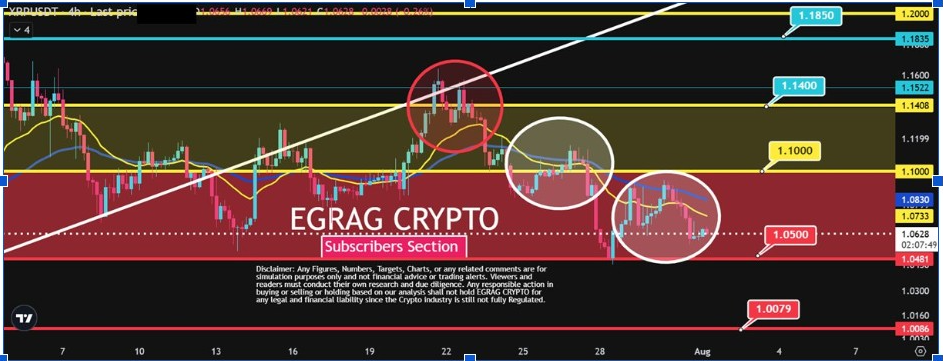
XRP is trading near a critical support zone as sellers maintain pressure below $1.10, with the four-hour structure showing a pattern of lower highs while buyers defend the $1.048–$1.05 demand area. Simultaneously, the XRP Ledger is preparing for its xrpld 3.3.0 software release, with five proposed amendments targeting privacy, atomic settlement, delegated permissions, and streamlined onboarding for institutional users.
XRP Price Defends the $1.05 Support Zone
XRP is trading near $1.063 after failing to sustain its latest recovery above short-term moving averages. The four-hour chart shows the price holding slightly above the $1.048 support level.
Crypto analyst EGRAG Crypto identified $1.05 as the immediate battleground between buyers and sellers (X post). Bulls must defend this level before attempting another move through nearby resistance.
The first recovery level sits near $1.083, where a moving average and recent price reactions create resistance. Reclaiming that zone could enable another challenge of $1.10. However, the chart shows several lower highs following XRP's rejection near $1.15, suggesting buyers still need stronger confirmation before controlling the short-term trend.
A four-hour close above $1.10 could open targets near $1.14 and $1.183. Further strength may expose $1.20 before the larger $1.30 resistance area comes into focus. Losing $1.048, however, would weaken the current setup, with a major liquidity area between $1.008 and $1.00 identified as the next downside zone.
Analysts Watch XRP's Long-Term Trendline
ChartNerd identified a multi-year ascending trendline supporting XRP's broader market structure, noting that the price is approaching another possible test of that baseline (X post).
The long-term chart highlighted several previous "spring" formations near rising support. Similar structures appeared before major expansion periods during earlier XRP market cycles. The latest pullback places XRP near the trendline extending from its 2020 market low. ChartNerd describes the potential contact as a structural reset rather than a complete breakdown.
XRP remains one of the few major cryptocurrencies with a federal court determination on its secondary-market sales. In July 2023, Judge Analisa Torres ruled that programmatic sales of XRP on public exchanges did not constitute investment contracts, providing a degree of regulatory clarity that most other digital assets still lack. However, the broader regulatory environment for cryptocurrencies remains unsettled, and ongoing enforcement actions involving other tokens continue to shape market sentiment across the sector.
XRPL v3.3.0 Brings Five Proposed Changes
The XRP Ledger is moving toward its next significant software release. RippleX Head of Product Jazzi Cooper outlined five possible amendments for xrpld 3.3.0 (X post).
The release is expected next week, though the amendments will not activate automatically. Validator operators must review and approve each change before enforcement across the network. The XRPL uses a consensus model based on a rotating set of trusted validators rather than proof-of-work or proof-of-stake, and amendments require at least 80% support from active validators over a two-week period to take effect.
Cooper said XRPL already supports tokenized assets at scale, and the new features aim to expand their use across transfers, trading, collateral management, and settlement. The amendments arrive as institutional interest in blockchain-based tokenization grows across the financial industry, with firms including BlackRock, Franklin Templeton, and JPMorgan exploring tokenized funds and settlement infrastructure on various distributed ledger platforms.
One proposed amendment introduces Permission Delegation, allowing institutions to assign narrowly defined transaction permissions without transferring control of their signing keys. Treasury teams could authorize routine operational activities while protecting sensitive issuance authority, helping institutions separate daily functions from higher-level account controls.
Additionally, Sponsored Fees and Reserves could enable banks, issuers, or platforms to cover users' transaction costs and fund account reserve requirements. Users would still control their accounts and private keys but would not need to acquire XRP before accessing supported network services.
Privacy and Atomic Settlement Enter Focus
Confidential MPT adds privacy capabilities to Multi-Purpose Tokens (MPTs) on the XRP Ledger using elliptic-curve encryption alongside zero-knowledge proofs. The amounts of tokens held by issuers and holders could be hidden from the general public, while designated parties could still access transaction details when regulatory or audit requirements apply. Cooper noted that financial institutions often require privacy before using public blockchain infrastructure, and the feature aims to offer confidentiality without eliminating oversight.
The batch settlement design ensures that every transaction inside a batch either succeeds together or fails together, supporting delivery-versus-payment structures and other atomic settlement workflows. Delivery-versus-payment, or DvP, is a long-standing standard in traditional securities settlement that ensures asset transfers and corresponding payments occur simultaneously, reducing counterparty risk.
Dynamic MPT, the fifth proposed amendment, allows issuers to adjust selected token properties after issuance without creating an entirely new token. Those properties may include transfer fees, metadata, and other predefined settings, enabling issuers to adapt token structures while preserving the original asset.
The network recently activated fix_Cleanup3.2.0 on July 29, after the amendment gained more than 85% validator consensus. For the v3.3.0 proposals, the community will be watching whether each amendment reaches the required validator threshold within the typical review window, as amendments that fall short of consensus are removed from consideration and may be resubmitted in a future release.

