XRP ETF Inflows Hit Strongest Week Since December 2025 as Fed Hawkishness Breaks Price Support
Key Takeaways
- •US spot XRP ETFs attracted $110.49 million in inflows for the week ending August 28, their strongest weekly showing since December 2025, with no net outflows in the past three weeks.
- •XRP dropped roughly 2% to around $1.36 after Fed Chair Warsh's hawkish remarks lifted implied September rate-hike odds from 35% to 57%, weighing on risk assets including Bitcoin, Ethereum, and BNB.
- •XRP broke below analyst Ali Martinez's $1.35–$1.38 support zone, weakening the short-term technical structure, with resistance layered at $1.60, $1.68, and $1.86.
- •The US Senate is scheduled to vote on the CLARITY Act on September 15, a market-structure bill clarifying SEC versus CFTC jurisdiction over digital assets.
- •A one-billion-XRP escrow unlock is set for September 1, with 600 to 800 million tokens historically re-locked, implying a net supply increase of 200 to 400 million XRP.
XRP slipped roughly 2% on Monday to open the week, with the XRP/USD pair now trading near $1.36 — and the timing of the move matters more than its size.
The decline followed remarks from Federal Reserve Chair Warsh reaffirming a hard commitment to the 2% inflation target, a message that lifted implied odds of a September rate hike from 35% to 57%. Bitcoin slid below $78,000 in the same session, while Ethereum and BNB also weakened; all three have since recovered slightly from their respective lows. The sensitivity is not unique to crypto: higher-rate expectations typically pressure risk assets broadly by raising the opportunity cost of holding non-yielding assets, and crypto has increasingly traded in step with that macro impulse.
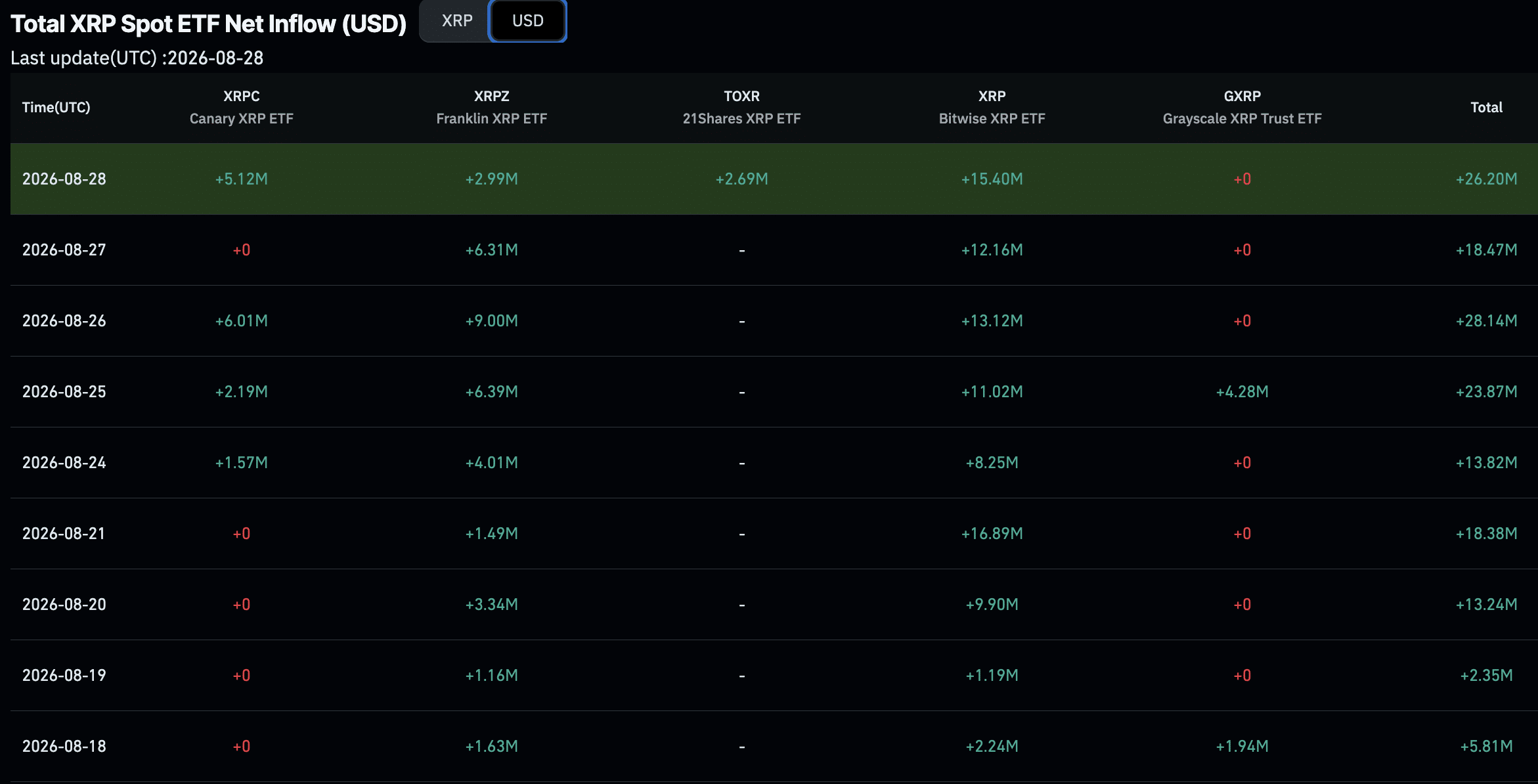
Even as the Fed's more hawkish tone drags risk assets lower, US spot XRP ETFs just posted their strongest week of inflows since December 2025 — $110.49 million for the week ending August 28.
ETF Flows Remain Positive Amid Market-Wide Pullback
According to CoinGlass data, spot XRP ETFs recorded $110.49 million in inflows for the week ending August 28, their strongest weekly showing since December 2025. The funds have not recorded a single week of net outflows over the past three weeks, even as XRP's spot price corrected.
That divergence sits at the heart of the current setup: ETF flow data and short-term price action are, for now, telling two different stories. Because spot ETFs give institutional and advisory channels regulated exposure to XRP without direct custody, sustained inflows are often read as a proxy for structural demand that does not necessarily show up in spot markets immediately. A recent breakdown of XRP whale selling against ETF inflows covers a similar mismatch between fund demand and spot-market pressure.
The Evidence Behind September's Crosscurrents
In August, XRP posted its strongest monthly performance since July 2025, gaining approximately 31% despite a pullback and holding a positive 26% return over 30 days. The token surged from $0.988 to $1.698 — a 71.8% increase — before correcting by roughly 20%. That kind of pattern can expose the token to macro shocks, such as recent Fed actions.
On the ETF front, August saw cumulative inflows of $153.54 million, lifting total net assets to $1.66 billion. Bitwise led with around $600 million in inflows, followed by Franklin Templeton's XRPZ product and Canary, both of which made significant contributions.
Corporate developments are also noteworthy. Speaking at the SALT Conference, Ripple CEO Brad Garlinghouse said he anticipates more than doubling revenue in 2026, driven by institutional partnerships tied to the RLUSD stablecoin. Ripple processed roughly $16 trillion in transaction volume over the past year and launched a delta-one trading desk through Ripple Prime, hiring Joseph Thompson to spearhead its tokenization strategy.
What XRP's Ecosystem Adds at Scale
Away from the price chart, the XRP Ledger is quietly becoming a multi-asset settlement layer. RLUSD has surpassed $1 billion in circulation on the ledger, and the network now hosts additional stablecoins, including USDB from Braza Bank, EURCV from Société Générale, USDC from Circle, and EUROP from Schuman Financial, per DefiLlama. The presence of bank- and issuer-backed stablecoins from institutions like Société Générale and Circle marks a shift for a ledger long positioned around payments infrastructure rather than DeFi activity.
That infrastructure build-out is a separate story from XRP's daily price swings and is worth watching independently of whatever the Fed does next — although Kalshi bettors are currently pricing in a "no-change" outcome.
For broader context on how monetary policy signals ripple through crypto sentiment, see this look at Fed Chair Warsh's influence on the Bitcoin rally.
Price Outlook: Bull, Base and Bear Scenarios
$XRP JUST BROKE THE DOWNTREND.
The correction did its job. Now comes the exciting part.
$2.50 → $3.50 → $6 → $13
THE ROAD AHEAD LOOKS WILD. pic.twitter.com/SEjooju4x3
— XRP Update (@XrpUdate) August 30, 2026
The technical picture took real damage this week. Analyst Ali Martinez had flagged a support zone between $1.35 and $1.38 where roughly 3.2 billion XRP tokens changed hands, and the price has now broken below that band, denting the short-term structure.
Bull case: Martinez's confirmed breakout above a descending trendline keeps $1.70 in play, with resistance layered at $1.60, $1.68 and $1.86. A decisive close above those levels could open a path toward $2.19, though this remains an analyst scenario rather than a certainty.
Base case: XRP trades sideways between the broken support zone and near-term resistance as ETF inflows and Fed-driven selling continue to offset each other, with traders watching whether the $1.35–$1.38 range can be reclaimed.
Bear case: Sustained trading below $1.35 leaves the reported breakout structure impaired and would likely delay any move toward the $1.70–$2.19 range Martinez has outlined.
Two additional catalysts loom before the end of September. The Senate is scheduled to vote on the CLARITY Act on September 15, following a 15-9 vote in the Banking Committee to advance the bill. The CLARITY Act is a proposed US market-structure bill that would clarify how digital assets are divided between SEC and CFTC jurisdiction, so its passage would bear on the regulatory standing of tokens like XRP. Separately, a one-billion-XRP escrow unlock is scheduled for September 1. That unlock is worth roughly $1 billion and, based on historical patterns, is expected to see 600 to 800 million tokens re-locked, resulting in a net supply increase of 200 to 400 million XRP — a monthly supply event that XRP's issuance schedule has produced for years via Ripple's escrow system.
For a deeper dive into how these flows interact with price targets, see this XRP price prediction piece tied to ETF inflows.
