XRP Falls 33% Since November 4 in Crypto Market Selloff as Analyst Weighs 2015-Style Bottoming Pattern
Key Takeaways
- •XRP has declined 33.07% since November 4, the largest drop among XRP, Ethereum, Solana, and Bitcoin in EGRAG Crypto's comparison.
- •Bitcoin fell 23.61% over the same period, outperforming Ethereum by 6.41 percentage points and Solana by 7.38 percentage points.
- •Bitcoin was separately quoted at $65,925, down 1.77%, with liquidations of leveraged positions adding downward pressure to its price.
- •EGRAG identified a 2015-style bottoming structure as the likeliest pattern but said price action must confirm it before he takes a firm view.
- •The analyst urged traders to manage emotion and prefer spot holdings, warning that leverage magnifies both gains and losses during rapid price swings.
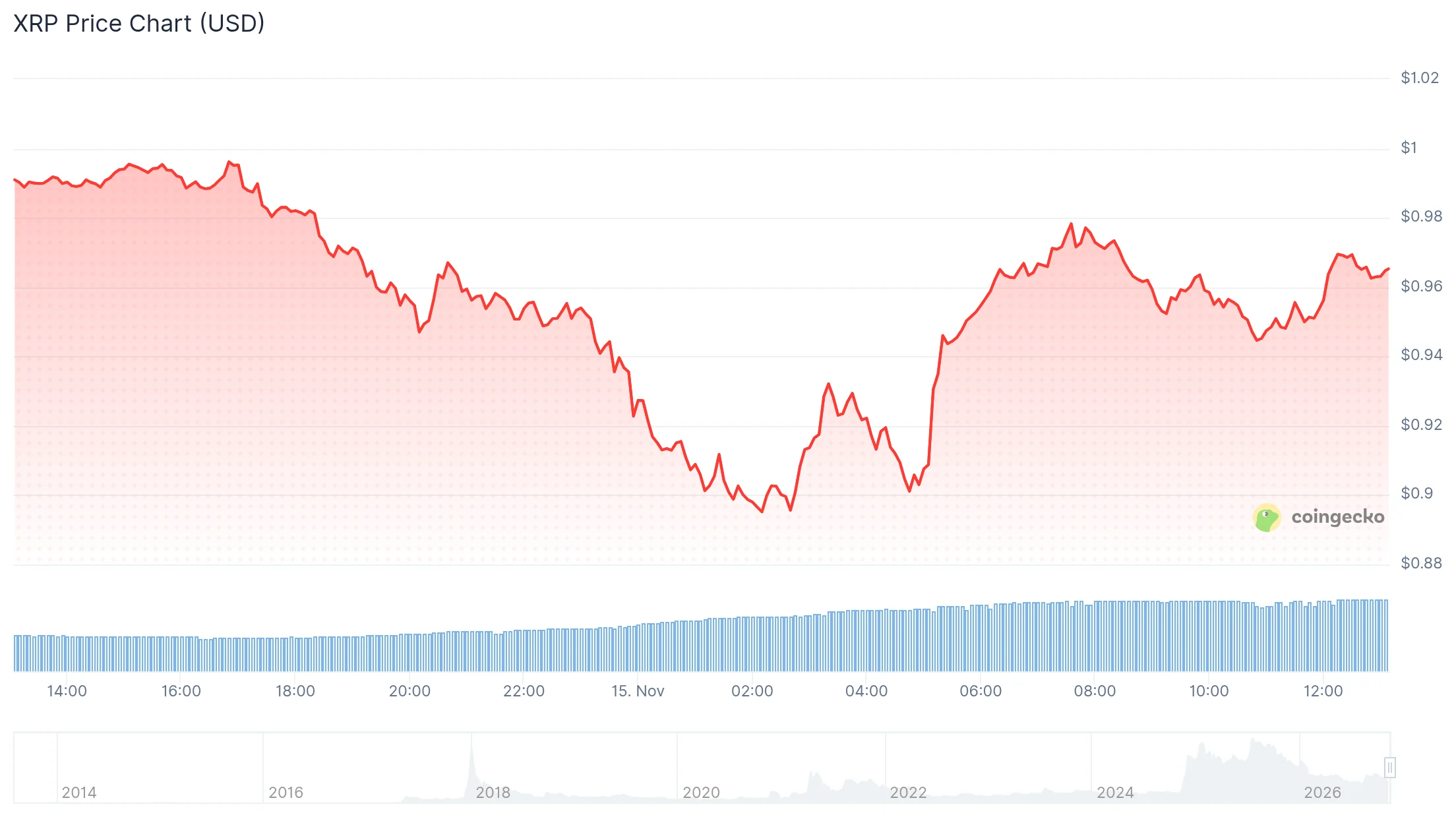
Crypto market analyst EGRAG Crypto says a broad selloff has cut four leading digital assets by 23% to 33% since November 4, with XRP suffering the steepest decline while Bitcoin outperformed Ethereum and Solana over the same stretch. The comparison puts XRP at the front of the drawdown, with Bitcoin showing the smallest loss.
In a post on X, the analyst compared percentage losses across XRP, Ethereum (ETH), Solana (SOL), and Bitcoin (BTC), framing the question now facing traders: does the sharp correction mark capitulation before a major reversal, or could another leg lower follow? EGRAG said price action must confirm the answer. He described a 2015-style bottoming structure as the likeliest pattern but held off a firm view until market evidence supports it.
The drawdown has been uneven: all four assets sold off hard, but the depth of losses varied considerably across the group.
Altcoins Trail Bitcoin in Broad Selloff
EGRAG's comparison tracked XRP down 33.07% from November 4 — the largest drop among the four assets. Solana lost 30.99% and Ethereum fell 30.02%, while Bitcoin declined 23.61% over the same period. The figures point to broad selling, with all three altcoins falling harder than Bitcoin.
XRP led the declines by a wide margin, exceeding Bitcoin's loss by 9.46 percentage points. Ethereum and Solana also underperformed Bitcoin, by 6.41 and 7.38 points respectively, and differed from each other by less than one percentage point — an indication of similar damage across the two large-cap altcoins.
Separately, Bitcoin was quoted at $65,925, down 1.77%, with crypto liquidations adding grip to the price. Liquidations occur when exchanges forcibly close leveraged positions whose collateral no longer covers losses, a dynamic that can add momentum to a falling market. That short-term quote uses a different measurement window than the four-asset comparison, which covers performance only since November 4. A near-term rebound or renewed decline would not, by itself, settle whether the larger drawdown has ended — the selloff remains severe across all four assets in the comparison.
What the Comparison Shows — and What It Does Not
The data documents the depth of losses but does not establish why traders sold or whether the decline has finished. The post compares percentage losses but does not identify a specific catalyst, and the figures describe performance from November 4 without indicating what happens next or whether each asset will recover at the same pace.
Direction across the market looked synchronized, but the damage was not evenly distributed. Bitcoin's smaller decline signals relative resilience, not proof that it has found a floor, and steep altcoin losses alone cannot confirm a reversal. The selloff carries weight because Bitcoin — the largest cryptocurrency by market value — often serves as a risk benchmark for traders, and a sharper drop in altcoins can reflect investors reducing exposure to higher-risk assets. Even so, the comparison cannot reveal whether selling came from spot holders, leveraged traders, or fund flows — and traders would need prices to stabilize before drawing firmer conclusions.
2015-Style Bottom: A Thesis, Not a Forecast
EGRAG framed the next move as an open question and said he needs confirmation from price action before taking a firm view. His reference to a 2015-style bottoming structure is a historical analogy, not a guaranteed repeat. The 2015 reference points back to a period in crypto's early history when a multi-year bear market faded into months of range-bound trading before any sustained recovery took hold.
Bottoming structures typically take time to form. Traders generally watch whether prices stop printing lower lows and then reclaim levels lost during the decline. The comparison does not identify those levels for XRP, ETH, SOL, or BTC, and it offers no target or timetable for a rebound, leaving the pattern as a thesis to be tested. Crypto markets have also changed in size and structure since 2015, so a similar chart shape would not ensure similar catalysts or outcomes.
Caution on Emotion and Leverage
As volatility rises, EGRAG urged traders to manage emotion. He described spot holdings as preferable and characterized leverage as a tool, noting that leveraged positions magnify both gains and losses, particularly when prices swing quickly. The liquidations cited during this selloff illustrate why that matters: when prices fall quickly, forced closures of leveraged positions can compound selling pressure, and borrowed positions amplify losses in exactly those conditions.
Source: Blockonomi

