XRP Slips Toward $1.32 as ETFs Add $14.38 Million
Key Takeaways
- •US spot XRP ETFs recorded $14.38 million in net inflows on September 1, with Franklin’s XRPZ and Grayscale’s GXRP leading the session.
- •Ripple’s September escrow release included 1 billion XRP in scheduled transactions, and 700 million XRP was later returned to new escrow accounts.
- •The remaining 300 million XRP outside the new escrows was made available to Ripple, but no cited transaction showed it moving to an exchange or public circulation.
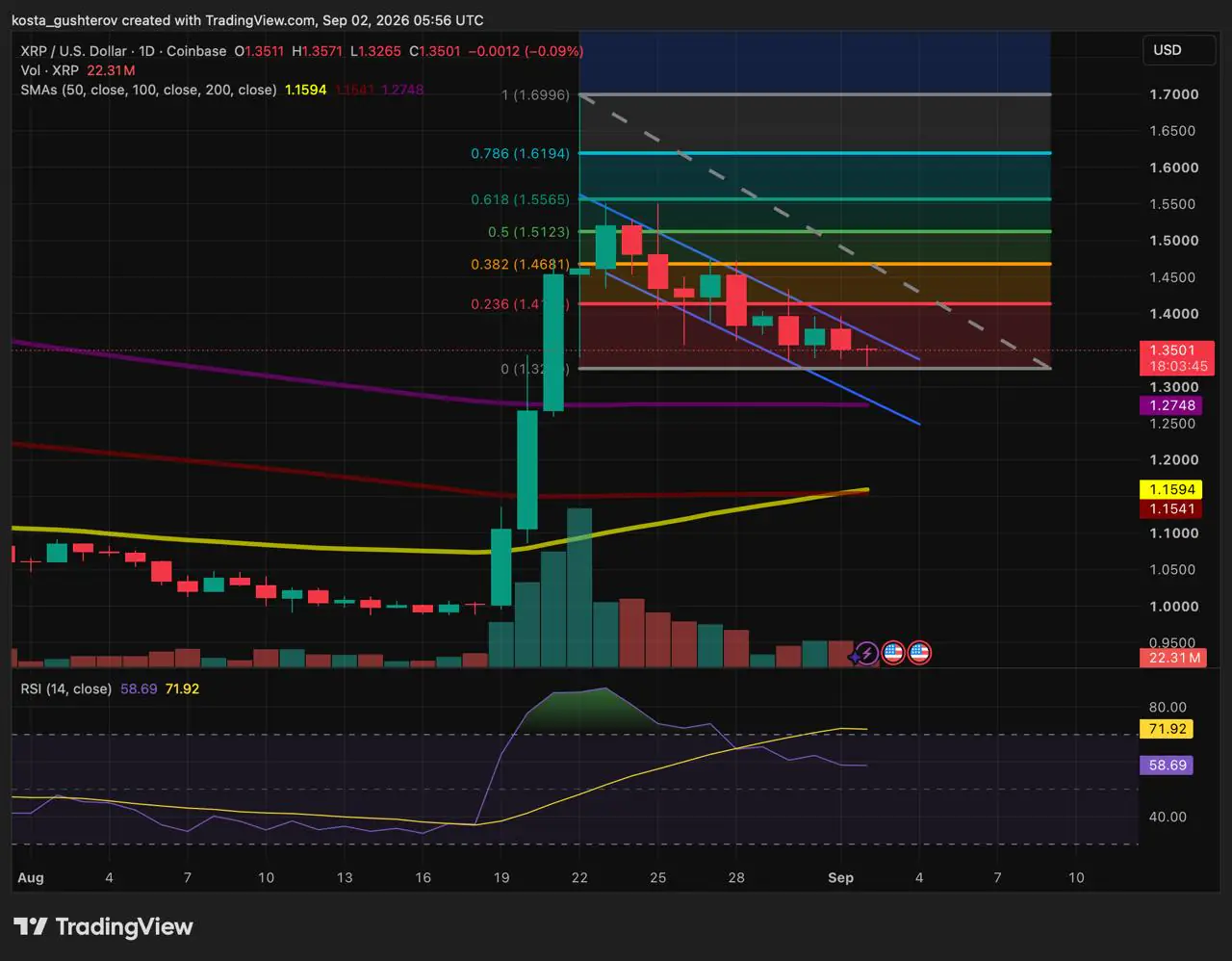
- •XRP dropped to roughly $1.3265 on September 2, its lowest price since the August peak, before recovering toward $1.35.
- •XRP remains inside a daily descending channel, and a close below $1.32 would mark a new correction low and shift attention toward $1.27.
Key Takeaways
- XRP ETFs drew $14.38 million on September 1.
- Ripple returned 700 million XRP to escrow.
- XRP set a post-peak low near $1.32.
- The descending channel remains intact for now.
ETF buying did not lift XRP
US spot XRP ETFs recorded $14.38 million in net inflows on September 1, according to SoSoValue. Franklin’s XRPZ led the session with $6.63 million, followed by Grayscale’s GXRP with $4.72 million.
Cumulative net inflows reached approximately $1.68 billion, while the products’ combined net assets stood at $1.44 billion after the session. The regulated funds therefore continued attracting capital during XRP’s correction.
XRP did not rise alongside the reported inflows, indicating that ETF demand had not yet translated into a broader price recovery. The token had gained nearly 70% during its August advance, giving recent buyers a substantial profit cushion and creating one plausible source of selling.
XRP was also not falling in isolation. Its pullback extended a wider crypto-market retreat that began on September 1 as higher Treasury yields and renewed concerns about the yen weighed on risk assets. Coindoo’s report on the two macro risks facing the crypto market explains why several large cryptocurrencies moved lower together. That broader pressure makes it difficult to attribute XRP’s decline to Ripple’s escrow activity alone.
Ripple’s 1 billion XRP unlock was not a sell order
Ripple’s scheduled September escrow release consisted of three transactions containing 500 million, 400 million and 100 million XRP. Later that day, a report citing XRPL transaction data showed the company creating new escrows for 500 million and 200 million tokens, returning 700 million XRP to time-locked accounts.
The sequence left 300 million XRP outside the newly created escrows. That amount became available to Ripple, but no cited transaction shows the entire balance moving to an exchange or entering public-market circulation.
Ripple’s explanation of the escrow system describes the monthly 1 billion XRP release as an upper limit on possible new supply rather than the amount automatically entering circulation. Tokens that remain unused can be placed into new escrows with later release dates.
The $14.38 million ETF inflow also cannot be directly compared with the roughly $405 million nominal value of the 300 million XRP remaining outside escrow at a price of $1.35. The ETF figure represents capital that entered the funds during one trading day. The larger number represents company-controlled inventory that has not been shown entering the public market.
XRP returns to the base of its August range
XRP has moved lower inside a daily descending channel since its August rally failed near $1.70. Selling volume has remained well below the levels recorded during the advance, so the pullback still lacks the force of a high-volume breakdown.
The failed breakout discussed in our August 29 analysis has since developed into a steady sequence of lower highs. XRP fell to $1.3265 on September 2 before recovering toward $1.35, marking its lowest price since the August peak. The wick stopped above the channel’s lower trendline, leaving the wider pattern intact.
A daily close below $1.32 would set a new correction low and invalidate the base of the Fibonacci structure. Attention would then shift toward $1.27, where the 200-day simple moving average sits close to the channel’s lower boundary. Losing $1.32 would weaken the setup, but a full channel breakdown would require a further close beneath that lower trendline.
Buyers face an earlier hurdle in the opposite direction. The upper boundary passes through the mid-$1.30s, making a close above it the first sign that the sequence of lower highs is ending. From there, $1.40-$1.41 marks the 0.236 Fibonacci retracement, followed by the 0.382 level near $1.47. Reclaiming both would carry XRP back into the middle of its August range.
What would confirm the ETF signal
Continued inflows would become more relevant to price if XRP held the $1.32 Fibonacci base and escaped through the channel’s upper boundary. A subsequent recovery above $1.41 with stronger volume would show that the breakout had developed beyond an initial reaction from support.
A close below $1.32 despite further inflows would carry a different message: demand through the funds would remain insufficient to stabilize the wider market. The next test would then shift toward the 200-day average and the lower portion of the descending channel.
The $1.32 base carries the clearer signal
September’s data do not support treating Ripple’s escrow release as the sole cause of XRP’s decline. Most of the unlocked tokens returned to escrow, ETF demand remained positive and the wider crypto market also moved lower.
XRP has now recorded its lowest price since the August peak, but it remains inside its descending channel. The immediate question is whether $1.32 can preserve the base of the recent range and give buyers another attempt at channel resistance. Fund demand is present, but price has not yet confirmed that it is strong enough to end the correction.
Disclaimer: This article is for informational purposes only and does not constitute financial or investment advice.
