MEXC Restricted and Supported Countries in 2026
Key Takeaways
- •Kazakhstan was added to MEXC’s restricted list in May 2025, and the blocked Ukrainian areas include Crimea, Donetsk, Luhansk, Zaporizhzhia, Kherson, and Sevastopol.
- •MEXC says it cannot operate in several markets because of sanctions, missing licenses, and regulator warnings, including in the US, UK, Singapore, Hong Kong, and Kazakhstan.
- •MEXC has suspended trading and deposits from Indian addresses while it works on FIU-IND registration, but India is not described as permanently prohibited.
- •The exchange warns against using a VPN to bypass regional blocks, saying such behavior can trigger freezes, verification requests, or account closure.
- •MEXC offers futures trading only where local law permits it, and its verification tiers determine withdrawal and fiat transaction limits.
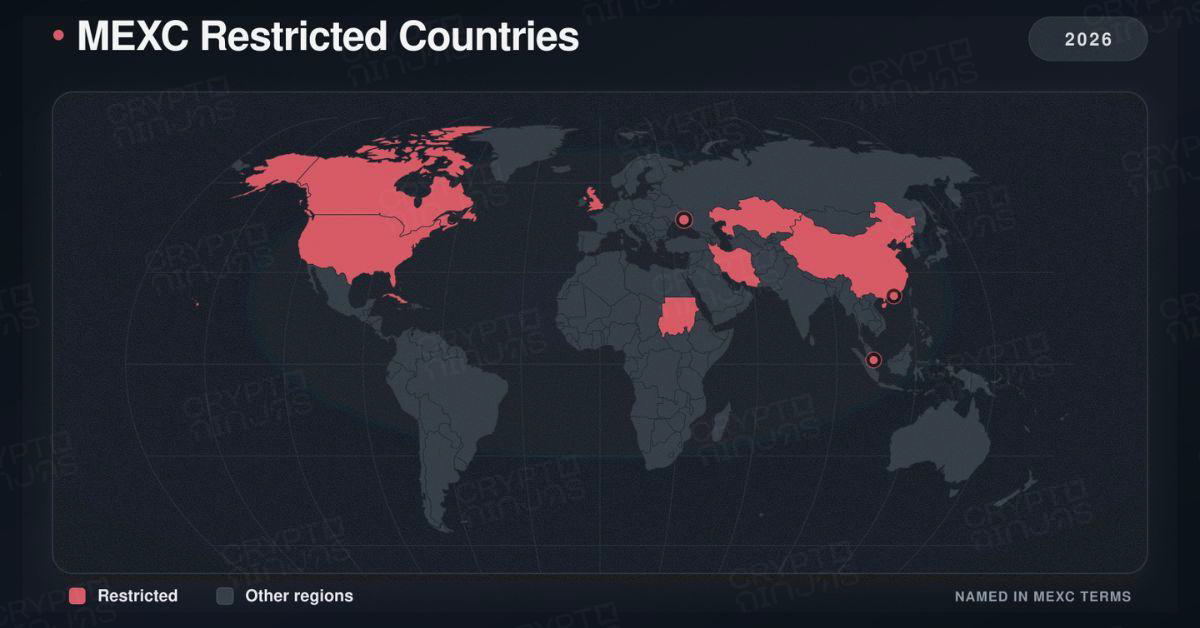
MEXC is available in more than 170 countries and regions, but users cannot access the exchange from the United States, Canada, the United Kingdom, and several other restricted locations. The main MEXC restricted countries also include North Korea, Cuba, Sudan, Iran, Mainland China, Singapore, Hong Kong, Kazakhstan, and Russia-controlled parts of Ukraine.
This guide is for crypto traders and investors who want to confirm whether MEXC is accessible in their country, understand why the exchange blocks certain regions, and find legal alternatives if they live in a restricted market. It covers MEXC restricted and supported countries, whether MEXC can be used in the USA or UK, VPN risks, futures availability, KYC rules, and regulatory compliance so users can avoid account issues, terms violations, and unnecessary trading risk.
What Are the MEXC Restricted Countries?
The MEXC restricted countries are North Korea, Cuba, Sudan, Iran, Mainland China, Singapore, the United States, the United Kingdom, Hong Kong, Kazakhstan, Canada, and the Russian-controlled regions of Ukraine; Kazakhstan was added in May 2025. Those Ukrainian regions currently include Crimea, Donetsk, Luhansk, Zaporizhzhia, Kherson, and Sevastopol.
MEXC also blocks countries and territories under EU or US Office of Foreign Assets Control sanctions. Currently, the FATF list names North Korea, Iran, and Myanmar.
MEXC also recently suspended trading, deposits, and other digital asset trading services from Indian addresses while working on FIU-IND registration. India is not a permanently prohibited country, but the exchange remains unavailable there during the suspension.
Beyond the full ban list, a few countries face a smaller, app-store-only restriction. The iOS app is currently removed in India, Japan, and South Korea, and the Android version is missing in those same places plus Indonesia. Users may still be able to access the MEXC website through a web browser in most cases, but that does not guarantee eligibility for all services in that country or territory, and fresh app downloads are unavailable.
Note: MEXC has officially not marked Europe as a restricted jurisdiction, but it does hold a Markets in Crypto-Assets (MiCA) license. As a result, its availability in Europe remains uncertain.
Why Does MEXC Not Work in These Restricted Countries?
MEXC does not work in these countries for three main reasons: sanctions law, missing licenses, and direct regulator bans. Different jurisdictions impose different access rules, and users should be aware of those restrictions.
Countries such as North Korea, Iran, Cuba, Sudan, and parts of Ukraine are under heavy sanctions from the US, the EU, and the FATF. Because of those international restrictions, MEXC cannot legally offer services there.
Missing licenses explain the next group. The United States requires federal derivatives registration plus state money transmitter licenses. Singapore requires a “Payment Services Act” license from its central bank, and Hong Kong has a strict licensing regime and added MEXC to its Suspicious Virtual Asset Trading Platforms Alert List. MEXC holds none of these approvals, so it blocks access rather than risk penalties.
In other markets, local authorities stepped in. The UK restricted access after the FCA placed MEXC on its official warning list. Kazakhstan took a similar approach by requiring all crypto exchanges to register with its own financial center.
Can I Use MEXC in the USA?
No, MEXC cannot be used in the USA. The United States is at the top of the prohibited list, and MEXC has never built a US entity or pursued the approvals that would allow one.
Real access in the US would require CFTC registration for any derivatives product, a FinCEN Money Services Business filing, and separate money transmitter licenses in nearly every state. MEXC holds none of these approvals, so users in the US are blocked. The exchange uses automatic system checks to block IP addresses coming from American internet service providers.
Is MEXC Blocked in the UK?
Yes, MEXC is fully blocked in the United Kingdom, and the restriction became stronger this year. Previously, access was limited to app-store removals on iOS and Android, but now the Financial Conduct Authority has placed MEXC Global Ltd on its official Warning List and described the firm as unauthorized.
Accordingly, MEXC names the United Kingdom as a prohibited jurisdiction and does not accept UK registrations or trade applications.
Can I Use a VPN to Access MEXC in These Restricted Countries?
No, users should not use a VPN to bypass MEXC’s country block because doing so violates the platform’s Terms of Service. MEXC checks IP addresses and account activity, and it can freeze funds or request extra verification if it finds a mismatch between a user’s stated location and actual location. The platform reserves the right to restrict access or terminate accounts that violate location rules or provide false residency information.
The User Agreement also requires users to report any move into a blocked country. Even a false home address claim gives MEXC the right to close an account and close open positions without warning.
A VPN may allow a user to reach the sign-up page temporarily, but it does not provide protection if a problem arises later. MEXC does have security measures such as two-factor authentication and cold storage for user assets, but those safeguards do not override its location rules. An unstable connection can also create login, verification, or trading problems when attempting to bypass regional blocks.
Traders should do their own research before relying on any exchange-access workaround. There is no dispute process, no regulator to call, and no guarantee a withdrawal will clear. Using a VPN in this context carries significant risk when regulated exchanges are available in many restricted regions.
What Are the Best MEXC Alternatives in the US and Canada?
The best MEXC alternatives in the US and Canada are Coinbase and Crypto.com.
Coinbase: Coinbase operates with full regulatory approval in both countries. It holds money transmitter licenses in all 50 US states and is registered as a Restricted Dealer with the Canadian Securities Administrators (CSA) under CIRO. Users can connect bank accounts directly through US ACH and Canadian Interac e-Transfers for instant deposits.
Crypto.com: Crypto.com is another major MEXC alternative. It holds Money Services Business (MSB) registrations with FinCEN in the United States and FINTRAC in Canada. Users can fund accounts using US wire transfers or Canadian Interac e-Transfers with zero deposit fees.
What Are the Best MEXC Alternatives in Europe?
The best regulated MEXC alternatives for users in the European Economic Area (EEA) are Bybit EU and OKX Europe.
Bybit EU: Bybit operates through regulated local partnerships, including registration with the Dutch Central Bank (DNB) via SATOS and a MiCA-compliant framework in the European Union. Users can deposit euros directly through SEPA and SEPA Instant with zero to low bank transfer fees.
OKX: OKX is another strong replacement in the EEA because its European exchange operates under a full MiCA license rather than an older temporary VASP registration. Users can buy and trade more than 350 crypto pairs directly with euros through SEPA bank transfers and card rails.
What Are the Best MEXC Alternatives in Russia?
The best practical MEXC alternatives currently available to many Russian users are Bybit and Bitget.
Bybit: Bybit is widely used by Russian users because it offers Ruble (RUB) peer-to-peer (P2P) trading channels. Users can trade with zero P2P platform fees across major Russian payment methods, including SBP (Faster Payments System) and local bank cards.
Bitget: Bitget is another alternative for Russian users, especially for spot, futures, trading bots, and copy-trading-style tools on one platform. Users can fund accounts directly with rubles through card payments via Advcash or through P2P trading with more than 100 payment methods.
Note: No foreign exchange holds an “official license” to operate in Russia. In this context, “best alternative” means the platform that is most reliable, widely used, and easiest to access without breaking any rules.
What Are the Best MEXC Alternatives in Asia (Japan) and the Middle East (Iran)?
The best MEXC alternative in Japan is Binance Japan, but Iran does not currently have a licensed major international exchange. The US Treasury has also sanctioned Iran’s local exchanges — Nobitex, Wallex, Bitpin, and Ramzinex — as part of the ongoing conflict with Iran, making this an active and serious legal situation.
Binance: In Japan, Binance operates through Binance Japan Inc. It is registered with Japan’s Financial Services Agency as a Crypto Asset Exchange Service Provider. This followed Binance’s purchase of a locally licensed Japanese exchange, Sakura Exchange BitCoin. In the Middle East, Binance also holds a full VARA Virtual Asset Service Provider license for retail trading in Dubai, UAE, making it one of the few exchanges licensed for both regions.
OKX: OKX is the second strong option for the Middle East. Its Dubai entity, OKX Middle East, holds a VARA (Virtual Assets Regulatory Authority) license, allowing it to legally offer AED deposits, withdrawals, and spot trading pairs to UAE residents.
What Are the MEXC Supported Countries?
MEXC supports more than 170 countries once the prohibited list is excluded, and it says it has more than 40 million users while offering access to over 2,300 cryptocurrencies and other digital assets.
Countries not named in the main prohibition list commonly include Brazil, Mexico, Argentina, Chile, Colombia, Turkey, Georgia, Vietnam, Thailand, Malaysia, Taiwan, Australia, New Zealand, Nigeria, Kenya, Ghana, and South Africa. However, this does not mean every feature has local regulatory approval. Regulatory restrictions can still limit futures, fiat services, or app access in some countries, and availability can vary by market based on local rules. MEXC does not hold a single license. Its operations span multiple jurisdictions, but those rules still limit what investors can access, and it remains unlicensed everywhere it operates.
Can We Use MEXC Futures Trading in These Allowed Countries?
Yes, MEXC futures trading can be used only in an allowed country where local law also permits crypto derivatives. MEXC currently offers up to 200x leverage for perpetual futures contracts, with a standard trading cost of 0.04% taker fees. By contrast, the spot market offers 0% maker fees.
Users may also be eligible for a futures trading bonus when signing up with an MEXC referral code.
Does MEXC Require KYC in These Available Countries?
MEXC does not apply identical KYC rules in every country. However, identity checks are now expected for most regular trading and withdrawal features. Users may also need to create an account before seeing country-specific verification limits and available services. Local law determines what an unverified user can do and which features are available, so exact limits depend on the country, the services offered on the site, and the documents requested during verification.
The platform offers two main personal verification tiers:
Primary KYC: This unlocks standard spot and futures trading, unlimited crypto deposits, P2P trading, and withdrawals of up to 80 BTC per day. Customers must submit identity documents to access certain digital asset trading features. Acceptable documents include a passport, national ID card, driver’s license, or residence permit.
Advanced KYC: This increases the daily crypto withdrawal limit to 200 BTC and allows users to buy or sell up to $20,000 in fiat currency per day. Users must complete facial verification, and they may be asked to use two devices during checks or login protection.
Does MEXC Meet Regulatory Compliance Requirements?
No, MEXC does not meet full regulatory compliance in most of its major markets, and the record reflects that.
MEXC’s regulatory issues can affect customers through service suspensions, account-freezing events, or feature limits in restricted jurisdictions. Estonia canceled MEXC’s MTR license in late 2023 after the platform failed anti-money laundering and compliance checks. Although MEXC Estonia appealed the decision, the license remains inactive.
In Australia, the exchange never received direct registration from AUSTRAC or official approval from ASIC. In Dubai, the financial regulator VARA issued a public alert telling people to stay away from the platform. Germany’s regulator BaFin also warned against MEXC for offering crypto custody services without the required government license.
MEXC operates across multiple jurisdictions, but that does not remove the regulatory risk users take when trading digital assets. Unsupported activity such as games of chance can also draw extra scrutiny under platform rules. The exchange currently operates mainly through its Seychelles entity, a jurisdiction with far lighter rules than the US, UK, or EU.
The post MEXC Exchange’s Restricted and Supported Countries in 2026 appeared first on CryptoNinjas.
