World Liberty Financial Wins Preliminary OCC Approval for USD1 National Trust Bank
Key Takeaways
- •The OCC granted preliminary conditional approval on August 14, 2026 for World Liberty Trust Company, National Association, an initial milestone that does not authorize the bank to open.
- •Preopening conditions include maintaining at least $20 million in tier 1 capital, with the greater of 50% of tier 1 capital or $10 million held in Eligible Liquid Assets.
- •The proposed uninsured national trust bank would handle USD1 issuance, redemption, reserve maintenance, and custody nationwide, taking over those roles from BitGo Bank & Trust, the current exclusive issuer and custodian.
- •World Liberty Financial reports that USD1 has surpassed $4 billion in circulation, a footprint that remains far smaller than Tether's USDT and Circle's USDC.
- •The OCC letter cites the GENIUS Act as recognizing uninsured national banks' authority to issue stablecoins, and the institution does not plan to seek a Federal Reserve master account or become a Bank Holding Company Act bank.
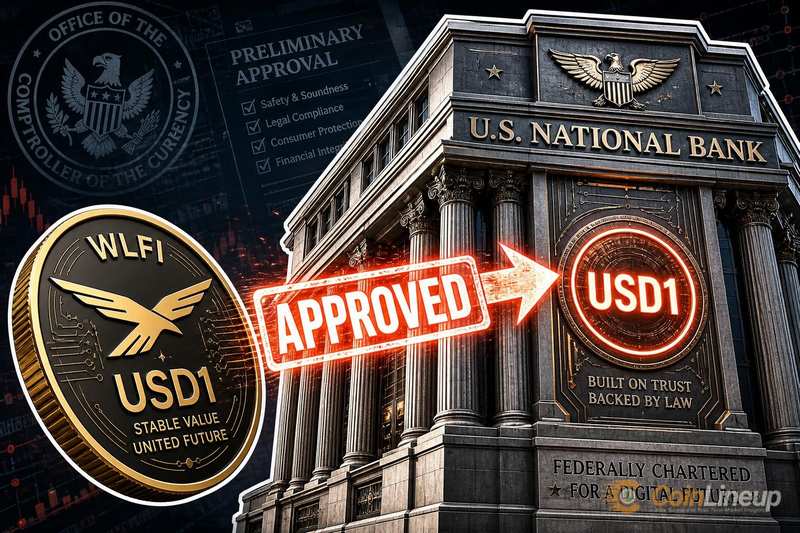
World Liberty Financial, a crypto venture associated with President Donald Trump and his family, has received preliminary conditional approval from the Office of the Comptroller of the Currency (OCC) to establish a national trust bank tied to its USD1 stablecoin, a regulatory step that would allow the firm to issue and redeem the dollar-linked token under a federal charter instead of relying on a third-party issuer.
The OCC granted the preliminary conditional approval on August 14, 2026, for World Liberty Trust Company, National Association, according to the agency’s decision letter. The approval is an initial milestone and does not authorize the bank to open.
What the preliminary OCC approval means
Preliminary conditional approval indicates that the OCC, the U.S. regulator that charters and supervises national banks, is prepared to issue a charter once the applicant satisfies a set of preopening requirements. It is not the same as final approval for a fully operating bank.
Final approval depends on meeting conditions that include capital, audit, and operational-readiness requirements before the institution can begin business. Until those conditions are satisfied, World Liberty Trust Company remains a proposed entity rather than an active bank.
One preopening condition requires the bank to maintain at least $20 million in tier 1 capital, with the greater of 50% of tier 1 capital or $10 million held in Eligible Liquid Assets.
The approval marks a regulatory milestone for the Trump-linked firm, which had previously secured a conditional charter approval in earlier reporting on the bank charter application. The latest letter moves that process closer to a USD1-specific trust structure.
How the proposed bank is linked to USD1
USD1 is a dollar-linked stablecoin designed to track the value of the U.S. dollar and backed by reserves. It is the defining feature of this filing, distinguishing it from a standard banking application.
The proposed bank’s authorized activities include USD1 issuance and redemption, reserve maintenance, fiduciary digital asset custody, and conversion services for custody customers. Those functions would place the stablecoin’s core operations inside a chartered national trust bank.
According to the OCC letter, World Liberty Trust plans to issue USD1 nationwide by taking over that role from BitGo Bank & Trust, which is currently the exclusive issuer and custodian for USD1. The transition would move issuance and custody functions to the new entity.
World Liberty Financial said USD1 has surpassed $4 billion in circulation, according to the company’s announcement, highlighting the operational scale the proposed structure is intended to support. That footprint remains far smaller than the two largest stablecoins, Tether’s USDT and Circle’s USDC, the benchmarks against which newer dollar tokens are typically measured.
Why the approval matters
The OCC described World Liberty Trust as an uninsured national trust bank rather than a full-service, deposit-taking lender. Reuters reported in its coverage of the decision that a trust charter generally would not permit deposit-taking or lending in the way a traditional bank can. The national trust charter has precedent in the digital asset sector: Anchorage Digital has operated an OCC-chartered national trust bank since 2021.
The letter cites the GENIUS Act — the federal stablecoin law signed in July 2025 that established a U.S. regulatory framework for payment stablecoins, including reserve, redemption, and disclosure requirements — as recognizing the authority of uninsured national banks to issue stablecoins, and says the bank must comply with future implementing rules. It also states that the institution does not plan to seek a Federal Reserve master account or become a Bank Holding Company Act “bank.”
A federal trust charter could strengthen USD1’s compliance profile and credibility, while bringing issuance and custody in-house would reduce dependence on the current BitGo arrangement. That shift carries added significance given the reported circulation of more than $4 billion.
The broader regulatory backdrop remains cautious. The crypto Fear & Greed Index stands at 34, placing the market in “Fear” territory. At the same time, regulators and institutions are adjusting their digital-asset approach, including the SEC’s withdrawal of a planned custody rule vote and Israel’s largest bank tapping Galaxy for Bitcoin and Ether trading.
These developments remain contingent until World Liberty Trust satisfies its preopening conditions and receives final approval. The company has not disclosed a target opening date. The steps that follow are procedural: final OCC approval once the preopening conditions are met, the planned handover of issuance and custody from BitGo, and compliance with the GENIUS Act’s future implementing rules as they take shape.
Disclaimer: This article is for informational purposes only and does not constitute financial or investment advice. Cryptocurrency and digital asset markets carry significant risk. Always do your own research before making decisions.
