Wisconsin Goods Exports by Destination, 2025
Key Takeaways
- •Canada has long ranked as Wisconsin's largest single destination for goods exports, leaving the state's trade profile especially exposed to any widening of U.S. tariff measures against its northern neighbor.
- •Wisconsin's export base is weighted toward manufactured goods, including machinery, electronics, and transportation equipment, alongside processed foods.
- •Section 338 of the Tariff Act of 1930, known as the Smoot-Hawley Tariff Act, authorizes the President to impose duties of up to 50 percent on countries found to discriminate against U.S. commerce, a provision rarely invoked that is now being applied against Canada.
- •As of 1 p.m. CT on publication day, gubernatorial candidate Tom Tiffany, the Republican congressman for Wisconsin's 7th district, had not commented on the Section 338 tariffs against Canada or that morning's threat to increase automobile tariff rates.
- •The tariff issue emerges ahead of Wisconsin's November 2026 gubernatorial election, with future ITA data releases expected to show how the state's export mix by destination evolves.
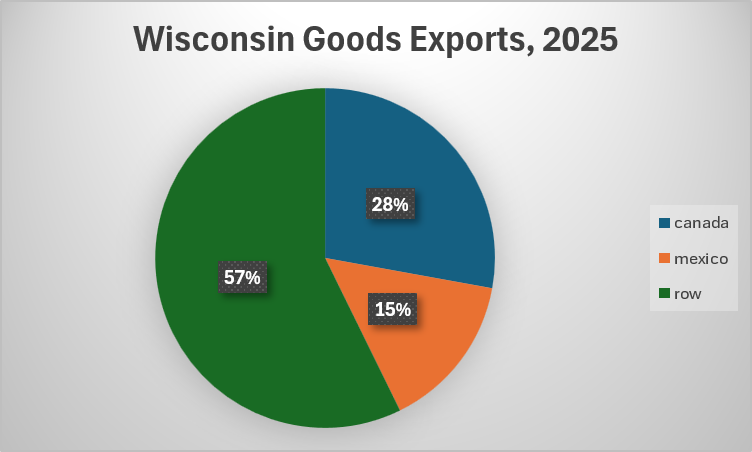
New data detail Wisconsin's goods exports by destination for 2025, published as the United States and Canada head into what the author characterizes as an expanded trade war. State-level destination data are particularly useful at such moments, because export dependence varies widely from state to state and a single national figure can mask how concentrated exposure is in particular regional economies.
The figures come from the U.S. Census Bureau via the International Trade Administration (ITA), together with the author's calculations, and can be explored through Trade Stats Express, the ITA's tool for national and state trade data. Canada has long ranked as Wisconsin's largest single destination for goods exports, which makes the state's trade profile especially exposed to any widening of U.S. tariff measures against its northern neighbor. Wisconsin's export base is weighted toward manufactured goods — including machinery, electronics, and transportation equipment — alongside processed foods, and Canada and Mexico have long ranked as the two largest markets for U.S. goods exports overall. Subsequent ITA data releases will show how the state's export mix by destination evolves as new tariff measures take effect.
The immediate backdrop includes the Section 338 tariffs to be levied against Canada. Section 338 of the Tariff Act of 1930, better known as the Smoot-Hawley Tariff Act, authorizes the President to impose new or increased duties, of up to 50 percent, on goods from countries found to discriminate against U.S. commerce — a provision that has rarely been invoked.
As of 1 p.m. CT on the day of publication, gubernatorial candidate Tom Tiffany — the Republican congressman representing Wisconsin's 7th congressional district — had not commented on the original Section 338 tariffs to be levied against Canada, nor on that morning's threat to increase tariff rates on automobiles. The timing places the tariff question ahead of Wisconsin's November 2026 gubernatorial election.
Source: Census via ITA, and author's calculations. Originally published on Econbrowser.

