Binance Launchpad Review: How to Buy Tokens in 2026
Key Takeaways
- •Binance Launchpad enables new blockchain projects to raise funds and reach a global audience by selling native tokens to Binance users through an Initial Exchange Offering format that emerged after the fraud-plagued ICO boom of 2017-2018.
- •Participation requires a KYC-verified Binance account and holdings of BNB or FDUSD, which must be committed during a specific subscription window, with Binance typically taking multi-day snapshots of holdings before a sale.
- •Token allocations are generally distributed through lottery or subscription models in which larger BNB holdings increase the chance of receiving tokens, and committed BNB is temporarily locked until the sale concludes.
- •The platform's advantages include exposure to millions of Binance users, pre-listing project vetting that lowers scam risk, discounted early pricing, and marketing and guidance support, while drawbacks include limited allocations, geographic restrictions, and post-listing price volatility.
- •The highest market capitalization projects launched via Binance Launchpad include POL (Polygon), FET (Fetch.ai), INJ (Injective), SAND (The Sandbox), and AXS (Axie Infinity Shards), spanning Ethereum scaling, AI, decentralized finance, and metaverse gaming.
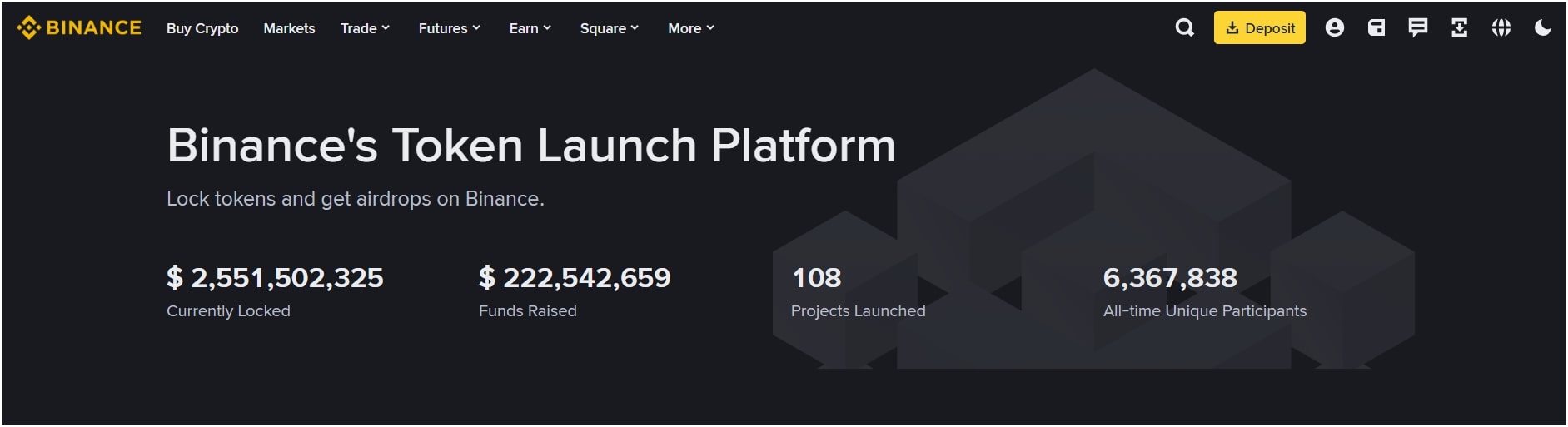
Binance Launchpad is the token launch platform operated by cryptocurrency exchange Binance, built to help new cryptocurrency projects introduce their native tokens to the market. The platform allows early-stage blockchain teams to raise funds and gain visibility by selling their tokens directly to Binance users, and every project is reviewed by Binance before listing to confirm that it is safe and legitimate.
Taking part in a Binance Launchpad token sale requires a verified Binance account, a balance of BNB held in the wallet, a visit to the Launchpad page while a sale is active, and a commitment of BNB during the subscription window, after which the exchange distributes the token allocation.
This guide explains what Binance Launchpad is, how the platform operates, and its advantages and drawbacks. It also outlines the steps required to join a Binance Launchpad token sale and reviews the leading Binance Launchpad projects by market capitalization.
What Is Binance Launchpad?
Binance Launchpad is a platform on the Binance cryptocurrency exchange that enables new blockchain projects to raise funds by selling their native tokens to Binance users in a process known as an Initial Exchange Offering (IEO). Binance vets each project carefully before listing it on the Launchpad, adding a layer of credibility for investors.
The IEO format emerged as a response to the initial coin offerings (ICOs) of the 2017–2018 crypto boom, in which projects sold tokens directly to the public without an intermediary — a period in which many such sales turned out to be fraudulent. By routing a sale through an exchange that vets the project and controls distribution, the IEO model makes the exchange itself the gatekeeper, which is why Binance's review step carries real weight for participants. Several other major exchanges have since introduced comparable launch programs, making the IEO a recurring feature of crypto fundraising.
Participation in these token sales requires holding a specified amount of Binance Coin (BNB) or the FDUSD stablecoin in the account, then subscribing to the sale during the subscription period. The sales give users a chance to invest early in projects that have the potential to grow. Allocation is typically handled through a fair system such as a lottery or subscription model to give everyone a reasonable chance at the tokens. Generally, holding more BNB translates into more tickets and a higher probability of obtaining the tokens.
After each sale ends, the new tokens are listed on Binance, enabling immediate trading without reliance on external exchanges. Binance Launchpad is recognized for supporting prominent projects such as Axie Infinity, The Sandbox, and Injective.
How Does Binance Launchpad Work?
Binance Launchpad functions as a token sale platform that helps new crypto projects launch, raise funds, and reach a global audience. A project seeking to launch its tokens on Binance Launchpad must first pass a thorough authenticity check, as Binance examines each applicant to ensure the project is strong and has a genuine purpose.
Once a project has been selected, Binance announces it on the Launchpad. Binance users who hold a certain amount of Binance Coin (BNB) can then sign up to support the new project. In many cases, a lottery system is in place, meaning not everyone who signs up will be able to purchase the new tokens. The more BNB a user holds, the more chances they receive in this lottery.
Under the lottery system, BNB holders receive tickets, and Binance randomly selects the winning tickets. Only winners can buy the new tokens. After the sale concludes, Binance lists the token on its exchange, where participants can trade or sell their allocation directly.
How to Launch a Project on Binance Launchpad
Launching a project on Binance Launchpad involves meeting the platform's requirements, submitting an application, undergoing review, gaining approval, and completing the listing process.
Meet Binance's Criteria: A project must be well-structured and thoughtfully designed. Binance looks for talented teams, innovative crypto projects, and a vibrant community, and wants to see that a project can make a positive impact in the world of cryptocurrency.
Submit Your Application: Projects must complete an application form on the Binance website. The form requests extensive information about the project, including the business idea, how the token operates, and details about the team. Applicants are expected to fill it out accurately and completely.
Undergo Review: Once an application is submitted, Binance thoroughly reviews the project, examining its plans, its current stage of development, and its potential for expansion. This process may take time.
Get Approved and Get Ready: After the review, Binance approves the project for Launchpad, and the team collaborates with Binance to arrange the token sale — determining specifics such as the number of tokens to sell and the price at which to sell them.
Launch and List: When everything is set, the token sale goes live on Binance Launchpad. After the sale concludes, Binance typically lists the tokens on its main exchange, where users can trade them.
What Are the Advantages of Binance Launchpad?
The advantages of Binance Launchpad include its large audience and exposure, robust trust and safety measures, early investment opportunities for users, and strong support provided to projects.
Big Audience and Exposure: Projects launched on the platform are exposed to millions of Binance users globally. This means a significant number of potential investors see the project immediately, and new projects can become well known instantly.
Trust and Safety: Binance thoroughly vets every project before it appears on Launchpad, reducing the risk of scams or poor-quality projects and making investors feel more secure.
Early Investment Opportunities: Investors have the opportunity to purchase new tokens at a special, usually discounted, price. If a project succeeds, early investments can be very profitable.
Solid Backing for Projects: Binance not only lists projects but also offers guidance and marketing support, delivering useful resources in addition to fundraising. Backing from a platform of this size can significantly improve a new project's potential for success.
What Are the Potential Drawbacks of Binance Launchpad?
The drawbacks include high demand and limited allocations for participants, the requirement to hold BNB, the inherent market volatility of newly launched tokens, and the temporary locking of funds during the sale period.
High Demand and Limited Allocation: Launchpad sales attract large numbers of participants, making them extremely competitive. Even those who join may receive only a small portion of the new tokens, and securing a large share can be challenging.
Requirement to Hold BNB: Participation generally requires holding a decent amount of Binance Coin (BNB). The more BNB a user holds, the higher their chances of receiving a better allocation — a disadvantage for users who do not want to hold BNB. This structural tie between sale access and Binance's native token gives BNB a concrete use case that resurfaces with every Launchpad announcement, on top of its standard roles such as trading-fee discounts on the exchange.
Market Volatility: Prices of newly listed tokens can fluctuate rapidly. While there is potential for large gains, there is also the possibility that prices may fall after listing, and crypto markets remain volatile.
Locking Up Funds: When BNB is committed to a Launchpad sale, the funds are locked for a short time and cannot be used in other trading activities during that period.
How to Buy Tokens in a Binance Launchpad Sale
Joining a Binance Launchpad token sale requires a verified Binance account, a holding of Binance Coin (BNB), a visit to the Launchpad page while a sale is active, a commitment of BNB during the subscription period, and receipt of the allocated tokens.
Step 1: Have a Verified Binance Account. Participants must have an account on Binance that is fully verified through the Know Your Customer (KYC) process. This check is necessary to participate in the sales, and it can be completed in the “Identification” section.
Step 2: Hold Binance Coin (BNB) or FDUSD. Most Launchpad sales require holding a certain amount of BNB or FDUSD tokens in the Binance wallet. As noted above, more BNB generally means more chances or a bigger share in the sale. Binance typically takes snapshots of BNB holdings over several days before the sale.
Step 3: Go to the Launchpad Page. When a new project is announced, users can visit the Binance website or app and find the “Launchpool” section. There, details about the upcoming token sale are displayed, including project information and the timeline for the sale. The “Subscription Period” start date is the key detail to look for. Binance groups new token launch activity under both Launchpad and Launchpool headings, and Launchpool itself is a companion program in which users stake BNB or FDUSD over a set farming period to receive allocations of new tokens as rewards, rather than committing funds to a purchase.
Step 4: Commit Your BNB During Subscription. As the Subscription Period opens, users go to the specific project's Launchpad page and “commit” their BNB, agreeing to use a certain amount of BNB to buy the new tokens. The BNB is locked during this short period.
Step 5: Receive Your Tokens. After the BNB commitment period ends, Binance calculates how many new tokens each participant receives based on their committed BNB and the total BNB committed by all participants. Allocated tokens are sent to the Spot Wallet, and any unused BNB is returned instantly.
Rules and Restrictions for Participation
The rules for joining Binance Launchpad include completing KYC, confirming country eligibility, holding BNB, committing BNB during the specific period, and understanding that per-user limits and market risks apply. Because eligibility is determined before a sale opens, the practical signals to watch for any future sale are the project announcement, the multi-day snapshot window for BNB holdings, and the subscription period start — all published on the project's Launchpad page when it goes live.
Identity Verification (KYC): Participants must complete identity verification on Binance by providing personal ID details and documents so Binance knows who they are. Without this, joining is not possible.
Geographical Restrictions: Not everyone from every country can join, as Binance maintains rules about which countries are allowed to participate in Launchpad sales. Regulatory restrictions may apply at this stage, so users should verify their country's eligibility.
BNB Holding Requirement: For most sales, participants need to hold Binance Coin (BNB) in their account. The amount of BNB held over a certain period determines how many new tokens a user might receive.
Commitment During Subscription: BNB can only be committed during a specific time window called the subscription period. Missing this window means missing the sale entirely, so participants should mark their calendars.
Per-User Caps: There is often a limit on how many tokens each person can receive, designed to ensure many people have a chance to buy rather than only a few big investors. Participants may not get all the tokens they want.
No Market Orders: When committing BNB, market orders or instant buys are usually not available. BNB must be committed during the subscription window specifically for the Launchpad sale.
Top Binance Launchpad Projects by Market Capitalization
The top Binance Launchpad projects by market capitalization include POL (Polygon), FET (Fetch.ai), INJ (Injective), SAND (The Sandbox), AXS (Axie Infinity Shards), BTTC (BitTorrent-New), EGLD (MultiversX), KAVA (Kava), ARKM (Arkham), and SFP (SafePal). Taken together, the lineup spans Ethereum scaling, artificial intelligence, decentralized finance, metaverse gaming, and file sharing — a cross-section of the project types that have reached Binance's launch platform.
1. POL (Polygon)
Polygon, formerly known as Matic Network, is a scaling solution for Ethereum. It makes transactions on Ethereum much faster and cheaper by acting as a second layer, a “Layer 2” solution. Polygon lets different blockchains connect and work together, building what some call an “Internet of Blockchains.” The POL token is used for paying small fees, staking to keep the network safe, and voting on project changes. The token is also available for futures trading on Binance.
2. FET (Fetch.ai)
Fetch.ai brings together artificial intelligence (AI) and blockchain technology. Its main goal is to create a world where AI programs can find each other and share information. The project automates tasks such as financial trading and energy grid optimization. The FET token is used for payments and for building AI programs on the Fetch.ai network.
3. INJ (Injective)
Injective is a blockchain built specifically for finance. It helps people build decentralized trading platforms, which can support many activities, from regular buying and selling to more complex financial products. The main idea is very fast and secure trading without a central company controlling everything. The INJ token is used to pay network fees and to vote on how the network should change and update over time.
4. SAND (The Sandbox)
The Sandbox is a metaverse world that users can explore. Players can create their own games, digital items, and art, and these creations are exclusively owned by the players themselves using blockchain technology, specifically as NFTs. People can then sell these items in the game's marketplace. SAND is the main token used for all things in The Sandbox, such as buying land or trading items.
5. AXS (Axie Infinity Shards)
Axie Infinity is a game where people collect small, unique digital creatures called Axies. Players can create new Axies, battle with them, and trade them with others. The game allows players to earn money by playing, a model known as “play-to-earn.” AXS is the governance token that gives players a say in how the game is run, allowing holders to vote on important decisions about the game's future.
6. BTTC (BitTorrent-New)
BitTorrent-New is a new version of the long-standing BitTorrent file-sharing system. The new version leverages blockchain to enhance the efficiency and security of file sharing. The BTTC token is used for various functions on the network, such as rewarding people who share files or speeding up downloads.
7. EGLD (MultiversX)
MultiversX, formerly called Elrond, is a blockchain that can handle many transactions very quickly. It uses a method called “adaptive state sharding” to divide the work, allowing it to process thousands of transactions each second, which makes it a highly scalable blockchain. EGLD is the main token for the network, used for transaction fees, securing the network by staking, and voting on network changes.
8. KAVA (Kava)
Kava is a platform for decentralized finance, or “DeFi,” that lets people borrow and lend cryptocurrency. It combines the power of the Ethereum and Cosmos blockchains, which helps Kava run very fast while working with many different crypto assets. KAVA is the token used to secure the network and take part in decision-making for the platform.
9. ARKM (Arkham)
Arkham is a blockchain intelligence tool that helps users track and analyze on-chain data. It uses AI-powered tools to deanonymize blockchain addresses and link them to real-world entities such as exchanges, firms, or individuals. The platform also has an “Intel Exchange” where people can buy and sell information about crypto addresses. ARKM is the token for the platform, used to access its services.
10. SFP (SafePal)
SafePal makes secure wallets for crypto storage, offering both physical wallets that look like small devices and software wallets for phones. These wallets help people keep their crypto assets safe and easy to manage. SafePal was the very first hardware wallet project that Binance Labs invested in. SFP is the token for SafePal, which can be used for discounts on products, earning rewards, and voting on new features for the wallet.
Is Binance Launchpad Safe and Profitable?
In terms of safety, Binance Launchpad carries a good level of protection. Binance checks each project very carefully before it is listed on the Launchpad, looking at the project team, the underlying idea, and whether the project is real. This vetting helps reduce the chance of scams.
As for profitability, many projects launched on Binance Launchpad have indeed seen their value rise substantially after their initial offering, meaning some early investors have made good profits. However, this is not guaranteed for every project. The crypto market can change very fast, and because many people want to join these sales, it is often hard to get a big share of the new tokens. There is therefore potential for profit, but there are also risks, and success is not certain.
Can You Make Money With Binance Launchpad?
Making money with Binance Launchpad is possible. Many projects launched on the platform have done very well in the past, and participants can acquire new crypto tokens at a very low price before they are traded publicly. If a project becomes popular, the price of these tokens can rise considerably after being listed on the main exchange — this is how participants can make a profit. As noted above, this outcome is not certain. There are risks involved, and careful research is essential.
This article was originally published by Crypto Ninjas.

