Werner Enterprises Unfazed by July Spot Rate Slowdown, CEO Points to Sustained Supply-Driven Recovery
Key Takeaways
- •Werner Enterprises reported a 28% year-over-year increase in one-way truckload revenue per truck per week during the second quarter despite running a fleet 34% smaller than a year earlier.
- •CEO Derek Leathers estimates that 850 to 900 CDL training schools have closed and approximately 10,000 training programs were removed from the FMCSA Training Provider Registry, tightening driver supply.
- •Werner's dedicated fleet, representing 80% of its total truckload network, achieved a 5% year-over-year rise in weekly revenue per truck excluding fuel surcharges.
- •The company expects one-way rate per mile to grow 10% to 13% year over year in the third quarter and plans to resume expanding the one-way fleet.
- •Werner's stock has gained 57% since spot rates first turned positive ahead of Thanksgiving, though shares declined 0.7% on Thursday.
Executives at Werner Enterprises (NASDAQ: WERN), one of the largest truckload carriers in the United States, expressed confidence in the ongoing freight recovery despite a seasonal slowdown in truckload spot market trends during July. Chairman and CEO Derek Leathers told investors Tuesday that the supply-led recovery remains intact and that the current administration is not easing its regulatory crackdown on non-compliant operators.
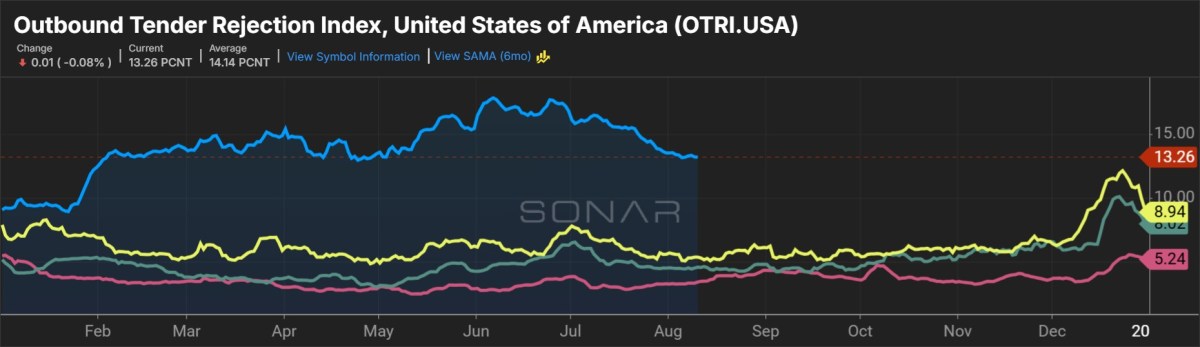
Tender rejections — a widely tracked gauge of carrier willingness to accept contracted freight and a proxy for capacity tightness — peaked in June, and spot rates have continued to decline from their Fourth of July highs. The summer lull has unsettled investors — second-quarter earnings reports were generally solid, yet shares of most carriers have sold off by mid-single to mid-teen percentages since those results.
Speaking at Deutsche Bank's Chicago Industrials Summit, Leathers dismissed concerns about the July softness: "There's no concern, if you will, from my perspective about … some of these little snippets of news that we've seen in July."
Supply-Side Constraints Tighten
Leathers emphasized that the driver supply pipeline has been significantly constricted. He estimates that 850 to 900 commercial driver's license (CDL) training schools have been forced to close due to insufficient training standards. That figure comes on top of approximately 10,000 training programs removed from the FMCSA's Training Provider Registry.
Capacity has also been impacted by a crackdown on electronic logging devices (ELDs) that allowed operators to manipulate hours-of-service records. As Leathers noted, such devices enabled scenarios where "10 trucks were able to behave like 15."
Even before regulatory enforcement intensified last year — with stricter oversight of English-language proficiency requirements and non-domiciled CDL restrictions — carriers had already been exiting the market due to weak economic conditions. Following an extended downturn, numerous fleets continue to struggle, meaning the recent rate improvement may have arrived too late for some operators.
Leathers indicated he expects further enforcement, noting that the FMCSA is likely to receive increased funding from its annual budget allocation in October.
Peak Season Outlook
Even with only modest demand, Leathers argued that a supply-driven recovery has durability. "Christmas is still going to come. Peak season is still going to be a reality."
He noted an "increased acceptance" among shippers that the capacity shortage "is real," a shift that benefits an industry that "hasn't been reinvestable in several years."
Inventories at some of Werner's retail customers are running lean, while others are maintaining satisfactory stock levels. The company anticipates a normal peak season this year — but unlike last year, this year's peak will benefit from significantly higher rates.
One-Way Fleet Turnaround
During the second quarter, Werner's one-way truckload fleet posted a sharp improvement following a restructuring. Revenue per truck per week, excluding fuel surcharges, jumped 28% year over year, driven by a 16% increase in miles per truck and a 10% rise in revenue per total mile.
The rate gains were particularly notable given that Werner had only half the spot market exposure compared with a year earlier, and that length of haul increased by nearly 100 miles — a dynamic that typically exerts downward pressure on per-mile rates.
Under the restructuring plan, the company exited unprofitable accounts and repurposed or disposed of underutilized trucks. The one-way fleet stood at 1,700 units at the end of the second quarter, 34% smaller year over year. Higher pricing and improved utilization pushed the total TL segment's adjusted operating ratio to 94.5%, an improvement of 270 basis points year over year.
Werner expects one-way rate per mile to increase 10% to 13% year over year in the third quarter. With the turnaround largely complete, the company now intends to resume growing this fleet.
Dedicated Operations
The dedicated fleet, which represents 80% of Werner's total TL network, is securing low- to mid-single-digit contractual rate renewals. Revenue per truck per week, excluding fuel, rose 5% year over year in the second quarter.
Werner acquired dedicated carrier FirstFleet for $245 million in January. Excluding FirstFleet from the results, Werner's legacy dedicated operation recorded an 8% increase in revenue per truck per week. That metric is projected to grow 3% to 5% year over year for full-year 2026.
While the consolidated TL margin remained more than 10 percentage points below the prior peak, it represented the segment's strongest performance since the fourth quarter of 2023. Management reiterated its path to low-double-digit margins during the middle of the freight cycle, which it said could occur as early as next year. The company identified several levers to reach that target: higher rates, stronger demand, truck additions to existing dedicated accounts with no start-up cost offset, higher gains on equipment sales as used truck prices rise (accounting for 150 basis points of margin improvement alone), and automation and cost-reduction initiatives.
Shares of WERN declined 0.7% on Thursday, compared with a 0.3% drop in the S&P 500. Werner's stock has gained 57% since spot rates first turned positive ahead of Thanksgiving.

