Week 44: Sticky Prices vs Uneven Demand — The G3 Verdict Week
Key Takeaways
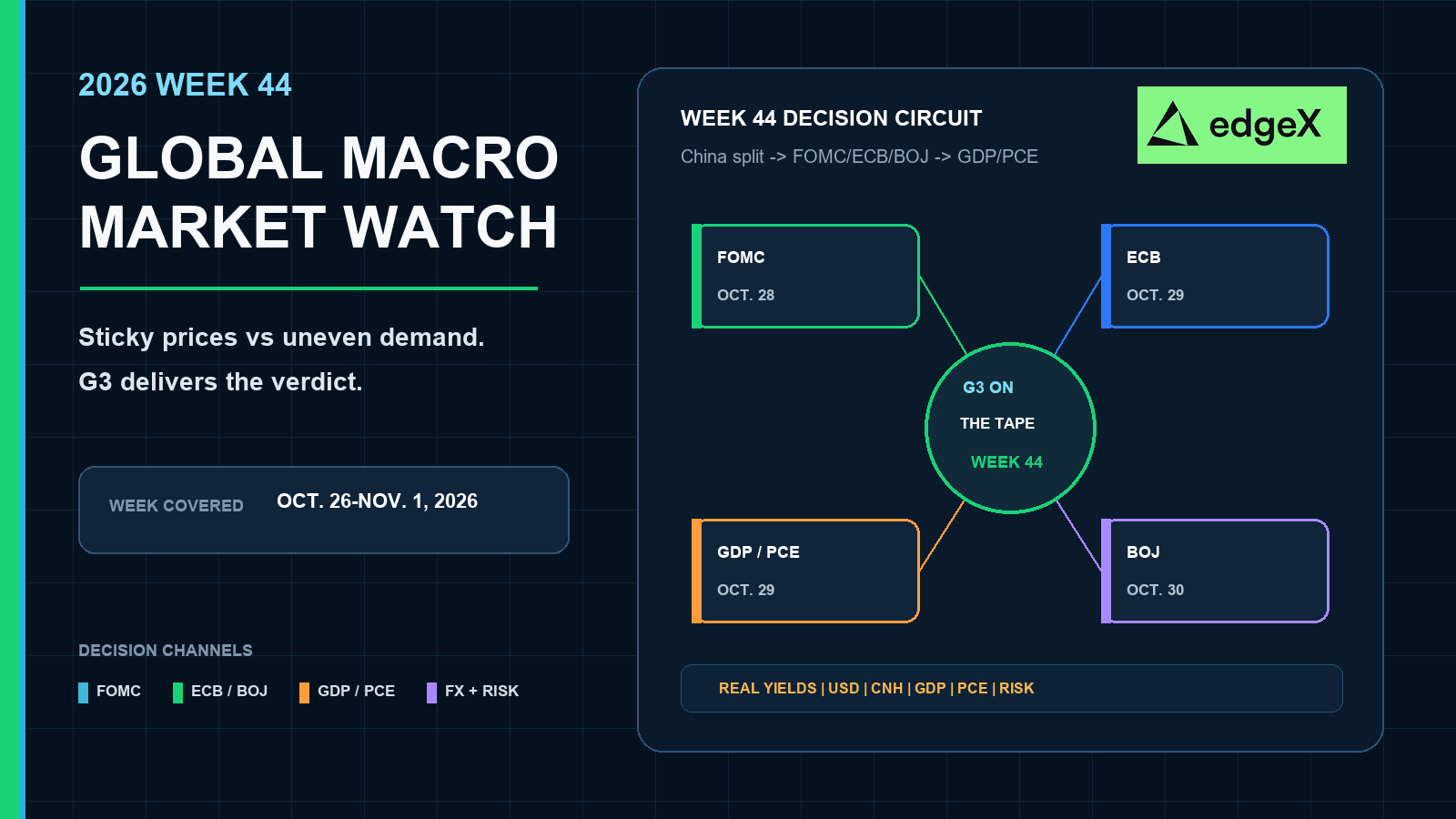
- •The FOMC decision on October 28, the ECB decision on October 29, and the Bank of Japan meeting on October 29–30 all fall in the same week, joined by U.S. Q3 GDP and September PCE data on October 29.
- •The base case assigns a 65% probability to sticky prices prevailing, with 25% on a soft-pause path and 10% on a mixed G3 split such as a hawkish Fed paired with a softer ECB.
- •Hot U.S. CPI and PPI prints are identified as the freshest hard data guiding central banks, while soft labor results alone are treated as insufficient to shift policy expectations.
- •China's third-quarter GDP rose 4.5% year over year, but real-estate investment fell 20.6%, private investment dropped 10.4%, and retail sales grew only 1.1%, pointing to structurally weak domestic demand.
- •In the sticky-price base case, the dollar and short-term yields remain supported while Bitcoin, Ethereum and rate-sensitive growth stocks stay on the back foot.
Quick Answer
Trade Week 44 as a G3 decision and confirmation week, not another China GDP reprint and not another CPI dump. The core conflict is sticky prices versus uneven demand. Our base case is a 65% sticky-price win: the Fed keeps higher-for-longer language alive, and enough of the G3 complex refuses to treat soft activity as clean cover. That favors the dollar, short-term yields, oil and industrial metals, and quality stocks; it keeps Bitcoin/Ethereum beta and expensive growth on the back foot. Assign about 25% to the soft-pause path if GDP and PCE cool together and one or more G3 banks turn patient. Leave about 10% for a mixed G3 split, usually hawkish Fed with softer ECB or a still-live BOJ Outlook.
Why Sticky Prices Still Beat Uneven Demand
The title is the trade. Prices reaccelerated. Demand did not collapse cleanly enough to cancel that impulse. Soft U.S. labor reduced one policy scare. Then U.S. CPI and PPI printed hot again. China’s October 19 package kept headline growth alive at 4.5% y/y, but the domestic engine stayed broken: property investment deep in contraction, private investment weak, retail thin. That is uneven demand, not soft-landing proof.
The 65% / 25% / 10% stack is not a hunch. It comes from three already-banked facts. First, the latest U.S. CPI and PPI impulse is still hot, so inflation risk remains the freshest hard print into the FOMC, ECB, and BOJ. Second, soft labor and China’s domestic-demand split have not yet produced a clean preferred-inflation cool-down, and in recent late-cycle episodes that mix usually keeps higher-for-longer language alive until PCE or equivalent confirmation fails. Third, Europe and Japan still carry sticky-price or hot trade-price residue, so a full synchronized soft pause is the harder outcome. That is why sticky prices get 65%, a same-week soft pause gets 25%, and a split G3 verdict gets 10%.
Week 44 is the verdict week. Position for the 65% path. Keep the other two branches as contingency, not as the starting book.
Week 44 Global Macro Calendar
| Date | Region | Scheduled event | Why it matters for the thesis |
|---|---|---|---|
| Oct 27–28 | United States | FOMC meeting; decision Oct 28 | First verdict on whether sticky prices still bind after soft labor |
| Oct 28–29 | Euro area | ECB Governing Council; decision Oct 29 14:15 CET | Tests whether soft factories buy a pause against sticky inflation |
| Oct 29 | United States | Q3 GDP advance; September PCE / personal income | Same-day check on whether demand still feeds the price impulse |
| Oct 29–30 | Japan | BOJ MPM; Outlook Report Oct 30 | External price heat versus domestic cooling into policy language |
| Oct 30 | United States | Employment Cost Index, Q3 | Labor-cost filter after the FOMC statement |
| Oct 31 / Nov 1 | China adjacency | Official PMI window into month-turn | Later demand pulse after the G3 cluster, not the week’s centerpiece |
United States: Sticky Prices Meet Soft Labor
The decision question
CPI and PPI are already out. Soft labor is already known. The October 28 FOMC statement has to show whether the Fed still treats sticky prices as the live risk. The October 29 GDP/PCE set then shows whether demand still carries that impulse. PCE is the Fed’s preferred inflation gauge.
Base-case market call
The cleaner U.S. prediction is not another soft-jobs trade. It is a Fed that still flags upside inflation risk, then a GDP/PCE set that fails to clear soft. In that 65% path, short-term yields and the dollar stay supported, quality cash-flow stocks hold up better than expensive growth, oil and copper stay firmer while growth does not break, and pure liquidity crypto trades stay vulnerable. Soft labor alone is background noise, not the override. The 25% soft-pause branch needs both a patient statement and cooler PCE in the same week.
| U.S. Week 44 prep | What to watch | Sticky-price win (65%) | Soft-pause win (25%) |
|---|---|---|---|
| Already-known prices | CPI/PPI already hot | Higher-for-longer stays live | Needs GDP/PCE proof to fade |
| Oct 28 FOMC | Statement and press conference | USD/yields supported; crypto/growth soft | Soft Fed reopens a risk bid |
| Oct 29 GDP / PCE | Growth vs preferred inflation | Demand still feeds sticky prices | Soft growth + cooler PCE flips risk |
Europe: Soft Factories Are Not Clean Cover
The decision question
Europe still has soft factories and sticky inflation. The October 29 ECB cannot treat activity weakness as automatic disinflation. The unfinished October 23 flash PMI cluster can refine breadth later; it is not closed evidence at the October 23 cutoff.
Base-case market call
The sharper Europe call is that soft factories still do not buy a pause by themselves. Inside the 65% path, ECB keeps inflation risk in the statement, EUR rates stay sensitive, European growth stocks stay capped, and crypto beta remains under a higher-for-longer global tone. The 25% soft-pause branch needs a clearly softer statement, not just weak industry. The cleanest 10% mixed split is hawkish Fed with softer ECB: long USD versus EUR.
| Europe Week 44 prep | What to watch | Sticky-price win (65%) | Soft-pause / mixed branch |
|---|---|---|---|
| Already-known setup | Soft industry beside sticky inflation | Soft activity still not buying disinflation | Soft factories finally buy a pause |
| Oct 29 ECB decision | Statement and Lagarde press conference | EUR rates firm; risk stays capped | Soft ECB helps European risk assets |
| Post-decision EUR rates | Front-end pricing vs USD | USD/EUR stays sticky-price heavy | EUR softens; mixed split favors USD/EUR |
Japan: Hot Trade Prices Keep BOJ Live
The decision question
Domestic CGPI cooled, but export and import prices stayed firm enough to keep the late-October BOJ meeting live. The October 29–30 meeting and October 30 Outlook have to show whether external price heat still shapes policy language.
Base-case market call
Japan’s sharper read is that hot trade prices keep the Outlook live even after a softer domestic PPI. In the 65% path, JPY stays volatile and Asia risk stays jumpy, which usually caps clean crypto and Asia-equity follow-through. Soft domestic PPI alone does not settle Japan. A patient BOJ after hot trade prices is a local yen-softening relief trade. Paired with a soft Fed, that becomes one of the cleaner 10% mixed-split setups: U.S. duration catches a bid while JPY volatility stays elevated.
| Japan Week 44 prep | What to watch | Sticky-price win (65%) | Soft-pause / mixed branch |
|---|---|---|---|
| Already-known CGPI mix | Domestic cooling, hot trade prices | BOJ risk stays live for JPY | Soft domestic PPI alone settles nothing |
| Oct 29–30 MPM | Statement and Outlook Bank’s View | JPY volatility stays high | Soft BOJ fades the Japan risk premium |
| JPY / rates response | Post-Outlook pricing | Asia risk stays jumpy | Soft guidance eases yen; mixed split stays noisy |
China Inheritance: Growth Held, Domestic Demand Split
China is the uneven-demand side of the thesis, not the Week 44 reprint. The October 19 NBS package already showed Q3 GDP at 4.5% y/y and 1.2% q/q. That headline looked resilient under a 5.0% PPI print. The structure underneath did not. Keep the NBS English PressRelease hub open if revisions arrive midweek.
The domestic weakness is structural. Real-estate development investment fell 20.6% over the first nine months, so the property engine that once carried household wealth and local activity is still contracting. Private investment fell 10.4%, which means non-state capex is not replacing property. Retail sales rose only 1.1% even as household income rose 5.3% nominally, a gap that points to weak spending confidence rather than a simple income collapse. Urban surveyed unemployment held at 5.2%. The NBS itself said domestic demand remains insufficient. China is still exporting and producing enough to keep industrial demand alive, but it is not healing the household-and-property core that markets need for a clean soft landing.
That is why uneven demand does not automatically cancel sticky prices. Export-linked industry still supports oil, copper, and industrial commodity beta. Property, private investment, and household demand do not. Soft China alone does not settle Fed or ECB week. It means a hawkish G3 cluster lands on sticky prices plus a damaged domestic China engine.
| China inheritance | What is already out | Sticky-price handoff | Soft-landing handoff |
|---|---|---|---|
| Q3 GDP | +4.5% y/y; +1.2% q/q | Growth still absorbing producer heat | Soft landing under hot PPI |
| Sep IP / trade | IP +5.5%; goods trade still firm | Industry and exports still turning | Output buckling under costs |
| FAI / retail / property | FAI −7.2%; retail +1.1%; RE −20.6% | No clean domestic-demand relief | Domestic demand fading into G3 |
Cross-Asset Impact Into G3 Week
The 65% sticky-price path is the starting book: fade pure liquidity Bitcoin/Ethereum longs; prefer quality stocks over expensive growth; keep oil and industrial metals supported; stay with USD and front-end yield support. The 25% soft-pause path flips that map: crypto can catch a policy-relief bid, growth equities rebound, gold rises while industrial metals soften, and USD/front-end yields lose support. The 10% mixed G3 split is narrower: hawkish Fed with softer ECB favors USD versus EUR; soft Fed with a still-live BOJ Outlook keeps JPY volatility elevated even if U.S. risk bounces.
Soft prices with firm growth remains the rarest clean risk-on mix. Bitcoin and Ethereum can lead. Broad equities improve. Industrial metals join gold instead of splitting lower. The dollar softens only selectively as the curve stops bear-flattening.
| Week 44 mix | Crypto | Equities | Commodities | FX and rates |
|---|---|---|---|---|
| Hot prices + firm G3/GDP-PCE (65%) | Buy dips only in BTC/ETH; fade pure liquidity trades | Prefer quality balance sheets over rate-sensitive growth | Keep oil/industrial metals supported | USD and front-end yields stay bid |
| Hot prices + soft G3 guidance | Risk-off first; cut beta until breadth stabilizes | Rotate toward defensives and cash-flow names | Energy can stay firm even as cyclicals wobble | Supportive for quality USD; hurts high-beta FX |
| Soft prices + soft growth (25%) | Policy-relief bid becomes available again | Rate-sensitive growth can catch a bid | Metals split: gold up, industrial soft | Front-end yields fall; USD softens |
| Soft prices + firm growth | Best risk-on mix: BTC/ETH lead if confirmed | Broad equity risk appetite improves | Gold and industrial metals both bid | USD softens selectively; curve pressure eases |
What Would Confirm the Week 44 Signal?
Week 44 confirms a sticky-price G3 path if three things line up: the FOMC keeps upside inflation risk alive after soft labor; ECB and BOJ refuse to treat soft factories or cooler domestic PPI as enough cover; and the October 29 GDP/PCE set shows demand and preferred inflation still validating that impulse. That is the 65% path: USD and yields stay supported while crypto and growth stay on the back foot.
The path fails if GDP/PCE cool hard and one or more G3 banks pause with clearly softer guidance. Then hot September prices look late rather than live, and risk assets can rebound into the 25% soft-pause branch. A split G3 outcome keeps the 10% mixed case alive through USD/EUR or JPY volatility rather than a clean global risk-on signal. Until those checks print cleanly, sticky prices versus uneven demand still resolves in favor of higher-for-longer—not soft-landing certainty.
Week 43 Review: Growth Held, Domestic Demand Split
Week 43 is still incomplete at the October 23 cutoff, but the decisive China package is already on the tape. Soft labor and hot prices were the handoff from Week 42. October 19 answered the first growth check. That is the uneven-demand side of the Week 44 thesis, not the Week 44 forecast.
China’s third-quarter GDP rose 4.5% y/y and 1.2% q/q, lifting the January–September pace to 4.6%. Headline growth held under hot producer prices. The domestic engine did not. September industrial production rose 5.5% y/y and goods trade stayed firm, but fixed-asset investment fell 7.2%, real-estate development investment dropped 20.6%, private investment fell 10.4%, and retail sales rose only 1.1% even with household income up 5.3% nominally. Urban surveyed unemployment held at 5.2%. The NBS itself said domestic demand remains insufficient.
That package did not give G3 week a soft-landing certificate. The unfinished October 23–25 items—above all the October 23 flash PMI cluster across Japan, Europe, the U.K., and the United States—remain unfinished adjacency at the October 23 cutoff. This review does not invent those prints. Week 44 therefore moves from the China package already out to actual G3 decisions and U.S. GDP/PCE confirmation.
| Already-known Week 43 setup | Evidence | What Week 44 inherits |
|---|---|---|
| China Q3 GDP | +4.5% y/y; +1.2% q/q; Jan–Sep +4.6% | Growth held under hot PPI |
| China activity split | Sep IP +5.5%; retail +1.1%; FAI −7.2%; RE −20.6% | No clean domestic-demand relief |
| Price pressure | U.S. CPI/PPI already hot; China PPI +5.0% | Sticky-price base case still live |
| Flash PMI cluster | Scheduled Oct 23 | Unfinished adjacency; no invented actuals |
| G3 destination | Fed/ECB/BOJ late October | Week 44 owns the decisions |
Trade with an Edge
After a G3 verdict week, the market problem is rarely the thesis alone. It is expressing that thesis when yields, the dollar, crypto beta, and Asia risk reprice in the same session. For traders who need that kind of clean, self-custodial execution, decentralized venues like edgeX have become a practical way to stay with the tape in perpetuals and spot.
Unlike traditional centralized platforms, edgeX is built around self-custody, meaning you keep control of your assets and authorize fund movements yourself. For active traders, that offers a meaningful advantage: market access without handing custody to an exchange.
edgeX also combines the core benefits of DeFi with a trading experience designed for serious execution. The platform emphasizes deep liquidity, high-speed order matching, and low-slippage performance, helping traders stay responsive during volatile conditions. With support for high leverage, it gives experienced market participants more flexibility in how they express macro views and manage risk.
Beyond execution, decentralized trading infrastructure can offer structural advantages: greater transparency, on-chain verification, and reduced dependence on centralized intermediaries. For traders who want performance without giving up control, that model is increasingly compelling.
edgeX is built for that balance: bringing together a professional trading experience with the core principles of decentralized markets.
Traders looking to explore a more capital-efficient, self-custodial way to trade can take a closer look at edgeX.
Frequently Asked Questions
What should traders prepare for in Week 44?
A G3 decision week plus same-day U.S. confirmation: FOMC on October 28, ECB on October 29, BOJ on October 29–30, and U.S. Q3 GDP advance with September PCE on October 29. Those events decide whether sticky prices still outweigh uneven demand across crypto, equities, commodities, and FX.
Is Week 44 another China week?
No. China’s October 19 package is already out and belongs in the incomplete Week 43 review. Week 44’s forecast work is G3 decisions and U.S. GDP/PCE confirmation, not another China GDP reprint.
Why review Week 43 if the week is not over?
Because the decisive China package is the uneven-demand side of the thesis, not the forecast. Growth held while domestic demand stayed split. Week 44 has to test whether sticky prices still bind despite that handoff. Remaining October 23–25 items, including flash PMI, are unfinished adjacency.
What is the single most important Week 44 event?
The FOMC decision on October 28 is first because it sets the U.S. policy tone after hot CPI/PPI. The October 29 GDP/PCE set is the necessary confirmation, and ECB/BOJ decide whether the same sticky-price split still binds outside the United States.
How should traders treat unfinished flash PMI prints?
As unfinished Week 43 adjacency, not as closed evidence. Do not invent October 23 PMI levels. Score G3 week against the China package already out and the price pressure already known until primary PMI releases are confirmed.

