Former Trump aide recounts president’s ‘insane’ explanation of the ‘H’ in ‘Jesus H. Christ’
Key Takeaways
- •Alyssaah Griffin, a former Trump administration official and current co-host of The View, claimed on social media that Trump told her the "H" in "Jesus H. Christ" stands for "Horatio" on her first day at the White House.
- •The letter "H" in the expression has no established meaning or definitive origin, meaning there is no official answer to the question Trump posed.
- •Trump has repeatedly made unusual spelling and word claims, including using "Dumocrats" as an insult and asserting that "dumb" is spelled with a B at the end.
- •At a South Carolina rally, Trump conflated the Nobel Peace Prize with the Pulitzer Prize while claiming he deserved both, apparently referring to 85-year-old South African jurist and former UN Human Rights Commissioner Navanethem Pillay.
- •Trump's religion-related missteps include posting an AI-generated image of himself as Jesus and referring to "Second Corinthians" as "Two Corinthians" during a 2016 speech at Liberty University.
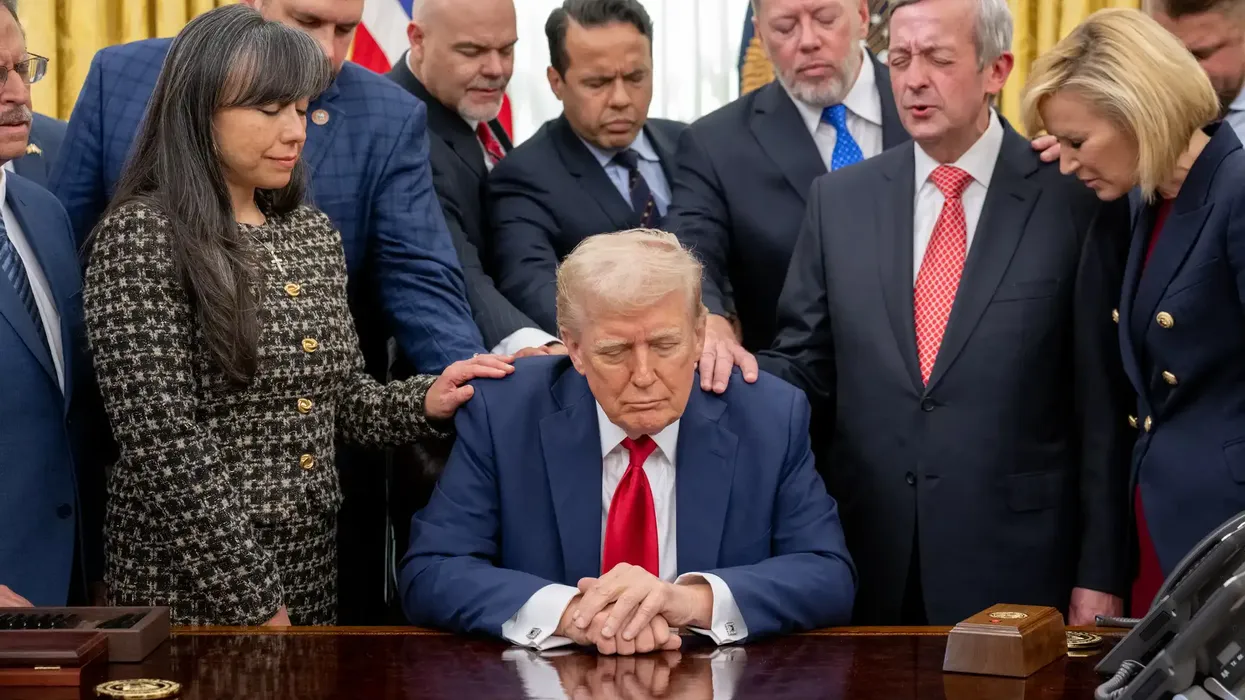
Alyssa Farah Griffin, a former Trump administration official who served as White House director of strategic communications and is now a co-host of The View, shared what she described as an “insane” anecdote about President Donald Trump on Thursday.
Farah Griffin was responding on social media to a post asking what the “H” stands for in the expression “Jesus H. Christ.” She wrote: “Hand on my heart, my first day at the White House, Trump asked me if I knew what the H stood for. I said no. He said Horatio. I think about that at least once a week.”
The post drew a response from a prominent political commentator: “Sigh. Why is this completely insane and yet entirely realistic.” For readers unfamiliar with the expression, the “H” in “Jesus H. Christ” has no established meaning — the phrase has circulated in American English for generations without any definitive origin for the letter, so there is no official answer for what is itself an unofficial oath. Farah Griffin’s account has also been linked to a broader pattern of Trump’s unusual word choices and spelling claims.
One recent example is Trump’s use of “Dumocrats” as an insult against political opponents, a play on the name of the Democratic Party. He has repeatedly said, “Most people don’t know that ‘dumb’ has a B at the end,” sometimes adding, “they think it’s D-U-M, and that’s okay.” CNN has noted that “dumb” is a basic word that most Americans learn to spell in grade school. CNN reported on Trump’s use of “dumb” and “Dumocrat.”
Another example concerns Trump’s statements about immigrants. He has often claimed that other countries release “asylum” inmates who then enter the United States illegally. Critics have suggested that he is confusing mental institutions with political asylum, which refers to protection sought by people fleeing persecution; the two concepts are unrelated. Reason examined Trump’s use of “asylum” in this context.
Trump has also sometimes continued speaking after misspeaking, presenting the error as if it were intentional. At a rally in South Carolina on Wednesday, he repeated his claim that he should have received the Nobel Peace Prize. He then paused and said: “Does anybody know the name of that peace prize? They gave the Pulitzer Prize to a young lady — I think she’s 80 years old — a young lady who nobody ever heard of.”
The two honors are distinct: the Nobel Peace Prize is awarded annually in Oslo by the Norwegian Nobel Committee, while the Pulitzer Prizes are administered by Columbia University and recognize achievement in journalism, letters, and the arts. He appeared to be referring to 85-year-old Navanethem “Navi” Pillay, a South African jurist former United Nations High Commissioner for Human Rights who has spent her career promoting human rights. Trump then appeared to acknowledge the confusion while reframing the remark: “I didn’t get the Nobel Prize. I didn’t get the Pulitzer. I should have gotten the Pulitzer for writing, too,” he added. The Independent reported on the South Carolina remarks.
The “Jesus H. Christ” anecdote also touches on Trump’s relationship with U.S. Christians. The source article states that 80 percent of Christians voted for him in all three elections, although that support has declined as his approval rating has fallen. Trump has made several other religion-related gaffes, including posting an AI-generated image of himself as Jesus earlier this year during a dispute with the Pope. The image prompted outrage among some disillusioned followers. AlterNet previously reported on Trump and evangelicals.
He has also misread biblical passages, including referring to “Second Corinthians” as “Two Corinthians,” a remark that came during a 2016 campaign speech at Liberty University, a Christian university in Virginia.
Farah Griffin’s original post is available on X.

