When Rising Yields Hit Tech: What Comes Next for Global Stocks
Key Takeaways
- •U.S. benchmarks finished Week 34 lower, with the Nasdaq down 2.1%, the S&P 500 down 1.4%, and the Dow down 0.9%, as higher Treasury yields compressed valuations on long-duration technology stocks despite a Friday rebound.
- •Samsung Electronics and SK Hynix, which together account for more than 53% of KOSPI market value, cushioned Korea's 0.93% weekly decline, while 30 Korean sector ETFs fell 6.8% on average, exposing the gap between index resilience and market breadth.
- •Hong Kong's Hang Seng rose 3.55% for the week to 26,009.46, outperforming the CSI 300's 1.01% decline, as offshore risk appetite proved more responsive to global liquidity than mainland sentiment was to policy expectations.
- •Nvidia, which reported record revenue of $81.6 billion in its previous quarter, and Salesforce are scheduled to report earnings on August 26, alongside U.S. inflation data and Federal Reserve communication at the Jackson Hole symposium.
- •The base case for Week 35 is a volatile, selective market rather than a synchronized rebound, with weak AI guidance combined with firmer inflation identified as the clearest risk-off scenario.
Quick Answer
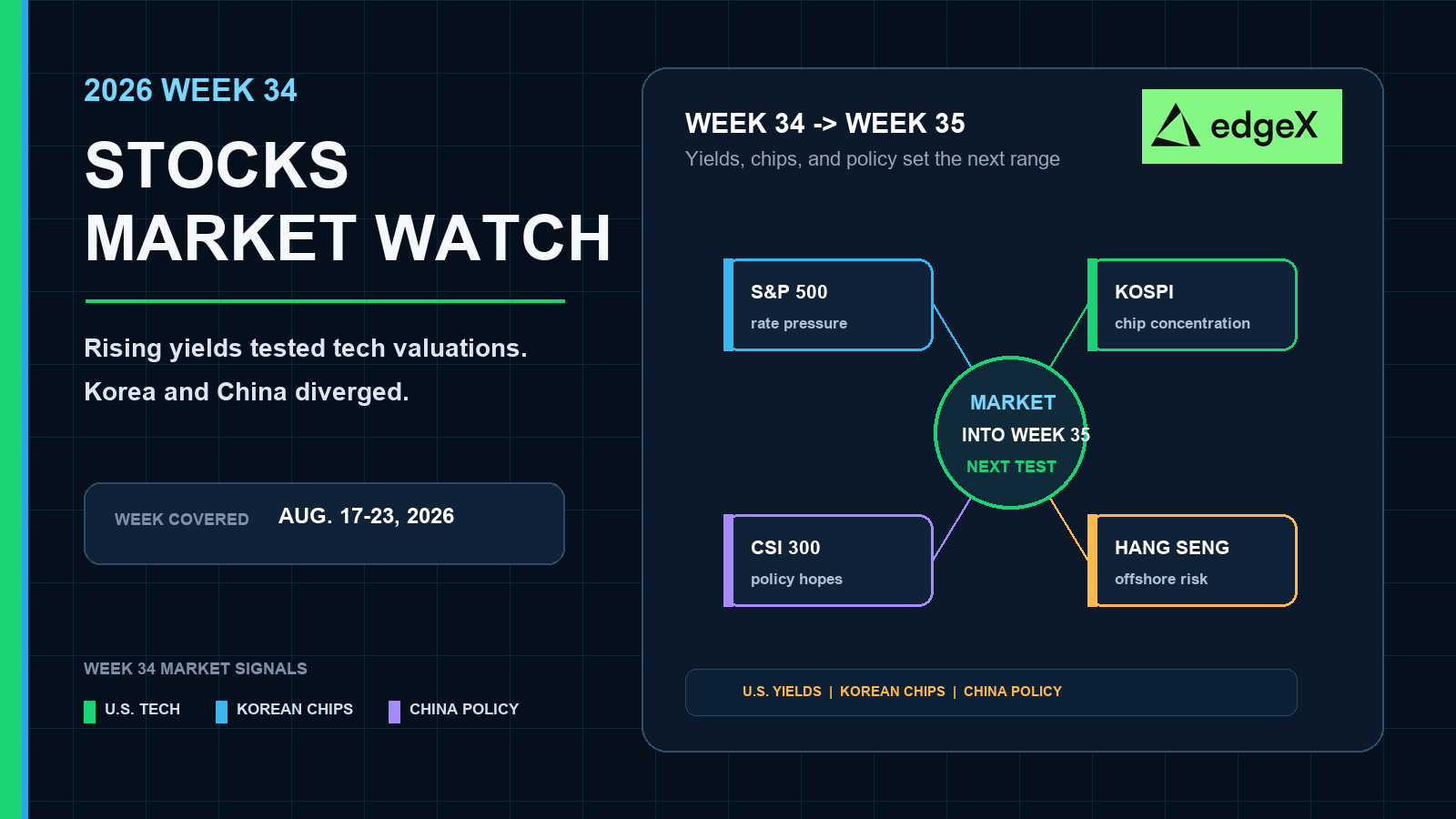
Stocks did not experience one uniform global sell-off in Week 34. The United States faced a discount-rate reset, with rising yields making expensive technology cash flows worth less today. Korea held up better because semiconductor leaders and shareholder-return news cushioned the KOSPI, but that protection was narrow. Mainland China recovered on policy expectations without fully repairing demand concerns, while Hong Kong finished with the strongest momentum. For Week 35, the base case is continued volatility rather than an automatic rebound: strong AI guidance and contained inflation could broaden the advance, while disappointing guidance or another yield rise would expose the same concentration risks seen in Week 34.
Global Equities Lost Momentum
The week ending August 21 separated index resilience from market breadth. A Friday rebound repaired part of the damage, but it did not reverse the weekly loss in the major U.S. benchmarks or erase the evidence that leadership had become narrower across Asia. The comparison matters because the same global rate move was transmitted through different domestic market structures.
Friday's rebound repaired breadth, not the week
The S&P 500 gained 0.43% Friday to close at 7,674.37, while the Nasdaq added 0.43% to 26,180.45. Reuters reported that Nasdaq advancers outnumbered decliners by roughly 1.85 to 1, and the Dow recovered about 500 points during the session. That is a healthier one-day breadth reading than the earlier sell-off, but it arrived too late to prevent weekly losses of 1.4%, 2.1%, and 0.9% for the S&P 500, Nasdaq, and Dow respectively.
The market's message was therefore conditional rather than capitulatory. Buyers were willing to step back into quality technology and cyclical names when prices fell, yet they were not willing to restore the previous week's multiples without clearer evidence that yields had stabilized. The rebound was a positioning response, not proof that the valuation issue had disappeared.
Week 34 Global Stock-Market Dashboard
The table uses dated closes where a reliable August 14-to-August 21 comparison was available. Friday figures are included to separate the week's result from the final-session move.
| Market | Week 34 result | What moved the tape |
| S&P 500 | -1.4%; Friday +0.43% to 7,674.37 | Higher Treasury yields and technology valuation pressure; late breadth improved |
| Nasdaq Composite | -2.1%; Friday +0.43% to 26,180.45 | Long-duration growth and AI-linked multiples were repriced |
| Dow Jones Industrial Average | -0.9%; Friday rebound of about 500 points | Defensive and industrial exposure softened the weekly drawdown |
| KOSPI | -0.93% (6,977.94 to 6,912.95); Friday +0.88% | Samsung and SK Hynix support, semiconductor concentration, foreign-flow sensitivity |
| CSI 300 | -1.01% (4,665.88 to 4,618.90); Friday about +0.57% | Fiscal-support hopes and AI interest offset softer domestic-demand confidence |
| Hang Seng | +3.55% (25,116.85 to 26,009.46); Friday +1.21% | Financials and technology rebounded as offshore risk appetite improved |
U.S. Technology Faced a Valuation Reset
The U.S. decline was less about a new earnings shock than about the price investors were willing to pay for distant cash flows. Treasury-market pressure raised the discount rate applied to software, AI infrastructure, and other long-duration growth stories. The Friday recovery showed that demand for those businesses remained intact, but the weekly Nasdaq underperformance showed that conviction now required a better entry point.
Higher yields changed the price investors would pay
When real yields rise, a larger share of a growth stock's valuation sits in cash flows that arrive years ahead. The arithmetic does not require an earnings miss to create a drawdown: a higher discount rate alone can compress the multiple. That mechanism explains why the Nasdaq's 2.1% weekly loss exceeded the Dow's 0.9% decline even though both indexes participated in Friday's bounce.
Technology investors also faced a concentration problem. A handful of mega-cap AI and platform companies still determined a disproportionate share of index performance, so even a modest rotation away from the most expensive names could pull the benchmark down. The week's price action was a reminder that strong secular demand and attractive short-term returns are different claims.
Breadth improved too late to erase the weekly damage
The 1.85-to-1 advancer-to-decliner ratio reported for Friday was encouraging, but one broad session cannot establish a durable trend. A stronger signal would require several sessions in which equal-weighted and mid-cap shares participate while Treasury yields stop climbing. Until then, the U.S. market remains vulnerable to a repeat of the pattern: a narrow group rallies on good news, then the whole index de-rates when bond investors demand more compensation.
For investors comparing regions, this distinction is important. The United States still offered the deepest earnings visibility in AI and software, but it also carried the greatest sensitivity to valuation compression. Week 34 rewarded patience more than momentum chasing.
Korean Stocks Held Up Better, but Concentration Stayed High
The KOSPI's 0.93% week-over-week decline looked comparatively modest beside the Nasdaq's 2.1% loss. That relative performance was real, but it should not be read as broad Korean strength. The index's transmission channel ran through memory-chip pricing, global AI-capital-expenditure expectations, foreign flows, and the market weight of Samsung Electronics and SK Hynix.
Semiconductors cushioned the KOSPI
On Friday, the KOSPI rose 0.88% to 6,912.95. Samsung and SK Hynix led the rebound after shareholder-return and buyback headlines, reinforcing the idea that large-cap memory exposure could absorb some of the global technology sell-off. Reuters noted that the two companies together account for more than 53% of KOSPI market value, so their moves can dominate the index even when the broader tape is weak.
That concentration links Korea to the global AI cycle in two directions. Stronger data-center demand supports Korean memory exports and earnings expectations; a rise in U.S. yields or a cut to AI-spending assumptions can reverse the flow quickly. Currency moves and foreign positioning add another layer because overseas investors measure Korean returns in both won and dollars.
Index resilience was not the same as market breadth
Reports that 30 Korean sector ETFs fell 6.8% on average while the KOSPI declined about 0.9% illustrate the gap between headline resilience and participation. A reader tracking only the benchmark could miss weakness in smaller technology, consumer, and domestic-demand names. That makes the KOSPI a useful relative-strength signal, but a poor standalone measure of the health of Korean equities.
China Rebounded on Policy Hopes but Still Finished Lower
Mainland China and Hong Kong offered a different version of selective risk-taking. The CSI 300 fell from 4,665.88 on August 14 to 4,618.90 on August 21, a decline of about 1.01%, even as Friday buying lifted the index roughly 0.57%. The Shanghai Composite was nearly flat around 3,903.81 Friday. Investors were willing to price a possible policy response, but not yet willing to assume that domestic demand, property, and consumption had fully turned.
Mainland liquidity did not fully restore risk appetite
The late-week recovery followed reports that investors were looking for a fiscal boost. That expectation helped stabilize blue chips and provided a floor under the CSI 300, whose banks, industrials, and consumer companies are more exposed to domestic policy than the U.S. technology benchmarks. Yet policy anticipation is not the same as realized earnings. Without clearer improvement in household spending, property activity, or private-sector confidence, the rebound remained tactical.
China's technology complex also complicated the benchmark reading. AI and chip shares could rally even while the broader CSI 300 lagged because the index has a heavier mix of financials, industrial producers, and established consumer companies. Investors therefore had to separate a tradable AI theme from the wider question of whether China's domestic growth engine was re-accelerating.
Hong Kong showed how offshore sentiment can turn faster
Hong Kong finished the week with the Hang Seng up about 3.55%, rising from 25,116.85 on August 14 to 26,009.46 on August 21, according to Yahoo Finance historical data. Friday alone added 1.21%. The advance followed a volatile path in which AI shares retreated before financial and technology names recovered. Hong Kong's offshore investor base makes it more responsive than mainland China to global rates, U.S. technology positioning, and cross-border liquidity.
The contrast with the CSI 300 is useful. Mainland shares received support from domestic policy expectations but still lost about 1.01% for the week; Hong Kong responded more directly to the global risk bid and gained about 3.55%. A sustained regional rally would need both: credible domestic-demand support in China and a less hostile rate backdrop for offshore technology valuations.
What Week 34 Changed
The week changed the market's burden of proof. U.S. investors now need evidence that earnings can outrun a higher discount rate; Korean investors need breadth beyond the two semiconductor giants; and Chinese investors need policy transmission into demand rather than another round of expectations. Hong Kong's 3.55% weekly rally showed that offshore risk appetite can return quickly, but its volatile path also showed how quickly it can reverse.
Across the three required markets, the most useful conclusion is not that one region “won.” The U.S. had the clearest earnings engine but the sharpest valuation sensitivity. Korea was relatively resilient because its semiconductor leaders aligned with the AI theme, yet that resilience was concentrated. Mainland China offered policy optionality but still lacked a fully convincing domestic-demand impulse, while Hong Kong provided a faster read on global liquidity.
That mix favors disciplined position sizing and explicit scenario checks in Week 35. A trader comparing equity exposure across regions should ask which channel is being paid for: U.S. growth duration, Korean memory-cycle beta, Chinese policy optionality, or Hong Kong offshore liquidity. Nvidia and macro data can change the U.S. signal quickly, but the stronger confirmation will come from whether Korea broadens beyond chips and whether Chinese policy expectations translate into domestic-demand evidence.
Week 35 Forecast: Earnings, Rates, and Policy Must Align
The August 24-30 outlook starts from a fragile position: Friday's rebound improved sentiment, but Week 34 did not resolve the conflict between earnings optimism and a higher discount rate. A durable advance needs confirmation from both company guidance and macro conditions. The base case is a volatile, selective market in which regional leadership changes with yields, AI expectations, and policy signals rather than a synchronized global rally.
Nvidia and U.S. data will decide whether breadth expands
Nvidia and Salesforce are scheduled to report on August 26. Nvidia's previous quarter delivered record revenue of $81.6 billion, so the next test is not simply whether demand remains strong; investors will judge forward guidance, data-center growth, margins, networking demand, and the pace of new-system deployment. Salesforce provides a separate check on whether AI spending is moving from infrastructure into recurring enterprise-software revenue.
The earnings response will share the stage with U.S. inflation and growth data, Treasury yields, and policy communication around the Jackson Hole symposium. Strong guidance with contained inflation would favor semiconductors, software, industrial infrastructure, and eventually smaller companies. Strong earnings paired with rising yields could lift capitalization-weighted indexes while leaving breadth narrow. Weak AI guidance and firmer inflation would create the clearest risk-off combination.
Korea needs chip breadth while China needs policy transmission
South Korea is likely to remain highly sensitive to Nvidia's guidance because memory demand, server investment, and foreign flows feed directly into Samsung Electronics and SK Hynix. A constructive signal would be gains spreading from those two companies into equipment, components, exporters, and the KOSDAQ. If the KOSPI rises while broader Korean sectors remain weak, concentration risk will still be unresolved.
Mainland China and Hong Kong need different confirmation. The CSI 300 requires evidence that fiscal support is reaching property, consumption, private investment, and earnings expectations. The Hang Seng can continue to benefit from offshore liquidity and lower global yields, but its stronger Week 34 performance leaves it vulnerable if technology sentiment reverses. The most durable Asian outcome would combine stable U.S. yields, firm memory demand, credible Chinese policy follow-through, and broader participation beyond the largest index weights.
| Market | Constructive Week 35 signal | Base-case expectation | Main downside trigger |
| United States | Strong AI guidance, contained inflation, stable yields, wider breadth | Volatile and selective; mega-cap leadership remains important | Higher yields plus weaker forward guidance |
| South Korea | Samsung and SK Hynix gains spread into equipment, exporters, and KOSDAQ | Chip-led resilience with persistent concentration risk | AI-capex doubts, won weakness, or foreign outflows |
| Mainland China | Fiscal measures improve domestic-demand and earnings expectations | Policy-supported but uneven recovery | Policy expectations fail to reach consumption or property activity |
| Hong Kong | Offshore inflows continue as global yields stabilize | Higher beta to global risk appetite after a strong Week 34 | Technology reversal or renewed global rate pressure |
Trade Stocks Without the TradFi Gatekeeping
The stock market moves fast. Your trading infrastructure should too.
As RWA markets mature and tokenized stocks become a serious alternative to tradFi access points, more traders are asking the same question: why settle for a centralized platform that controls your assets, demands KYC, and keeps your trading fees?
edgeX Exchange offers a different answer. Built on EDGE chain and settling on Ethereum via Arbitrum, edgeX is a decentralized perpetual futures platform where you can trade stocks with up to high leverage—without handing over your identity or your keys.
Here's what sets it apart:
- True self-custody — Users control their private keys at all times. Withdrawals require no platform approval, ever.
- Institutional-grade liquidity — $10M depth within a one-basis-point spread, with sub-0.1 basis point slippage on trades over $100K.
- CEX-level speed — The order book processes up to 200,000 orders per second with sub-10ms matching latency.
- No KYC required — Sign up and start trading without the friction of traditional onboarding.
- 100% trading fee rewards — Every fee you pay comes back to you through the Trade to Own program.
- USDC-backed security — Backed by Circle Ventures, with a 1:1 dollar redemption guarantee on all USDC held on the platform.
Whether you're rotating out of tradFi equities, exploring RWA perpetuals, or simply looking for a smarter way to trade stocks on-chain, edgeX delivers the execution quality of a top-tier exchange with the security guarantees of decentralized infrastructure.
Available on iOS and Android - so your edge goes wherever you do.
Frequently Asked Questions
How did U.S. stocks perform in Week 34 of 2026?
The S&P 500 fell 1.4%, the Nasdaq Composite fell 2.1%, and the Dow Jones Industrial Average fell 0.9% for the week ending August 21. All three rebounded Friday, but the final session did not erase the weekly losses.
Why did technology stocks underperform?
Higher Treasury yields increase the discount rate applied to future cash flows, which puts more pressure on expensive, long-duration growth and AI-linked stocks.
Did Korean stocks outperform the United States?
The KOSPI's roughly 0.93% weekly decline was smaller than the Nasdaq's 2.1% loss, but Korea's result was concentrated in Samsung Electronics and SK Hynix rather than broadly shared across sectors.
What happened in mainland China?
The CSI 300 fell about 1.01% from August 14 to August 21, while Friday buying followed hopes of additional fiscal support. The Shanghai Composite was nearly flat Friday near 3,903.81.
Why include Hong Kong in the comparison?
Hong Kong reflects offshore liquidity and global technology positioning more directly than mainland benchmarks. The Hang Seng gained about 3.55% for the week and rose 1.21% Friday to 26,009.46.
What is the stock-market outlook for Week 35?
The base case is continued volatility and selective leadership. Strong Nvidia and Salesforce guidance combined with contained inflation and stable Treasury yields could broaden the rally; weaker guidance or another yield increase would favor defensive positioning and pressure long-duration growth shares.
What should investors watch in Korean and Chinese stocks next week?
In Korea, watch whether strength spreads from Samsung Electronics and SK Hynix into equipment, exporters, and the KOSDAQ. In mainland China, watch whether fiscal-support expectations improve property, consumption, and earnings confidence. In Hong Kong, monitor offshore flows and technology sensitivity to global yields.

