2026 Week 34 Global Macro Market Watch: Fed Minutes Meet China Data and Global PMIs
Key Takeaways
- •The Federal Reserve will release minutes from its July 28-29 FOMC meeting on August 19, revealing how officials assessed the balance between persistent inflation and downside risks to employment and growth.
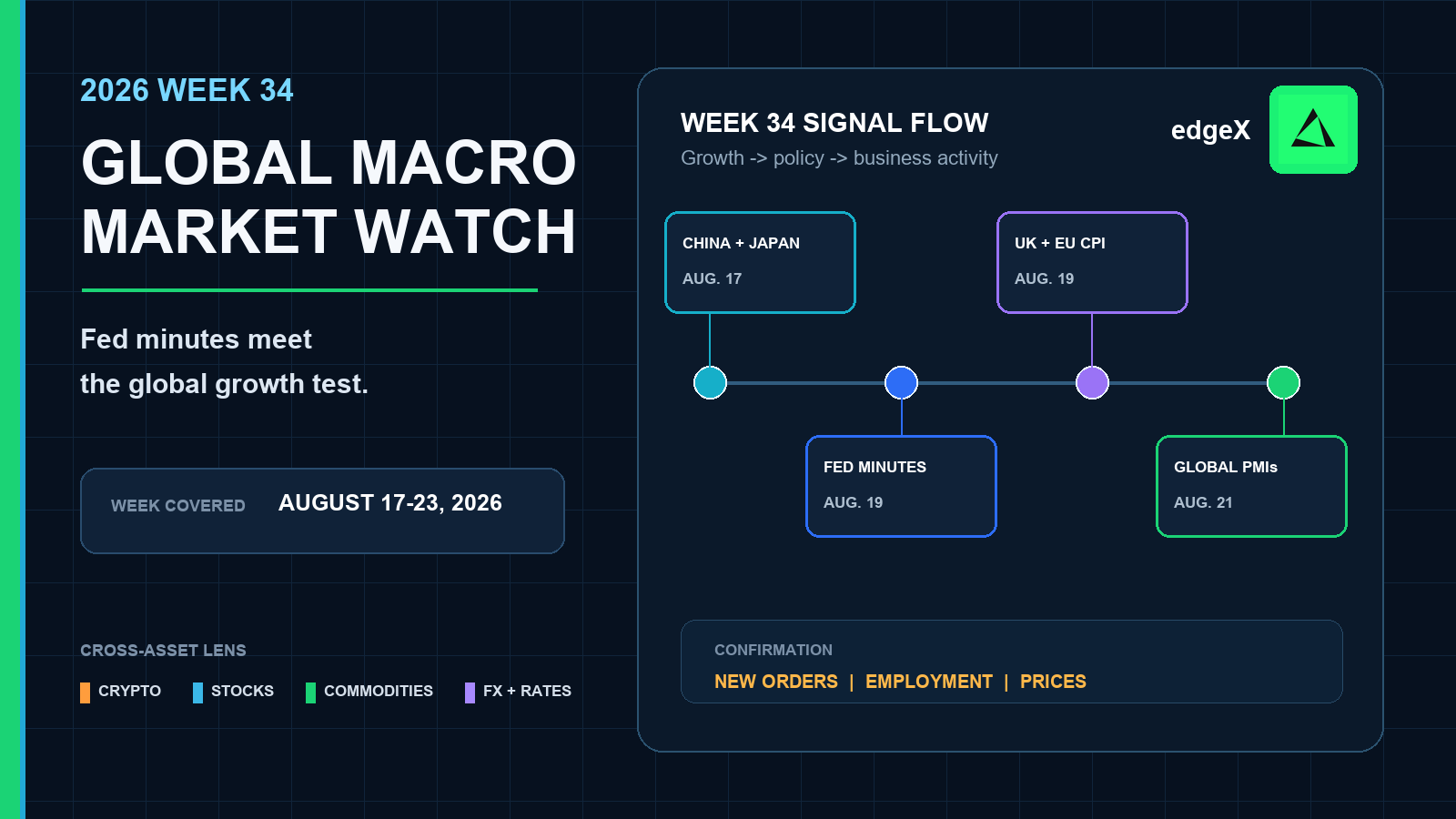
- •China's July activity data on August 17, covering industrial production, retail sales, fixed-asset investment, and property, will indicate whether domestic demand is stabilizing alongside manufacturing momentum.
- •Japan's preliminary second-quarter GDP report on August 17 will distinguish between growth driven by domestic consumption and business investment versus expansion reliant on trade or inventory effects.
- •UK and euro-area inflation releases on August 19 will test whether services price pressure is cooling enough to support eventual rate cuts without signaling deteriorating household demand.
- •Flash PMIs on August 21 will provide a synchronized business-cycle comparison across major economies, with investors focused on new orders, employment, and input-price components rather than headline readings alone.
Quick Answer
Week 34 tests whether policy relief can broaden without a sharper growth scare. Constructive markets need China's activity data to stabilize, Japan and global PMIs to avoid contraction, and the Fed minutes to leave room for easing without implying that the U.S. economy is deteriorating. The difficult combination would be weak Asian demand, sticky UK or euro-area inflation, and Fed communication that keeps real yields elevated.
Why Week 34 Matters
Week 34 shifts the macro argument from individual inflation prints to global confirmation. China and Japan begin the week with evidence on demand and output. Canada, the UK, the euro area, and Japan then update the inflation picture. The Federal Reserve's minutes reveal how policymakers interpreted the U.S. balance of risks at their July 28-29 meeting. Friday's flash PMIs show whether businesses across major economies are seeing the same direction of travel.
Markets are pricing whether inflation is easing enough to permit lower rates and whether growth can avoid a damaging slowdown. Softer inflation supports bonds and growth stocks when activity holds; beside contracting output, it can instead warn of weaker earnings and commodity demand.
Policy expectations need economic confirmation
The Fed minutes are backward-looking, but they can change how investors interpret new data. Emphasis on persistent inflation could keep Treasury yields and the dollar firm; greater concern about employment and growth could bring forward rate-cut expectations.
Global PMIs will test that interpretation. Dovish minutes with resilient surveys support a soft landing; weak surveys would make the same minutes look like a response to deteriorating demand.
Week 34 Global Macro Calendar
| Date | Region | Scheduled Event | Why Markets Care |
|---|---|---|---|
| August 17 | China | July industrial production, retail sales, fixed-asset investment, property, and energy data | Tests domestic demand, manufacturing momentum, CNH, Hong Kong equities, metals, crude, and regional growth expectations. |
| August 17 | Japan | Preliminary second-quarter GDP | Measures consumption, investment, inventories, and net exports relevant to JPY, JGB yields, exporters, and BOJ expectations. |
| August 17 | Canada | July Consumer Price Index | Can reprice Bank of Canada expectations, CAD, Canadian yields, banks, housing-sensitive shares, and gold through the North American rate channel. |
| August 18 | United States | July housing starts and building permits; import and export price indexes | Tests construction demand and external price pressure after the prior week's CPI and PPI releases. |
| August 19 | United States | Minutes of the July 28-29 FOMC meeting | Shows how officials weighed inflation, employment, growth, and the conditions for changing rates. |
| August 19 | United Kingdom | July consumer price inflation | A direct test for Bank of England expectations, gilts, GBP, domestic equities, and consumer margins. |
| August 19 | Euro area | Final July HICP and June construction output | Confirms the inflation composition while adding a read on rate-sensitive real activity. |
| August 19 | Japan | July trade balance | Connects export demand, energy-import costs, JPY moves, and the external contribution to growth. |
| August 20 | China | One-year and five-year loan prime rates | Signals borrowing-cost support for companies, households, mortgages, property, and broader risk sentiment. |
| August 21 | Japan | July national Consumer Price Index | Tests the durability and breadth of price pressure relevant to BOJ normalization and real household income. |
| August 21 | Global | August flash manufacturing, services, and composite PMIs | Provides a synchronized business-cycle check across major developed and emerging economies. |
| August 21 | United Kingdom | July retail sales | Tests whether household demand is keeping pace with prices and wage growth. |
China and Japan Set the Opening Growth Signal
China's July activity package arrives at the start of Week 34 and carries more weight than any single headline. Industrial production will show whether factories retained momentum. Retail sales will test household demand. Fixed-asset investment and property indicators will reveal whether policy support is reaching private activity or remaining concentrated in public projects and selected industries.
Stronger industry without healthier consumption could support exporters and selected commodities while leaving domestic demand unresolved. Broader improvement across retail, investment, and property would be more constructive for CNH, Hong Kong equities, copper, crude, AUD, and Asia-sensitive shares.
Broad weakness would suggest that inadequate demand, not only better supply, is driving global disinflation. Lower input prices can help margins, but weak end demand can reduce revenue faster than costs fall.
Japan's GDP tests the quality of regional growth
Japan's preliminary second-quarter GDP arrives on the same day. Investors should separate domestic demand from net exports and inventories. Consumption and business investment would provide a stronger signal than growth driven mainly by temporary trade or stockbuilding effects.
A firm domestic result could support the yen and Japanese yields by preserving room for BOJ normalization. Weakness may pressure the yen, while exporters gain less from depreciation if overseas demand is fading.
Japan's July trade data on August 19 and national CPI on August 21 complete the picture. Trade shows how global demand and energy costs are affecting the external balance. CPI shows whether households face enough persistent price pressure to keep BOJ policy normalization in play.
The Fed Minutes Reopen the September Debate
Minutes from the Federal Reserve's July 28-29 meeting are due August 19, three weeks after the policy decision. Markets will look beyond repeated inflation language to the range of views inside the committee. The most important question is whether officials saw inflation risk as dominant, or whether employment and growth concerns were beginning to carry more weight.
A record that stresses patience and persistent inflation could lift front-end yields and the dollar while pressuring long-duration equities, gold, and crypto. Minutes that show a broader discussion of downside employment risks could support rate-sensitive assets, especially if U.S. housing and import-price data also point to cooling.
The minutes cannot capture post-meeting data. Their value is showing the committee's reaction function: the evidence needed to change rates, the required confidence on inflation, and whether risks are becoming more balanced.
Housing and trade prices provide a fresh U.S. check
July housing starts and permits arrive August 18. Permits provide a forward-looking signal for builders, materials, banks, and housing-sensitive spending. Because starts are volatile, the split between single-family and multifamily activity matters more than the headline alone.
Import and export prices arrive the same day, testing external inflation through currencies, energy, traded goods, and U.S. pricing power abroad. They show whether the prior week's CPI and PPI signal is broadening through trade.
UK and Euro-Area Inflation Test the European Rate Story
UK July inflation is scheduled for August 19. Markets should watch services, housing-related components, food, and goods rather than relying only on the headline rate. Persistent services inflation could keep Bank of England expectations restrictive and support sterling, but higher yields can weigh on housing, consumer shares, and smaller companies.
Softer inflation would usually help gilts and rate-sensitive equities. The interpretation becomes less constructive if lower inflation reflects weak household demand. That is why July retail sales on August 21 matter: they show whether consumers are maintaining real spending power as prices and borrowing costs change.
Eurostat's final July HICP release arrives on August 19. The final reading is less likely than a flash estimate to deliver a large surprise, but the component detail can still affect European Central Bank expectations. Services inflation, core pressure, and differences between major member states will determine whether investors see a common disinflation trend or a fragmented one.
Construction output adds a real-economy check. Europe needs lower inflation to translate into better financing conditions without another leg down in activity. If inflation cools while construction and PMIs stabilize, European bonds and equities can share the benefit. Sticky prices with weak activity would revive the region's stagflation risk.
China's LPR Fixing Tests the Policy Transmission Channel
China's one-year and five-year loan prime rates are due August 20. The one-year rate influences corporate and household borrowing, while the five-year rate is important for mortgages and the property channel. A reduction can signal an effort to lower financing costs, but the market response depends on whether borrowers are willing and able to use cheaper credit.
An unchanged fixing after weak activity data could disappoint investors looking for a stronger policy response. A cut could support property developers, banks, consumer shares, industrial metals, and regional currencies, although the durability of the move would still depend on credit demand and confidence.
The LPR should therefore be read together with the August 17 activity package. Policy easing is more credible when retail sales, private investment, housing transactions, and business borrowing begin to improve. Rate cuts without better transmission may lift sentiment briefly without changing the growth path.
Flash PMIs Deliver the Week's Broadest Test
August flash PMIs are scheduled across major economies on August 21, beginning in Asia and moving through Europe and North America. The surveys provide timely evidence on output, new orders, employment, delivery times, inventories, and input and selling prices. Their value in Week 34 is synchronization: investors can compare regions using a similar framework within one trading day.
The strongest configuration would be stable or improving new orders, easing input costs, and employment that avoids a sharp decline. That combination supports a soft landing and can broaden equity participation beyond defensive or mega-cap leadership. It can also support industrial commodities without forcing central banks to sound more restrictive.
A weaker configuration would combine contracting new orders with sticky input prices. That mix would pressure corporate margins and leave central banks with less room to respond. Crypto and growth equities would face competing signals from weaker activity and possible policy easing, while gold could benefit if real yields fall and recession hedging rises.
Services and manufacturing may tell different stories
Manufacturing is more exposed to inventories, trade, China, and goods demand. Services are more sensitive to wages, domestic spending, and labor availability. A manufacturing recovery with resilient services would support a broad expansion. Services strength combined with factory weakness could keep inflation concerns alive while limiting the benefit to cyclical assets.
Investors should also watch employment subindexes. Businesses can report weak output without immediately cutting staff, but sustained employment deterioration would make central-bank easing more likely and earnings risk more visible.
Cross-Asset Market Impact Map
| Macro Mix | Crypto | Stocks | Commodities | FX and Rates |
|---|---|---|---|---|
| Firmer China data, dovish Fed minutes, stable PMIs | Better liquidity expectations and broader risk appetite can support BTC and ETH if spot demand confirms. | Growth, cyclicals, Hong Kong shares, Japanese domestic stocks, and European exporters can participate. | Copper and crude gain demand support; gold can hold if real yields ease. | USD may soften while CNH, JPY, GBP, and high-beta currencies strengthen selectively. |
| Firmer growth, hawkish Fed minutes, sticky European inflation | Higher yields can restrain crypto despite better activity. | Banks and value may outperform long-duration growth; regional dispersion increases. | Industrial commodities can hold, while gold faces a real-yield headwind. | USD and front-end yields rise; GBP and EUR depend on relative policy expectations. |
| Weak China data, dovish minutes, softer inflation | Easier policy expectations help liquidity, but weak breadth would question durability. | Defensives and quality growth may outperform China-sensitive cyclicals. | Gold can outperform copper, iron ore, and crude. | Bonds rally; CNH and commodity-linked currencies remain vulnerable. |
| Weak global PMIs, sticky prices, limited China support | Tight financial conditions and growth anxiety create a difficult combination. | Earnings expectations and valuation multiples face simultaneous pressure. | Industrial demand weakens while gold depends on the balance between USD strength and safe-haven demand. | USD can strengthen; curves may flatten as growth risk meets restrictive policy. |
A convincing move needs agreement between policy signals and the real economy. Supportive Fed minutes matter less if PMIs and Asian demand deteriorate; better Chinese data matter less if European inflation keeps yields high and household demand weak.
What Traders Should Watch Next
Start with Monday's China, Japan, and Canada releases because they establish the initial balance between growth and inflation. Then watch whether U.S. housing, trade prices, UK inflation, and the Fed minutes reinforce or contradict that opening signal. China's LPR fixing will show whether policy is responding to the activity picture.
Friday's PMIs are the confirmation point. Watch new orders, employment, and price components rather than only whether the headline is above or below 50. Cross-asset confirmation should appear in Treasury and European yields, USD, CNH, JPY, copper, crude, gold, equity breadth, and crypto spot demand.
Trade with an Edge
In fast-moving markets, execution matters just as much as direction. That's why more traders are turning to decentralized venues like edgeX for perpetuals and spot trading.
Unlike traditional centralized platforms, edgeX is built around self-custody, meaning you keep control of your assets and authorize fund movements yourself. For active traders, that offers a meaningful advantage: market access without handing custody to an exchange.
edgeX also combines the core benefits of DeFi with a trading experience designed for serious execution. The platform emphasizes deep liquidity, high-speed order matching, and low-slippage performance, helping traders stay responsive during volatile conditions. With support for high leverage, it gives experienced market participants more flexibility in how they express macro views and manage risk.
Beyond execution, decentralized trading infrastructure can offer structural advantages: greater transparency, on-chain verification, and reduced dependence on centralized intermediaries. For traders who want performance without giving up control, that model is increasingly compelling.
edgeX is built for that balance: bringing together a professional trading experience with the core principles of decentralized markets.
For readers looking to explore a more capital-efficient, self-custodial way to trade, edgeX is worth a closer look.
Frequently Asked Questions
What is the most important macro event in Week 34 of 2026?
The July FOMC minutes are the main U.S. policy event, but the August 21 flash PMIs are the broadest global test. A durable cross-asset move will require policy expectations and business-cycle evidence to point in a compatible direction.
When are the July FOMC minutes released?
The Federal Reserve states that minutes of regularly scheduled meetings are released three weeks after the policy decision. The July 28-29 meeting minutes are therefore due August 19, 2026.
Why is China's August 17 data package important?
It combines industrial production, retail sales, investment, and property indicators. Together they show whether policy support is reaching factories, households, private investment, and housing, with implications for CNH, Asian equities, commodities, and global exporters.
What should investors watch in the global flash PMIs?
New orders, employment, input costs, selling prices, and the gap between manufacturing and services are more informative than the headline alone. Improving orders with easing costs would be constructive; weak orders with persistent cost pressure would be more difficult.
How can Week 34 affect crypto markets?
Fed communication, real yields, the dollar, and global growth expectations can change crypto liquidity and risk appetite. Macro relief is more durable when spot demand, ETF flows, market breadth, and moderate leverage confirm the move.

