2026 Week 32 Global Macro Market Watch: Jobs, PMIs, Trade, Productivity, and Fed Aftershocks
Key Takeaways
- •The U.S. July Employment Situation report on August 7 is the week’s main labor-market release and could affect Treasury yields, the dollar, equities, gold and crypto.
- •JOLTS data on August 4 will provide an earlier view of labor demand through job openings, quits, hires and separations.
- •ISM manufacturing and services PMIs will help investors assess whether growth remains broad and whether price pressures are easing or staying persistent.
- •Productivity and unit labor cost data on August 6 could influence the inflation outlook before the following week’s CPI release.
- •China-related demand signals, Canadian labor and trade data, and Japan household spending will add a global layer to market interpretation.
Why Week 32 Matters
Week 32 is a follow-through week. The Federal Reserve’s July 28-29 decision sits just before it, so the market enters August with a fresh policy message and then immediately receives the data that can either confirm or challenge that message. That is the kind of calendar that can make a quiet summer week feel much larger than the headline list suggests.
The reason is sequencing. If the Fed sounds patient and the next week brings controlled labor cooling, steady services activity, and softer cost pressure, traders may extend the soft-landing trade. If the Fed sounds cautious and the next week delivers hot wages, sticky services, or a labor-market shock, the market may decide the policy path is less comfortable than it looked.
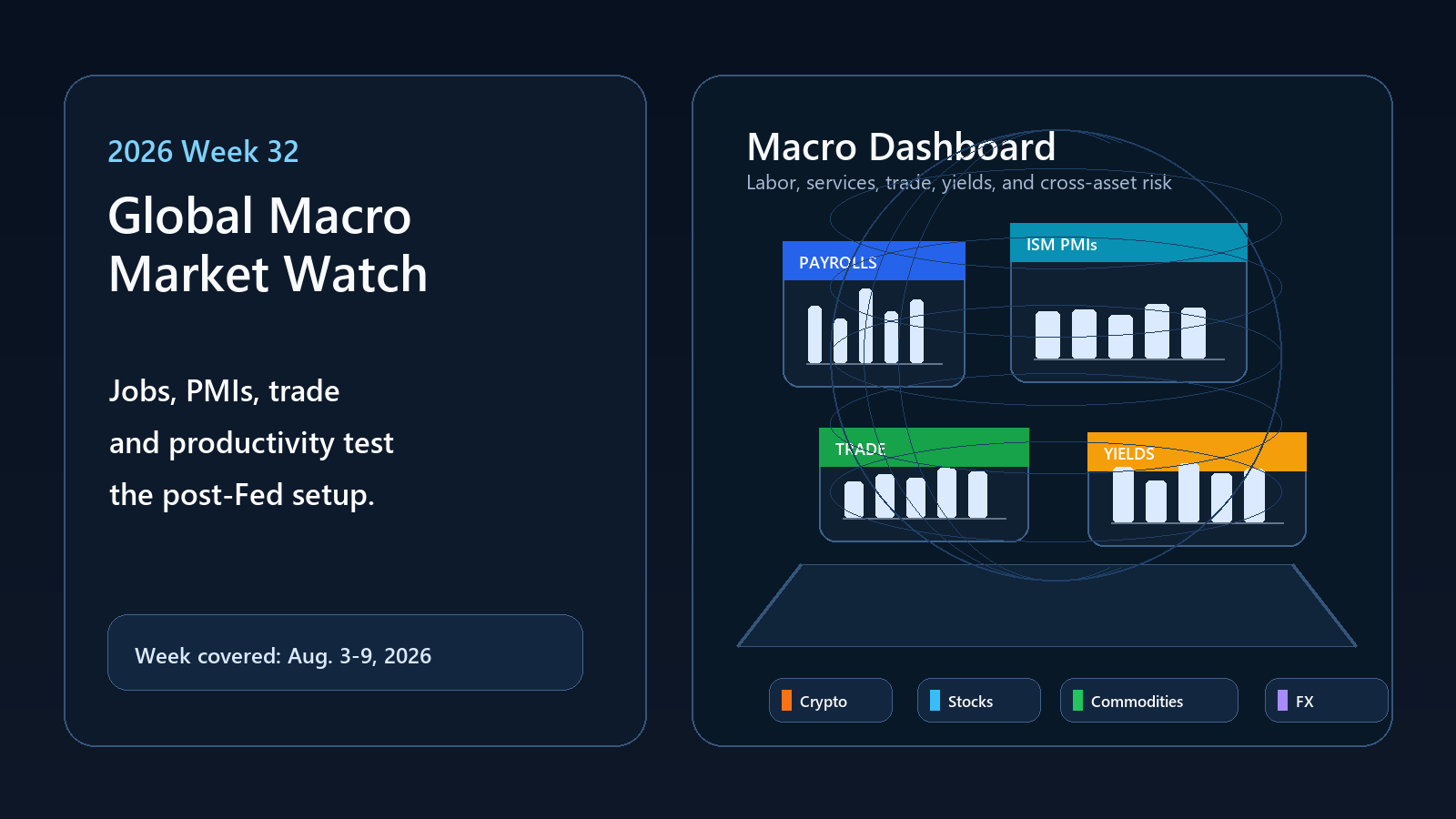
The better lens is not one release. It is a dashboard. JOLTS gives the labor-demand read. Payrolls give the employment and wage read. Productivity and unit labor costs connect growth to inflation pressure. ISM PMIs show whether manufacturing and services are expanding, contracting, or passing through costs. Trade data and China-linked demand signals tell commodity and FX traders whether global activity is broad enough to support risk.
The week is a test of interpretation, not just data
The same number can send different signals depending on the surrounding mix. A softer payrolls report can help if it lowers rate pressure without raising recession fear. It can hurt if it looks like layoffs are spreading. A strong services PMI can support earnings and cyclical stocks, but it can pressure bonds and crypto if the price components look sticky.
That is why Week 32 belongs to cross-asset interpretation. Crypto traders should watch the dollar and real yields. Equity investors should separate earnings resilience from higher discount-rate risk. Commodity traders should ask whether demand is improving or only supply is tightening. FX traders should watch whether the dollar is moving because of U.S. strength, global stress, or relative policy.
Global Macro Calendar for August 3-9, 2026
| Date | Region | Scheduled Event | Market Relevance |
|---|---|---|---|
| August 3 | United States | ISM Manufacturing PMI and construction spending | Tests factory demand, input prices, employment, industrial stocks, copper, and Treasury yields. |
| August 4 | United States | JOLTS and factory orders | Shows labor demand and whether goods activity supports or weakens the growth story. |
| August 5 | United States | ISM Services PMI, ADP private employment, and international trade | Services inflation, hiring, imports, and exports are central to Fed patience and risk-asset duration. |
| August 5 | Canada | International merchandise trade and services trade | Matters for CAD, North American demand, energy-linked FX, and trade-sensitive equities. |
| August 6 | United States | Productivity and costs, wholesale trade | Unit labor costs can reshape the inflation debate even before CPI arrives the following week. |
| August 7 | United States | Employment Situation for July | The week’s main labor-market event for yields, USD, equities, gold, and crypto. |
| August 7 | Canada | Labour Force Survey for July | A North American labor check that can move CAD and rate expectations. |
| August 7 | Japan | Household spending / family income and expenditure | A demand signal for yen, Japan equities, BOJ expectations, and Asia risk sentiment. |
The U.S. Labor Sequence Is the Main Event
The week ends with the July payrolls report, but labor risk begins earlier. JOLTS is scheduled for August 4, giving markets a look at job openings, quits, hires, and separations for June. It is less dramatic than payrolls, yet it often matters because it shows whether labor demand is cooling before the headline employment report confirms it.
Payrolls on August 7 will carry the bigger market weight. Traders will watch job growth, unemployment, participation, average hourly earnings, and revisions. A report that shows slower hiring but contained wage pressure would fit the soft-landing playbook. A report that shows sharply weaker hiring could raise recession risk. A report with firm wages and resilient job growth could push yields higher and challenge liquidity-sensitive assets.
Payrolls can reprice the post-Fed trade
The post-Fed setup matters because payrolls can either validate or undermine the market's first reaction to the July meeting. If investors leave the Fed decision expecting patience, a clean labor-cooling report could reinforce lower-yield trades. That would usually help long-duration equities, gold, and crypto, provided the growth signal does not look too weak.
The tougher outcome is a report that is neither cleanly strong nor cleanly soft. Sticky wages with slowing hiring can be awkward because it weakens the growth story while leaving inflation pressure alive. That mix is often harder for risk assets than either a simple strong-growth print or a simple disinflationary cooling print.
PMIs Will Show Whether Growth Is Still Broad Enough
The ISM calendar gives Week 32 two major forward-looking checks. Manufacturing is due on August 3 and services on August 5. Manufacturing matters for commodities, industrial shares, transport, semiconductors, and global trade sentiment. Services matters more directly for inflation persistence because services activity, wages, and prices have been central to the central-bank debate.
Markets will not only watch the headline PMI levels. New orders, employment, supplier deliveries, inventories, and prices paid can all change the interpretation. A soft headline with falling prices can support bonds and growth stocks. A soft headline with still-high price pressure is less helpful. A firm headline with cooling prices is the best version for risk appetite because it implies resilience without renewed inflation pressure.
Services are the rates-sensitive signal
Services PMI may matter more than manufacturing for the Fed reaction. The U.S. economy is heavily services-driven, and services inflation has historically been more tied to wages and domestic demand. If services activity remains firm while price pressure cools, the soft-landing trade gets a stronger foundation.
If services prices accelerate, the market may become less willing to believe that inflation risk is fading. That can lift Treasury yields and the dollar, which is usually a tougher backdrop for Bitcoin, Ethereum, gold, and high-multiple equities. For stocks, the sector split matters: cyclicals may like stronger activity, while long-duration growth may dislike the rate response.
Productivity and Trade Can Change the Inflation Story
Productivity is easy to overlook, but in Week 32 it deserves attention. The preliminary second-quarter productivity and costs report is scheduled for August 6. If productivity improves, the economy can potentially grow without creating as much unit labor cost pressure. That is a constructive combination for margins, inflation, and risk appetite.
If unit labor costs look firm, the story changes. Higher labor cost per unit of output can make the inflation path look stickier even if headline activity is cooling. That would put more pressure on the following week’s CPI release and make the bond market less comfortable with a simple disinflation narrative.
Trade data arrive in the middle of the week. U.S. international trade data for June are scheduled for August 5, alongside Canadian trade releases. Trade can matter through several channels: import demand, export strength, tariff effects, goods inflation, shipping, and the dollar. A widening deficit can signal strong domestic demand, weaker export competitiveness, or price effects depending on the details. A narrowing deficit can be constructive or defensive, depending on whether it comes from stronger exports or weaker imports.
China, Canada, and Japan Add the Global Demand Layer
Week 32 is not only a U.S. week. China-related PMI signals around the turn into August will frame the demand outlook for copper, oil, miners, Asia equities, AUD, CNH, and global manufacturing sentiment. If China activity looks firmer, commodities and cyclicals can get support. If it disappoints, traders may question whether the global growth story is too dependent on the U.S.
Canada adds another North American labor and trade check. The Labour Force Survey for July is scheduled for August 7, the same day as U.S. payrolls. That can matter for CAD, Canadian yields, and energy-linked equity sentiment, especially if U.S. and Canadian labor signals point in the same direction.
Japan’s household spending data, also scheduled for August 7, gives markets a domestic-demand read after a period in which yen moves, inflation, and BOJ expectations have carried global relevance. Stronger spending can support the case that Japanese demand is becoming more durable. Weak spending can complicate the outlook if inflation is still squeezing real consumption.
FX is the transmission mechanism
The dollar, yen, Canadian dollar, Australian dollar, and offshore yuan can reveal how markets are reading the week before equities or crypto fully adjust. A softer dollar tied to lower rate pressure and stable growth is generally supportive for crypto, gold, and global equities. A stronger dollar tied to U.S. outperformance can be mixed. A stronger dollar tied to stress is usually more defensive.
The yen deserves special attention because it can affect global carry trades. A yen rally caused by risk aversion or BOJ repricing can tighten conditions outside Japan. That can pressure leveraged trades across equities, crypto, and emerging markets even if the original data release is not directly about those assets.
Market Impact Map
The cleanest risk-on version of Week 32 would combine moderate U.S. labor cooling, services resilience, softer price components, improving productivity, stable trade data, and no negative surprise from China demand. In that setup, Treasury yields could stay contained, the dollar could soften, crypto could hold risk appetite, and stocks could lean on the idea that earnings can survive a slower but not broken economy.
The risk-off version would look different: weaker payrolls with sticky wages, services prices that refuse to cool, firm unit labor costs, disappointing China demand, and defensive FX behavior. That mix would leave markets with less growth confidence and less comfort on inflation. It would be especially difficult for assets that need liquidity and confidence at the same time.
| Signal | Constructive Reading | Defensive Reading |
|---|---|---|
| U.S. payrolls | Slower hiring, stable unemployment, softer wages | Layoff risk, bad revisions, or sticky wage pressure |
| ISM services | Firm activity with cooling price components | Sticky services prices or weakening employment |
| Productivity and costs | Better productivity, contained unit labor costs | Cost pressure that keeps inflation concerns alive |
| Trade data | Stable demand and healthier export/import mix | Weak imports from demand stress or tariff-driven price pressure |
| China demand | Firmer PMI signal supports commodities and Asia risk | Weak activity pressures copper, AUD, CNH, and cyclicals |
| FX reaction | Softer dollar from lower yields and stable growth | Stronger dollar or yen from stress and position unwind |
What Traders Should Watch Next
The most important Week 32 question is whether the data confirm each other. If payrolls cool, PMIs hold, productivity improves, and the dollar eases, markets can treat the week as a soft-landing confirmation. If labor weakens while unit labor costs stay firm and services prices remain sticky, the signal is much less friendly.
Crypto traders should watch whether Bitcoin and Ethereum respond to lower yields with actual spot demand, not only leverage. Equity traders should watch the split between cyclicals and long-duration growth. Commodity traders should watch whether copper confirms China demand while crude follows its own supply and inflation channel. FX traders should watch whether USD and JPY are moving as risk signals or as relative-rate trades.
Week 32 may not have the drama of a Fed decision, but it has the next thing that matters: proof. The market will already have the policy message. Now it needs evidence that labor, services, costs, and global demand can support the story investors want to trade.
Trade with an Edge
In fast-moving markets, execution matters just as much as direction. That’s why more traders are turning to decentralized venues like edgeX for perpetuals and spot trading.
Unlike traditional centralized platforms, edgeX is built around self-custody, meaning you keep control of your assets and authorize fund movements yourself. For active traders, that offers a meaningful advantage: market access without handing custody to an exchange.
edgeX also combines the core benefits of DeFi with a trading experience designed for serious execution. The platform emphasizes deep liquidity, high-speed order matching, and low-slippage performance, helping traders stay responsive during volatile conditions. With support for high leverage, it gives experienced market participants more flexibility in how they express macro views and manage risk.
Beyond execution, decentralized trading infrastructure can offer structural advantages: greater transparency, on-chain verification, and reduced dependence on centralized intermediaries. For traders who want performance without giving up control, that model is increasingly compelling.
edgeX is built for that balance: bringing together a professional trading experience with the core principles of decentralized markets.
For readers looking to explore a more capital-efficient, self-custodial way to trade, edgeX is worth a closer look.
Frequently Asked Questions
What is the most important macro event in Week 32 of 2026?
The U.S. July Employment Situation report scheduled for August 7 is the main event because it can move Treasury yields, the dollar, equities, gold, and crypto. ISM services on August 5 and productivity and costs on August 6 are also important because they affect the inflation and growth interpretation.
Why does JOLTS matter if payrolls come later in the week?
JOLTS gives a labor-demand view through job openings, hires, quits, and separations. It can show whether employers are pulling back before that shift appears in payroll growth or unemployment.
How can productivity data affect markets?
Productivity matters because stronger output per hour can reduce unit labor cost pressure. That can support margins and make inflation look easier to control. Weak productivity with rising labor costs can do the opposite.
Why include Canada and Japan in a global macro watch?
Canada gives a North American trade and labor signal that can affect CAD and energy-linked markets. Japan household spending matters because yen moves, BOJ expectations, and Japanese demand can influence global risk sentiment.
What should crypto traders watch during Week 32?
Crypto traders should watch Treasury yields, the dollar, ETF demand, spot volume, and liquidation levels around the major releases. A macro-friendly headline can still fail if the move is driven only by leverage rather than durable demand.

