Mauldin: Long-Term Rates, Housing Prices and the Fed’s Limited Control
Key Takeaways
- •Mauldin says the Fed can control short-term rates more directly than long-term Treasury and mortgage yields.
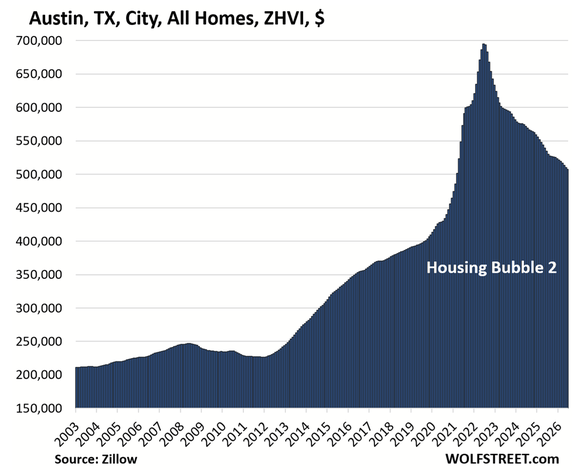
- •Wolf Richter’s data showed mid-tier home prices were below prior peaks in 28 of 33 large expensive cities, with Austin down 27%.
- •Pandemic-era Fed purchases of mortgage-backed securities helped lower mortgage rates and contributed to a lock-in effect that limited housing supply.
- •Realtor.com data cited by Mauldin showed 50.6% of outstanding mortgages still had rates of 4% or lower, while 21.9% were at 6% or higher.
- •Mauldin expects the FOMC may begin reducing the Fed’s balance sheet and says a 25 basis point rate increase would not surprise him.
Mauldin: Long-Term Rates, Housing Prices and the Fed’s Limited Control
John Mauldin of Mauldin Economics argues that Federal Reserve policy remains one of the most powerful forces in the U.S. economy, but its influence is uneven. In his latest letter, Mauldin says the Fed has deep control over short-term interest rates and overnight bank liquidity, while its ability to direct long-term yields, including mortgage and Treasury rates, is far more limited and more complex.
That distinction matters because long-term credit finances long-term economic growth and is central to the U.S. housing market. For many Americans, a home is their most valuable asset, and home equity is often part of retirement planning. Mauldin says that becomes a problem when expected equity proves smaller than homeowners anticipated. Mortgage rates also feed directly into monthly affordability, so the same house price can carry very different costs depending on the long-term rate environment.
The letter focuses on the interaction among long-term interest rates, the Fed’s limited ability to influence them, inflation and the housing market. Mauldin begins with recent housing price changes before turning to what he views as the Federal Reserve’s likely response.
Housing Prices and the Question of a “Superbubble”
Mauldin notes that whether housing price inflation is good or bad depends on whether someone is buying or selling. Rising prices benefit existing homeowners while making homes less affordable for buyers. Falling prices help buyers but hurt sellers.
He also stresses that home prices are linked to many other costs, including construction materials, skilled labor, fuel, insurance, taxes and interest rates, which he describes as the price of money. Inflation across those categories helped push home prices higher in recent years. More recently, prices have stabilized or fallen in many areas.
Mauldin cites Wolf Richter’s review of 33 large and expensive housing markets. Richter wrote: “Prices of mid-tier homes in June were down from their respective peaks in prior years in 28 of the 33 big and expensive cities we follow here, led by Austin (-27%), Oakland (-25%), New Orleans (-19%), Washington D.C. (-13%), Denver (-13%), Phoenix (-11%), Fort Worth (-10%), and Portland (-10%). All of the prices are seasonally adjusted.”
Austin, Mauldin says, illustrates the scale of the move. Home prices there rose almost vertically during the COVID era and are now down 27% over the last four years. Richter calls the period after 2020 “Housing Bubble 2.” Mauldin says that description may not be strong enough for Austin, where the 2005-2008 housing bubble appears small by comparison. He suggests the more recent episode could be called a “Superbubble.”
The pullback is less dramatic but still significant in cities such as Phoenix, where prices are down 11%. Mauldin says Phoenix is more typical: it saw a large post-COVID surge, followed by a correction that has been meaningful but not dramatic. He adds his personal view that much of U.S. housing still has more correction ahead.
The data cited by Richter uses the Zillow Home Value Index, or ZHVI, which includes single-family homes, condos and co-ops and draws on transaction data from public records. As of June 2026, 25 of the 33 cities in the report had year-over-year price declines. Eight cities recorded increases, including New York, Chicago and San Francisco. Mauldin says this underscores the familiar principle that “all real estate prices are local,” with New York’s dynamics differing from those in Austin or Dallas.
Condo Prices Under Pressure
Mauldin also highlights weakness in the condominium market. He says 65.8% of Americans owned a home as of 2025, while about 27% of people in the U.S. lived in a condo or homeowners association property.
According to Wolf Street, “Condo prices fell by 15% to 33% in 30 bigger cities, and in some cities prices have fallen back to 2006 levels. In another 39 bigger cities, condo prices fell by 8% to 14%. A massive hangover after a historic Condo Bubble.”
Mauldin notes that some cities did not experience large price increases during the first housing bubble. In those markets, the price shock came later, and prices are still falling. Austin is again one example, with condo prices down 28%.
The Fed, QE and the Mortgage Lock-In Effect
Across much of the country, Mauldin says home prices are below their peaks but still well above where they were before the COVID-era Federal Reserve sought to support the economy by driving mortgage rates lower.
He says the mechanism was quantitative easing, or QE. In this case, the Fed bought large quantities of mortgage-backed securities. Those purchases raised bond prices and reduced their yields, with lower yields passing through to mortgage borrowers. Mauldin points to the sharp increase in the Fed’s mortgage-backed securities portfolio beginning in 2020.
He describes the roughly $1.4 trillion infusion as having the intended effect, even more dramatically than the original QE rounds that began in 2009. The earlier amount was similar, he says, but it took place over about six years rather than two.
When creditworthy Americans were able to lock in 30-year mortgages at rates as low as 2%, many did so. Home prices rose sharply in 2020 and 2021, then moved higher again in 2022 and after, as the effects of the Ukraine war pushed rates higher from very low levels and made new construction more expensive.
Mauldin says the unintended side effect was the mortgage “lock-in” effect. Homeowners with very low mortgage rates became reluctant to sell because buying another home would require taking out a loan at a much higher rate. That reduced the supply of homes for sale. With supply reduced and demand rising or flat, prices remained elevated.
The lock-in effect is not permanent, Mauldin says. Homeowners may be reluctant to sell, but life events still occur: death, divorce, moves to nursing homes, better jobs and other changes. As a result, the share of mortgages with very low rates has been falling slowly over the past four years, helping prices ease.
Realtor.com data cited by Mauldin shows that mortgages with rates below 3% and from 3% to 4% rose sharply in 2020 and 2021. Both categories are now declining slowly, while the share of mortgages at 6% or higher is rising.
Realtor.com wrote: “Altogether, just over half of outstanding mortgages (50.6%) still carry rates of 4% or lower, and roughly 78% have a rate below 6%. The 6%-or-higher share now stands at 21.9%, up 3.9 percentage points from Q4 2024’s 18.0%, a meaningful year-over-year acceleration driven by sustained buyer activity despite elevated borrowing costs.”
It added: “The share of homeowners holding a mortgage with a rate of 6% or higher increased nearly 4 percentage points between Q4 2024 and Q4 2025, as buyer activity carried on despite high rates. Even in today’s high-price, high-rate market, homebuying activity around major life events, such as having kids, a job change, or a divorce, keeps the market in motion. Easing inflation and mortgage rates will be key drivers of seller activity as well, which will relieve some of the price pressure and competition in today’s undersupplied market…”
Realtor.com further said: “While roughly 78% of outstanding mortgages still carry rates below 6%, indicating that the rate lock-in remains substantial, the steady quarterly erosion of the sub-4% cohort and the accelerating growth of the 6%-plus population suggest the market’s center of gravity is gradually shifting. The question for 2026, now complicated by renewed rate volatility tied to geopolitical uncertainty, is whether relief arrives fast enough to unlock reluctant sellers before another spring season slips by.”
Mauldin describes this as an example of the market’s “invisible hand” correcting what he calls the Fed’s policy mistake, though at significant cost and over time.
Inflation, Long-Term Rates and a “Considerable Lag”
Mauldin says calls for the Fed to fix housing inflation overlook the central bank’s role in causing it. He says the Fed was a prime contributor to housing inflation and inflation more broadly, even if its actions were taken with good intentions.
He says the new Fed under Kevin Warsh is unlikely to launch new QE-style programs or otherwise try to influence long-term rates, except by reducing the Federal Reserve’s active balance sheet. Mauldin says Warsh appears willing to let the market go where it wants, which this year has often meant higher rates. He adds that the trend has continued since 2022, with the 30-year Treasury yield nearly back to where it was in 2007.
Long-term Treasury yields are shaped by more than the Fed’s overnight policy rate. Inflation expectations, expected future short-term rates, Treasury supply and demand, and the term premium all affect the long end of the curve. That is why Mauldin treats the central bank’s balance sheet as important but not as a simple lever that can set mortgage rates by decree.
Mauldin also cites economist Lacy Hunt, who this year reversed his long-held lower-rate stance. In a quarterly report this month, Hunt said the structures that produced global disinflation from 1990 to 2020 have eroded. Mauldin says Hunt primarily means globalization, which lowered prices through a long-term disinflationary trend, alongside supply shocks from Russia, mainly energy, and China and Asia, which affected a wide range of goods.
Hunt now expects persistently higher inflation and interest rates, Mauldin says, and believes the Fed has aggravated the situation by injecting more liquidity this year.
Mauldin says he expects the Federal Open Market Committee at its meeting next week to at least stop increasing the balance sheet and more likely begin reducing it. In a private group conversation, Hunt told Mauldin he believes balance sheet reduction would have more impact than simply raising rates, though both actions may occur.
According to Mauldin, Hunt believes the recent increase in the Fed’s balance sheet was the main driver of higher inflation over the past year. Mauldin says former Chair Jerome Powell did not cut rates as Donald Trump wanted, but did sharply increase the balance sheet.
Hunt thinks the Fed’s $290 billion in Treasury bill purchases since last December may explain why inflation began accelerating in February, before the Iran war produced an energy shock. Typically, when the Fed buys bonds and banks receive more cash, that money appears as excess reserves. This time, Mauldin says, banks increased lending across many sectors, which helped spur inflation — the classic case of too much money chasing too few goods.
Hunt wrote: “Chairman Warsh inherits an immediate situation where money growth needs to materially slow if Fed policy is to avoid reinforcing inflationary momentum. The challenge is that the short-run financial effects of balance sheet reduction may differ substantially from the longer-run inflation effects. Markets that have become accustomed to abundant liquidity may initially experience tighter financial conditions, while the eventual disinflationary benefits of monetary restraint may emerge only with a considerable lag.”
Mauldin says raising short-term rates, which he says may happen next week, is unlikely to solve the larger problem. A serious effort to fight inflation would run directly into markets that have benefited from the status quo.
Rosenberg’s Recession Concern
Mauldin notes that economist Dave Rosenberg disagrees with Hunt’s latest call. Rosenberg believes a hawkish Fed could trigger the recession he has long expected.
Rosenberg wrote in response to Hunt: “Tightening into a sub-2% growth environment with nominal wage growth easing and stable inflation expectations would be both a weird and irresponsible move. But the Fed has talked the markets into pricing in not just one but two moves in the next year. What the Fed has really caused here is a major communications problem before there has been any reason for a shift in the actual policy stance.”
Rosenberg added: “The situation has been compounded by the framework change. Removing forward guidance and reinforcing price stability twelve times in one press conference transfers uncertainty into the term premium rather than into the policy rate. You're seeing the cost in a steeper and higher yield curve — the long end is absorbing volatility that the Fed used to absorb through guidance. But the real risk runs the other way at this point, for if the labor data continue to deteriorate on the June trajectory, and a Fed that has spent the summer talking about price stability thinks it must deliver or risk its credibility — well, this is the policy error that produces the recession nobody expects.”
Mauldin says Hunt acknowledges the possibility of recession in his writing and private conversations. Hunt wrote in a recent piece that “absent a sustained recession, a favorable supply-side shock, or a prolonged period of monetary restraint, the broader structural backdrop ... suggests inflation and Treasury yields will trend upward.” Mauldin says Hunt does not believe reduced forward guidance increases volatility at the long end of the yield curve.
Bahnsen on Globalization, Debt and Inflation
Mauldin also cites David Bahnsen’s latest Dividend Cafe analysis of Hunt’s inflation thesis, saying he agrees with Bahnsen’s view.
Bahnsen wrote: “Dr. Hunt has been a long-time proponent of the view (which I share) that the long-term inflation range has been compressed by the twin effects of fiscal and monetary policy interventions. I refer to this dynamic as ‘Japanification’ and argue both from history and economic theory that excessive government indebtedness, followed by the elixir they use to treat it all (fiscal and monetary interventions), puts downward pressure on economic growth, and in that sense is either disinflationary (best case) or deflationary (Japan's generational experience). Regardless of the outcome to the price level, the impact on both nominal and real growth is erosive, and undermines the economic potential of a country (such as ours).”
Bahnsen continued: “Lacy has recently argued that the structural range of U.S. inflation is likely to move higher after 30+ years of this lower equilibrium range due to a ‘steady erosion of the disinflationary architecture that dominated the 1990-2020 period.’ He frames his argument for a new inflation range around the death of globalization.”
Bahnsen summarized the argument as follows: globalization accounted for the prior period’s disinflation; globalization is dying; therefore, the prior period’s disinflation will be gone.
He wrote that the first premise, that globalization ushered in much of the disinflation of his adult lifetime, is connected to the fall of the Soviet Empire and the rise of China on the world stage. Hunt, Bahnsen noted, called this “one of the largest positive supply shocks in modern economic history.” Bahnsen also cited “falling capital costs, low-cost energy, and rapid technological diffusion” as forces that “reinforced productivity growth and expanded productive capacity.”
Bahnsen said he and Hunt would both refer to this as non-inflationary growth, and that it explains much of the 1990-2006 environment. The aggregate supply curve shifted outward, he wrote, absorbing excess liquidity while enabling disinflation in goods prices.
But Bahnsen said globalization did not occur in isolation. At the same time, major economies increased debt substantially. As Hunt has argued, Bahnsen wrote, this “diverts income away from consumption and restrains aggregate demand growth.” Bahnsen described that outcome as both distortive and contractionary and said it reflects Hunt’s broader contribution to economic analysis: explaining how excessive debt affects prices, liquidity and growth.
FOMC Uncertainty and Mauldin’s Outlook
Mauldin says no one outside the few members of the FOMC truly knows what will happen at next week’s meeting. He personally expects the Fed to begin reducing the balance sheet and says he would not be surprised if it raised rates.
He says Warsh is in an extraordinarily difficult position and must credibly demonstrate both his own independence and the Fed’s independence, as well as his stated determination to control inflation. Mauldin says a 25 basis point rate increase would accomplish both. In his view, acting now would establish Warsh’s credibility and could mean the Fed has to do less in 2027.
Mauldin expects bond markets could move sharply for a short period, but says that once market participants understand Warsh is focused on lowering inflation, long-term rates would come down. He also says inflation would eventually fall below 2%, with mortgage rates declining correspondingly.
Whatever Warsh does, Mauldin says, he will face significant criticism. Mauldin says Warsh should do what he believes is necessary, while everyone else must adjust. Mauldin adds that he has always been, and remains, an inflation hawk.
For readers following the issue, the next measurable signals are not only the headline policy rate but also any decision on the Fed’s balance sheet, the pace of Treasury and mortgage-backed securities runoff or purchases, and the response at the long end of the yield curve. Those details are central to Mauldin’s argument that housing affordability and long-term rates are tied to forces the Fed can influence, but not fully command.
Mauldin closes by noting that he plans to travel to Philadelphia for a business meeting in the first week of August and to Washington, DC, the week after the midterm elections for an Inner Circle meeting.
Original source: https://goldseek.com/article/long-term-rate-headache
Official website:

