The Architecture of Money: Mapping Financial Power in the Age of Bitcoin
Key Takeaways
- •The Waterworks of Money was developed over two years of research, drawing on interviews with more than 100 experts from banking, government, academia, and monetary reform movements.
- •The collaborators argue that banks create new money when issuing loans, a mechanism that even a major bank CEO interviewed during the research did not fully understand.
- •Thomas Bollen states that years of extremely cheap credit allowed wealthy households and large multinationals to profit from asset inflation, deepening inequality for those without assets or comparable access to credit.
- •Martijn Jeroen van der Linden contends that post-2008 banking reforms repaired rather than structurally changed the system, with fragility resurfacing in the 2023 failures of Silicon Valley Bank and Credit Suisse.
- •Bollen likens bitcoin's design to full reserve banking, citing the Amsterdamsche Wisselbank's collapse after abandoning full reserves, while van der Linden notes that institutional investment has weakened bitcoin's promise as an alternative payment system.
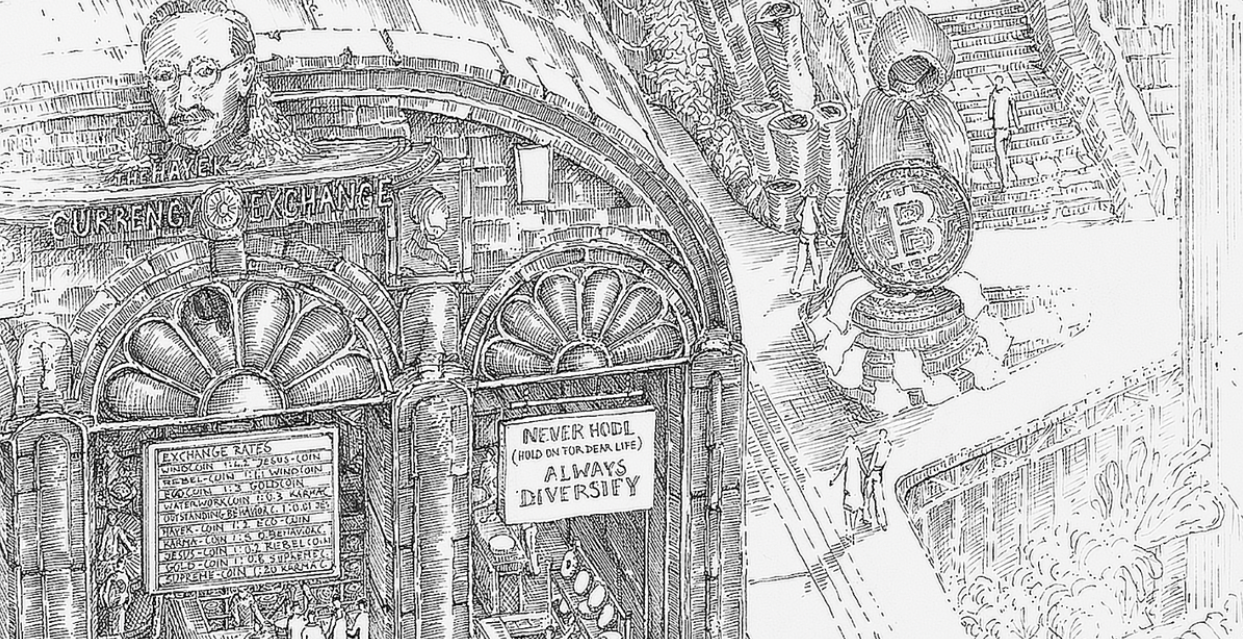
Money shapes where people live, what they can afford, and how wealth accumulates across generations. Yet the mechanisms that create and distribute it remain largely occluded, even as their consequences become increasingly difficult to ignore. For Dutch artist Carlijn Kingma, investigative financial journalist Thomas Bollen, and monetary researcher Martijn Jeroen van der Linden, that disconnect became the impetus for The Waterworks of Money. The ambitious project maps the hidden architecture of the financial system through drawing and animation, rendering it understandable to the people living within it without flattening its complexity.
The Waterworks of Money depicts the financial system as a vast network of reservoirs, channels, and pumps, revealing how money moves through banks, governments, businesses, and households. Some areas receive an abundance of liquidity, while others remain perpetually dry. The resulting drawing operates simultaneously as an artwork, an educational tool, and an examination of financial power.
The project emerged from two years of research, including interviews with more than 100 experts across banking, government, academia, and monetary reform movements. Kingma spent more than 2,200 hours translating that research into an intricate architectural landscape. Bollen, whose investigative journalism examines the workings of the financial system, and van der Linden, whose academic research explores money and monetary reform, helped develop the economic research and narratives behind the work.
One of the project's scenarios explores a monetary future shaped by bitcoin. As bitcoin enters traditional finance, an alternative monetary system either challenges existing structures of financial power or eventually becomes part of them — and the project's collaborators have watched both happen.
Ahead of Bitcoin Amsterdam, November 5–6, where Bollen joins two panels, Bitcoin Magazine sat down with all three of the project's collaborators to discuss making money visible, the relationship between monetary systems and inequality, and bitcoin's place in Europe's financial future.
What the Public Misunderstands About Money
Bitcoin Magazine (BMAG): The Waterworks of Money illustrates the financial system as a network of reservoirs, pumps, and channels, with some parts of society receiving abundant liquidity while others remain dry. After two years of research and interviews with financial experts, what surprised you most about how money actually works, and what does the public most fundamentally misunderstand about it?
Thomas Bollen: What surprised me most is that many people inside the system know a great deal about their own corner of it — interest rate derivatives, asset management or mortgage lending. Very few of them can oversee the larger system in which they operate.
What is clearly not well understood is that banks create new money when they make a loan. They are not just intermediaries that pass on the savings of their depositors.
But can you blame ordinary people for that? During the research phase we spoke to many bankers, and even a CEO of a major bank, who did not know they were working for a money-creating institution.
If we want to improve understanding, we should start at our schools and universities. Many textbooks still get it wrong, and economics education hardly pays any attention to it. In 2022, even the Riksbank's prize in economics (the Nobel prize that is not really a Nobel prize) was awarded for research that presents banks as mere intermediaries.
Cheap Credit and Asset Inflation
BMAG: One of the central ideas in The Waterworks of Money is that money doesn't flow evenly through society. Housing affordability has become a major issue in Europe and the United States, while asset prices and financial wealth have increasingly outpaced wages. How much of this inequality results from the design of our monetary system, rather than broader economic forces?
Bollen: It is impossible to capture that in a precise number, because so many factors play a role. But it is quite clear that the money system exacerbated inequality enormously during all those years when credit was extremely cheap.
Ray Dalio, founder of the hedge fund Bridgewater Associates, summed it up in 2019: "Money is free for those who are creditworthy." For everyone without money or creditworthiness, it was out of reach.
Cheap credit for rich people and large multinationals — who used it for share buybacks and M&A deals — drove up the price of shares, and of houses. Bank money creation produced a specific kind of inflation: asset inflation. Wealthy households and large multinationals, who already owned those assets, profited far more from it than people without them, or small businesses that did not have the same kind of access to cheap credit as their larger competitors.
The Challenge of Drawing the System
BMAG: The Waterworks of Money is filled with details that help explain how the financial system works. What was the most difficult part of the monetary system to illustrate, and did anything learned during the research change the approach to the drawing?
Carlijn Kingma: The biggest challenge was the way all the parts are connected. How do you show that clearly?
Water is the obvious metaphor for money, and it takes you a long way. Liquidity, cash flows, money drying up — they are already in the language of finance. It was also great for connecting the different parts of the system, because I could draw the pipes and canals that run between them.
But in some places you need more than that if you want to be completely accurate. Money comes in many forms: commodity money, public money, private credit money, and further out short-term debt and repo contracts can also serve as money or near-money. It was not possible to draw that many different kinds of water running through the system.
Art as a Doorway to Complex Ideas
BMAG: The work has been shown to both art audiences and people interested in economics, including at Bitcoin Amsterdam last year. Have you noticed differences in how these audiences respond, and has their feedback influenced how you think about the role of art in explaining complex ideas?
Kingma: The response depends on what people already know. Visitors with more financial knowledge usually laugh more, because they catch all the small jokes. We renamed Basel III to "Babel III," for instance, because the bank rules written after the crisis add up to about three bibles.
In our bitcoin future scenario, The Republic of a Thousand Coins, we put in a lot of jokes about central bankers. You can see Alan Greenspan there as an inflatable doll. That works best if you know who he is, and the bitcoin crowd knows far more about monetary history than the general public.
Above all, we noticed that art opens doors. The drawing gives people a visual starting point for a conversation. Even without any prior knowledge, the metaphor lets you see the social outcomes of how money flows.
Repair Without Reform
BMAG: Your research has examined how financial crises can reinforce the influence of institutions considered too important to fail, and more recently the growing power of asset managers such as BlackRock and Vanguard. Are we witnessing a genuine transformation in how financial power operates, or have the same underlying problems simply taken new forms since 2008?
Martijn Jeroen van der Linden: Following the crisis of 2008, there was a general consensus among mainstream policymakers, think tanks and many economists that the banking sector needed to be repaired. In Europe, the influential de Larosière Group concluded that the causes of the crisis were excessive leverage, opaque securitisation, shadow banking risks, and fragmented supervision in the EU, and argued that "repair is necessary and urgent." The banking repair consisted of new and stricter regulations, stronger coordinated supervision and new crisis management procedures. The underlying architecture remained unaltered, meaning that fundamental change never occurred.
But the architecture remained fragile. Take 2023, for example. When Silicon Valley Bank and Credit Suisse got into trouble, the crisis playbooks developed after 2008 stayed in the drawer. The US authorities guaranteed all SVB deposits, including the more than 90 percent above the insured limit. In Switzerland, the state backed the rescue of Credit Suisse by UBS.
Advocates of banking repair often claim to have made the system safer. But the fragility of funding long-term loans with runnable bank deposits is still there. Even with all the regulation, you cannot prevent a bank run, and that fragility is precisely what they refuse to solve. The banking system only survives because of massive public safety nets and privileges given to banks.
Large powerful non-banks have indeed emerged, but they do not play a pivotal role in money and payments. This is a key distinction between the two sectors.
Bitcoin Between Alternative and Establishment
BMAG: Bitcoin began as an attempt to create money outside the control of governments and banks. Today, it is increasingly held through investment funds and traditional financial institutions, including some of the same powerful asset managers examined in your recent work. Does this integration strengthen bitcoin's ability to change the financial system, or risk reproducing the concentration of power it originally sought to challenge?
van der Linden: As a financial asset, bitcoin has benefited from investments from traditional financial institutions. But the increasing use of bitcoin as an investment has compromised its promise of an alternative payment system.
At the same time, bitcoin and the rise of stablecoins have challenged the banks on their payment infrastructure. The banks are now innovating too: look at Wero, the payment wallet that a group of European banks launched in 2024. That is a change. But it is something different from the structural reform of money and banking.
The distinction between bitcoin as a financial asset and bitcoin as a payment alternative is therefore central to the project's question about financial power. The examples of institutional investment, stablecoins, and Wero show different ways in which monetary innovation can interact with existing financial infrastructure without necessarily changing its underlying structure.
Lessons From Amsterdam's Monetary History
BMAG: The project imagines bitcoin as an alternative to the existing monetary system. Amsterdam also has a remarkable history of monetary experimentation, from the development of modern financial institutions to David Chaum's pioneering work on private digital cash decades before bitcoin. Given that history, how do you see bitcoin's role in Europe's financial future, and has your perspective changed since the project began?
Bollen: What I appreciate about bitcoin's design is that it resembles full reserve banking. A bitcoin is not a claim on something else, so it carries no risk of a bank run. Bank deposits are: they are a promise that you can withdraw your money at any moment, while the bank can never keep that promise to all its customers at once.
We can learn a lot from our history. The Amsterdamsche Wisselbank, founded in 1609 and often seen as the world's first central bank, started out as a full reserve bank: every bank guilder was backed by coins in its vault. It went under only after it secretly began lending more and more to the Dutch East India Company.
That is the risk of every monetary experiment: it can go in the wrong direction. In the crypto world, all kinds of companies started copying the banks. They lent out their customers' bitcoins, while those customers still saw their coin balances in their accounts. Sam Bankman-Fried's FTX shows how this practice can go horribly wrong.
Event Details and Supporting the Project
Thomas Bollen will participate in two panel discussions at Bitcoin Amsterdam on November 6, 2026, on the Treasury Stage: Europe's Monetary History & Future: Austrian Economics, Banks & Bitcoin (11:00–11:30 AM), alongside Rahim Taghizadegan and Willem Middelkoop, and Staat vs. de Markt: Hoeveel Overheid Hebben We Nodig in Geld? (1:55–2:25 PM), alongside Paul Buitink and Simon Lelieveldt.
The full two-part animated exploration of The Waterworks of Money is available on YouTube, and the project can be supported by purchasing a signed, limited-edition print by Carlijn Kingma or making a donation toward its continued research at waterworksofmoney.com/buy.
The Bitcoin Museum & Art Gallery (BMAG) organizes international exhibitions, auctions, and artist collaborations exploring bitcoin and its cultural implications. More information is available at museum.b.tc.
Bitcoin Amsterdam takes place November 5–6, 2026; the code BA26-BMAG20 provides discounted admission.
This article, The Architecture of Money: Mapping Financial Power in the Age of Bitcoin, first appeared on Bitcoin Magazine and is written by Dennis Koch.

