Warsh Says Markets Are Doing the Work as Stocks Slide and Treasury Yields Jump
Key Takeaways
- •The Federal Reserve kept rates unchanged, and three members dissented in favor of a hike.
- •The S&P 500, Dow Jones Industrial Average, and Nasdaq all finished lower on the session.
- •The 10-year Treasury yield rose 9 basis points to 4.69%, while the 30-year yield climbed to 5.21%, the highest since July 2007.
- •Short-term Treasury yields fell, with the 2-month yield down 9 basis points and the 6-month yield down 8 basis points to 3.95%.
- •Warsh said the bond market has tightened financial conditions by responding to real-time data rather than Fed forward guidance.
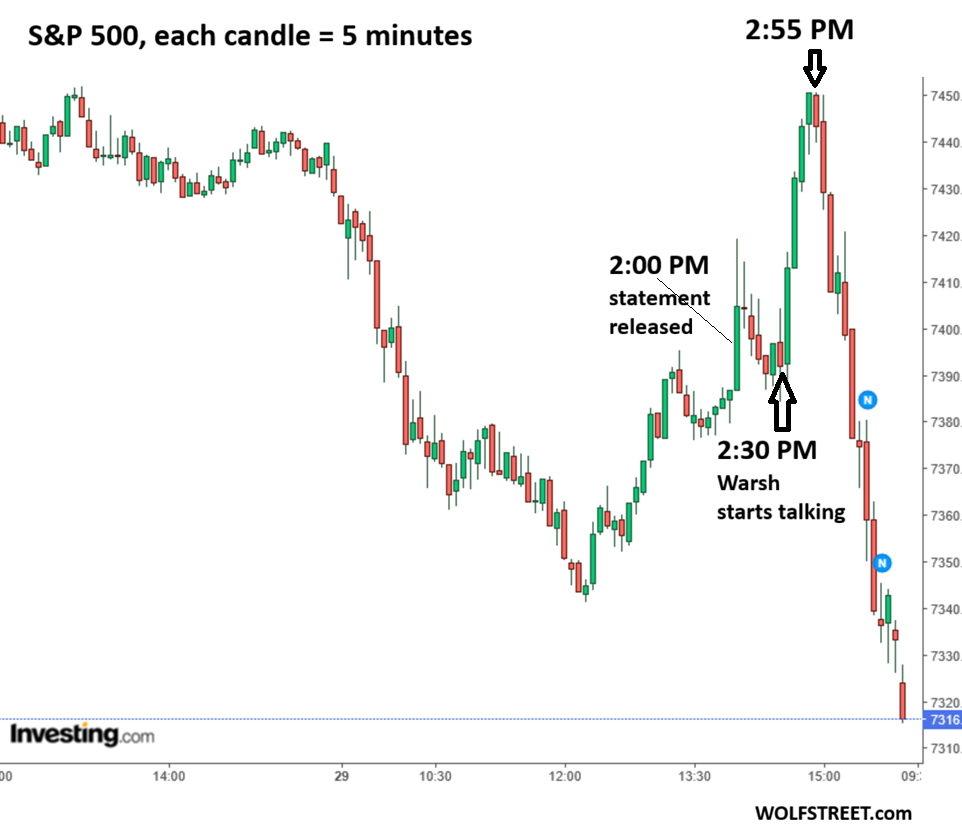
“While at some level, we haven’t done much in 42 days, the markets have done quite a bit”: Warsh
Between 2:55 p.m., about halfway through Fed Chair Warsh’s press conference today, and the market close, the S&P 500 fell 138 points, or 1.85%, in 65 minutes. The index reversed sharply from positive territory to deep red.
For the full session, the S&P 500 dropped 1.52%, the Dow Jones Industrial Average fell 2.19%, and the Nasdaq declined 1.74%.
Warsh made a clear impression during the post-FOMC press conference after the Federal Reserve left interest rates unchanged, with three members dissenting in favor of a rate hike. Even if he had preferred a hike, he was still three votes short, according to a chart by Investing.com.
Throughout the press conference, Warsh was neither overtly hawkish nor dovish. He carefully avoided anything that could be interpreted as forward guidance, offered no indication of where the Fed might take policy rates in September or later, revealed nothing about his own position, and repeatedly pushed back on reporters’ attempts to extract guidance.
What stood out, however, was his repeated and detailed emphasis on the idea that ending forward guidance was already working. He said Treasury yields had already surged since the last meeting as markets began to process data rather than the Fed’s comments, that buyers and sellers in the bond market were doing the hard work, and that markets had already raised rates and tightened financial conditions, which “has provided us some comfort that we’ve got the ability and capability to deliver.”
That matters because the yield move was not limited to one part of the curve. Treasury yields of three years and longer moved higher, with the long end spiking. The 10-year Treasury yield rose 9 basis points on the day to 4.69%. These are the rates that matter for a large part of the economy: 30-year fixed mortgage rates and most corporate bonds track the 10-year Treasury yield.
The 30-year Treasury yield jumped 12 basis points to 5.21%, the highest level since July 2007.
The Fed’s policy rates anchor overnight rates such as SOFR. Floating-rate loans and adjustable-rate mortgages in their adjustment period are affected by changes in the Fed’s policy rates through SOFR, meaning a hike would push those borrowing costs higher.
Short-term Treasury yields reflect a combination of current Fed policy rates and expected future policy rates over their maturity window. Those short-term yields fell on the day, undoing the portion of a rate hike that had been priced in for this meeting.
The 2-month yield dropped 9 basis points, reversing the remaining move from last week that had fully priced in a rate hike that did not occur. The 6-month yield fell 8 basis points to 3.95%, still pricing in one rate hike within its window, but not more than one.
Warsh on how the bond market is already doing the heavy lifting and tightening financial conditions now that it is operating without forward guidance:
“Nominal and real yields are materially higher across the Treasury curve. In fact, some of the increases in market interest rates between FOMC meetings are among the most significant in the last two decades, ranking around the top decile or so, but if the committee didn’t change its policy, what happened?
“In the intervening period, market attention centered on real data and real economic developments. Prices [of bonds] reacted in real time to incoming information, and the reduction in forward guidance may have been a factor.
“Market participants are learning to play the ball, not the referee, and market prices will continue to respond in the direction and magnitude they see fit. This is, in my view, a change for the better, and we’re just getting started…. We need to observe market reaction to developments, direct and unfiltered.”
He also said:
“What I’ve really been trying to do is getting an unfiltered message from markets, getting a direct message, letting buyers and sellers meet at prices for Treasuries, for the foreign-exchange value of the dollar, and then trying to judge for ourselves: What does that mean about our remit? How are we doing on inflation? How are we doing on employment?
“We’re trying not to interfere with that market signal. It’s part of the reason we’ve been somewhat spare in our words and pulled back from forward guidance, so they’re reacting to events much more directly over the 42 days since we last met.
This is a good thing. As I mentioned in the prepared remarks, we’ve seen material tightening not just in nominal rates but in real rates too, and we’re observing it, we’re trying to stay out of that because … we’re interested in the reaction of financial markets.”
Warsh added:
“First, as we said in the FOMC statement, the economy output is solid, CapEx and productivity are strong, labor markets solid, steady. The Treasury market seems to be saying that as well… and that’s why we’re seeing a tightening both in nominal rates and in real rates. While at some level, we haven’t done much in 42 days, the markets have done quite a bit.”
He continued:
“So rates are higher today than they were 42 days ago. Markets have made decisions in part because we stepped back from trying to influence those. Market judgments have moved up on what nominal rates are across the Treasury curve…. Markets are reacting in real time.”
And also:
“If you were to try to force a description that this [no hike today] was a pause, I would say financial market [bond] prices would take the other side of that. Financial market prices, in this intervening period, didn’t pause. They reacted to the inflation data in one direction, strong economic growth in the other direction, and nominal and real rates went up.”
He said he was encouraged that markets were responding to incoming developments rather than to Fed signaling:
“I was comforted that markets in the intermeeting period weren’t reacting to us, they weren’t reacting to dots or to speeches. They appeared more than ever to be reacting to real-time events so they’re gauging themselves how restrictive the Treasury curve should be, and that I think has been a useful development.”
Warsh also said:
“By not spoon-feeding markets, by not previewing our decisions, by not sort of giving nudges and leans, my colleagues and I have found in the intermeeting period, what we’re getting is the views from a very accomplished economist. That’s the internals of financial markets. Instead of just repeating or echoing back to us what we’re saying, they’re giving us somewhat, not perfect, their own judgment.”
He added:
“If you look broadly at [bond] market prices, they are certainly not saying ‘all clear’ but they are working in concert to keep us on our toes, and they have tightened financial conditions in this intermeeting period and that has provided us some comfort that we’ve got the ability and capability to deliver.”
Finally, he said:
“We’re not going to be constrained or take verbatim from what the markets are doing, but I think it’s useful to understand that markets can be a very good source of information, not a determining source, not a perfect source. But if we’re trying to land the plane and deliver 2% inflation, and we take a very useful source of information and get it all fogged up by giving it our own forecast, by providing rolling commentary, I can assure you that we’re going to have less information, less ability to land the plane successfully, and deliver price stability. We’re just trying to make sure that that source of information is as direct and unfiltered as possible.”
Enjoy reading WOLF STREET and want to support it? You can donate. I appreciate it immensely. Click on the mug to find out how:

