Fed Chair Warsh Charts Market-Driven Monetary Policy Course With Implications for Crypto
Key Takeaways
- •Kevin Warsh was confirmed as Federal Reserve Chair on June 17, 2026, and held the federal funds rate unchanged at 3.5–3.75% at his first FOMC meeting.
- •Warsh shortened the policy statement significantly and reversed the multi-decade trend toward increasingly detailed forward guidance, signaling deference to real-time market data.
- •Financial disclosures showed Warsh held equity in more than a dozen cryptocurrency-related organizations before assuming office, and he committed to divesting per federal ethics requirements.
- •Warsh's framework would treat asset prices, Treasury yields, and dollar movements as primary policy inputs, reducing the Fed's efforts to micromanage financial sectors.
- •Digital asset markets have already experienced increased volatility following Warsh's meetings, as traders lose the stabilizing communication cues they relied on under prior Fed leadership.
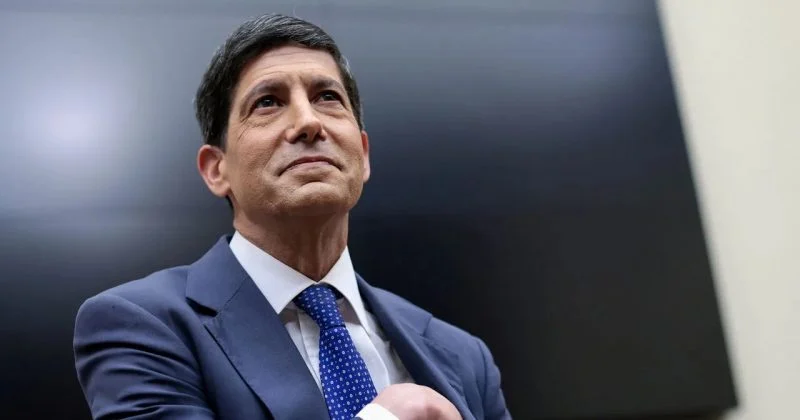
Kevin Warsh, confirmed as Federal Reserve Chair on June 17, 2026, is pursuing a markedly unconventional approach to central banking: stepping back from active intervention and allowing financial markets themselves to serve as the primary signal for policy decisions. The approach marks a sharp departure not only from the active crisis-era management Warsh participated in as a Fed governor from 2006 to 2011, but from the broader post-2008 trajectory in which the central bank expanded its toolkit to include forward guidance, large-scale asset purchases, and increasingly granular communication designed to anchor market expectations.
The Warsh Doctrine Takes Shape
At his first Federal Open Market Committee (FOMC) meeting, Warsh held the federal funds rate steady at 3.5–3.75%. What drew immediate attention was not the decision itself but the communication style accompanying it. Warsh released a substantially shortened policy statement that eliminated the carefully hedged language Fed watchers have spent decades learning to interpret. Fed policy statements had grown progressively longer and more detailed since the 1990s, culminating in the forward-guidance-heavy communications that defined the Bernanke, Yellen, and Powell eras. Warsh's reversal of that trend signals a broader philosophical shift: less prescription about future policy, more deference to real-time market data.
Warsh has been direct on the subject of inflation, describing it as an "unfair burden" and characterizing it as a tax that must be eliminated. He offered no caveats and employed no "soft landing" rhetoric, instead delivering an unequivocal pledge to restore price stability.
In July 2026, Warsh expanded on this philosophy, advancing the view that markets should deliver "unfiltered" signals free from Fed interference. Under this framework, the Fed would cease attempting to micromanage every sector of the financial system and instead rely on asset prices, Treasury yields, and dollar movements to inform policymakers about actual economic conditions. These market indicators have historically served as barometers for growth and inflation expectations, and Warsh's framing would elevate them to a primary policy input — a framework closer to the pre-Greenspan era of central banking than anything seen in recent decades.
A Fed Chair With Crypto on His Balance Sheet
Financial disclosures revealed that Warsh held equity stakes in more than a dozen cryptocurrency-related organizations before assuming office. These holdings included positions in prominent decentralized finance (DeFi) protocols as well as both Layer 1 and Layer 2 blockchain networks. Warsh committed to divesting from these assets upon taking the position, consistent with the ethics obligations that require senior Fed officials to avoid conflicts of interest.
Warsh has described Bitcoin as an important asset class for policymakers to understand, while simultaneously downplaying it as a systemic threat to the Federal Reserve's authority. This framing positions cryptocurrency as something the Fed should monitor without treating it as an adversary — a notable tonal shift from the skepticism that characterized previous Fed leadership.
What Market-Driven Policy Means for Crypto
Early market reactions to Warsh's policy meetings have already produced increased volatility across major digital assets. Digital assets have historically exhibited heightened sensitivity to monetary policy shifts: during the 2022–2023 tightening cycle, major cryptocurrencies declined steeply as the Fed raised rates aggressively, and rallied when policy eased. Under Warsh's framework, where intervention is less frequent and market turbulence is treated as natural rather than something to be smoothed out, crypto traders face an environment in which volatility may be amplified by the absence of the stabilizing communication cues the market has relied on for years.
Market participants are still adjusting to a Federal Reserve that communicates in a fundamentally different manner, intervenes less frequently, and appears comfortable treating market turbulence as a natural feature of the system rather than a problem requiring correction.
The federal funds rate at 3.5–3.75% already sits well below the peak levels seen during the recent tightening cycle. However, the current rate level may matter less than Warsh's reaction function: whether he will tolerate markets running hot, or whether his commitment to price stability will lead to preemptive tightening that could catch leveraged crypto positions off guard. With less forward guidance to anchor expectations, the burden of interpreting policy falls more heavily on market participants themselves.
