Google DeepMind says WeatherNext achieves breakthrough in cyclone forecasting
Key Takeaways
- •Google DeepMind's WeatherNext AI model delivers more than 24 hours of additional predictive lead time for cyclone track, intensity, and wind structure forecasting.
- •The model was trained on nearly 20 terabytes of global atmospheric data combined with historical records spanning approximately 5,000 past storms.
- •During the 2025 hurricane season, WeatherNext helped the National Hurricane Center predict Hurricane Melissa's rapid intensification and Jamaica landfall, enabling an advance warning.
- •Google DeepMind is open-sourcing the WeatherNext 2 and WeatherNext Cyclones model code and weights, plus a compact WeatherNext 2-mini version that runs on a single TPU.
- •The model achieves its accuracy using input data at a resolution of 28x28 kilometers, roughly 100 times coarser than traditional cyclone forecasting systems require.
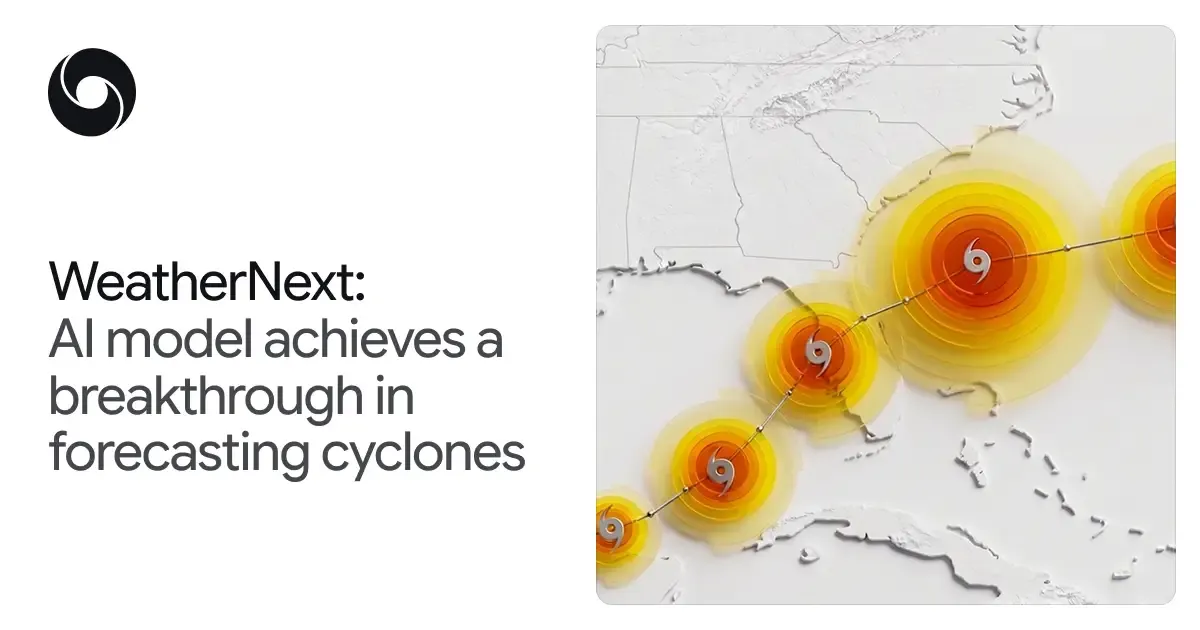
Google DeepMind says WeatherNext achieves breakthrough in cyclone forecasting
WeatherNext team
WeatherNext enables accurate cyclone forecasts that can provide an extra day of warning. Google DeepMind is now open sourcing the model.
Predicting how dangerous cyclones develop has long been a challenge in which every hour matters. Tropical cyclones — also known as hurricanes or typhoons — are among the most destructive weather phenomena on Earth, responsible for more than 700,000 deaths and $1.4 trillion in economic losses globally over the past 50 years. For forecasters, issuing timely and accurate warnings is a constant race against time. The United Nations has made early warning systems a global priority through its Early Warnings for All initiative, which aims to ensure every person on Earth is protected by hazard alert systems by 2027.
Today, in a paper published in Nature, Google DeepMind said its WeatherNext AI model achieved state-of-the-art accuracy in predicting a cyclone's track, intensity and wind structure. On average, the model gives forecasters an extra day of predictive accuracy: its three-day forecasts are as good as what prior models were able to provide for only the next two days. The company said that scale of improvement is roughly equivalent to a decade of meteorological progress. WeatherNext builds on Google's earlier AI weather models, GraphCast and GenCast, extending that line of research to focus specifically on tropical cyclones.
The work brought together AI researchers and engineers at Google DeepMind and Google Research, along with expert forecasters at the National Hurricane Center (NHC), the Cooperative Institute for Research in the Atmosphere (CIRA), the UK Met Office, and weather agencies around the world.
Google said the research has already had real-world impact. During the 2025 hurricane season, the model helped the NHC make a historic forecast for Hurricane Melissa by predicting the storm's rapid intensification and landfall in Jamaica. That enabled the NHC to issue an advance warning, giving teams on the ground critical time to prepare. This year, the groups continue to work together and are now predicting 1,000 possible scenarios for each cyclone to help support forecasters in their decision-making.
Weather affects everyone. Because of that broad impact, Google DeepMind is open sourcing its WeatherNext 2 and WeatherNext Cyclones models used during the hurricane season. By making the technology openly available, the company said it hopes to support the research community and expand AI's role in building more resilient communities — including helping local forecasters prepare for natural disasters, supporting the growth of renewable energy, and anticipating extreme weather. The open-source release enters a field where multiple technology companies, including NVIDIA and Huawei, have published AI weather models in recent years, reflecting growing industry interest in applying machine learning to operational meteorology.
How WeatherNext predicts weather and cyclones
Starting from global atmospheric conditions during Hurricane Milton in October 2024, WeatherNext Cyclones iteratively predicts both global weather patterns and fine-scale cyclone tracks up to 15 days in advance. Running a 1,000-member ensemble generates localized probability maps of tropical storm to hurricane-force winds.
Forecasting cyclones has traditionally required a trade-off between two distinct modeling approaches. A cyclone's track — where it goes — is steered by large-scale global atmospheric currents, which have typically been modeled best by coarser global systems. A cyclone's intensity — how strong it becomes — depends on highly localized, fine-scale thermodynamic processes around its core, which are generally modeled by specialized, higher-resolution local systems.
Google said WeatherNext bridges that gap by improving forecasting for both global weather and cyclones. It is a single AI model that predicts a tropical cyclone's track, intensity and wind structure with state-of-the-art accuracy. The company said the breakthrough comes from a combination of its training, architecture and approach to low-resolution inputs.
WeatherNext Cyclones was evaluated on historical cyclones from 2023 to 2024, with deterministic and probabilistic performance benchmarked against other leading weather models. On average, the model provides more than a full day, or 24 hours, of lead-time advantage for predicting cyclone tracks, intensity and wind structure.
The model was co-trained on two distinct data modalities: global weather dynamics and expert-curated historical cyclone observations. It was trained end-to-end on nearly 20 terabytes of global atmospheric data and the historical IBTrACS database spanning nearly 5,000 historical storms, allowing it to learn complex atmospheric patterns and extreme-weather behavior.
Cyclone forecast accuracy has improved steadily over recent decades. Google said the plots in the paper show the three-day accuracy of ECMWF-ENS track forecasts and HWRF intensity forecasts over time, and how WeatherNext Cyclones represents a step change in accuracy for both track and intensity. The company said this improvement is equivalent to about one decade of progress based on trends over the last 20 years.
The model uses Functional Generative Networks (FGNs) to efficiently produce ensembles of different predictions, capturing the inherent uncertainty in weather. Google said it can now generate a single 15-day forecast in less than a minute on a TPU, enabling forecasters to quickly evaluate the probability distribution of potentially devastating tail risks. Last year, the system produced 50 predictions at a time, matching global physics models. This year, Google scaled the ensemble size to 1,000 members to better capture rare but consequential scenarios such as rapid intensification events, as occurred during Hurricane Melissa in 2025.
Until now, very high spatial resolution has generally been considered the main driver of accurate intensity forecasts. However, WeatherNext Cyclones only needs data with a resolution of 28x28km, which is 100 times coarser than traditional models. A smaller version of the model, WeatherNext 2-mini, which operates at an even coarser 111x111km resolution, also showed strong performance. Google said this has surprised scientists, and it remains an open research question to fully understand how the models produce such accurate predictions at this resolution.
Opening up WeatherNext to the research community
Alongside the Nature paper, Google DeepMind is open sourcing the code and model weights, making them freely available for anyone to build on. The company said this includes academic research, operational forecasting and the development of more specialized, localized models. It hopes the release will accelerate progress across the global weather community and help meteorological agencies, researchers and nonprofits better predict weather events and make key decisions to protect lives and infrastructure.
Google is also releasing two sets of similar models: WeatherNext Cyclones, which ran during the hurricane season and is reflected in the paper's results; and WeatherNext 2, a later update that was operationalized in October. In addition, the company is releasing WeatherNext 2-mini, a compact version of the model that can run on a single TPU in a free public Colab notebook.
Users can also explore the latest cyclone forecasts on Weather Lab, which Google recently refreshed with a new interface and expanded to include global weather forecasts alongside cyclone tracks. Weather Lab now lets users visualize WeatherNext predictions for temperature, precipitation, wind speed and more in a single view. Both Weather Lab and the WeatherNext models are part of Google Earth AI.
Pushing the frontiers of AI for weather forecasting
Google said it has achieved a historic breakthrough by gaining more than a full day of lead time for predicting cyclones, an advance it described as equivalent to a decade of meteorological progress. As it prepares for future storm seasons, the company is inviting researchers, meteorological agencies and experts to partner on the open source models and explore the forecasts on Weather Lab.
By combining advanced machine learning with the real-world expertise of human forecasters, Google said it aims to build a collaborative weather forecasting ecosystem that can save lives and help communities adapt to a changing climate.
Note: For official weather forecasts and warnings, refer to your local meteorological agency or national weather service.
Acknowledgements
This research was co-developed by Google DeepMind and Google Research teams.
Google thanked its collaborators at NOAA/NWS/NCEP National Hurricane Center, the Cooperative Institute for Research in the Atmosphere (CIRA) and the UK Met Office for their partnership and contributions to the paper.
The paper's co-authors are Ferran Alet, Tom Andersson, Ilan Price, Stratis Markou, Andrew El-Kadi, Dominic Masters, Amy Li, Samier Merchant, Natalie Williams, Gregory Thornton, Ken MacKay, Olivia Graham, Akib Uddin, Ben Gaiarin, Devaja Shah, Elinor Kruse, Wallace Hogsett, David Zelinsky, John Cangialosi, Jonathan Martinez, James Franklin, Mark DeMaria, Kate Musgrave, Caroline L. Bain, Helen Titley, Jacklynn Stott, Remi Lam, Aaron Bell, Paul Komarek, Matthew Willson, Alvaro Sanchez-Gonzalez and Peter Battaglia.
