Senator Warren Supports Federal Crypto Regulation but Opposes the CLARITY Act
Key Takeaways
- •Senator Elizabeth Warren supports the concept of a federal cryptocurrency framework but opposes the CLARITY Act as the specific legislative mechanism for achieving it.
- •Warren's opposition to the CLARITY Act is connected to ethics concerns she has raised regarding President Trump's cryptocurrency ties, prompting her to request an SEC investigation.
- •The CLARITY Act, tracked as H.R. 3633, is a market-structure bill that would allocate jurisdiction over digital assets among federal regulators.
- •The central policy dispute revolves around how stringent crypto regulations should be and whether the SEC or CFTC should hold primary authority over digital assets.
- •Senator Cynthia Lummis has circulated a revised version of the CLARITY Act text amid ongoing legislative negotiations.
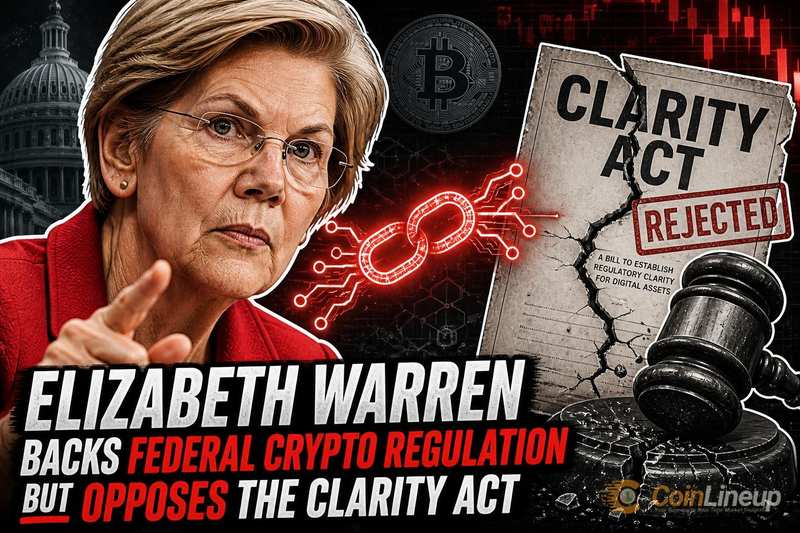
Senator Elizabeth Warren has staked out a nuanced position in the debate over federal cryptocurrency regulation, endorsing the concept of a national framework for digital assets while firmly opposing the CLARITY Act — the market-structure bill currently advancing through Congress.
Warren articulated her stance during opening remarks at the Senate Banking Committee's mark-up of the CLARITY Act, a procedural step where lawmakers debate and propose amendments before deciding whether to advance legislation. Her position draws a clear distinction between two issues that are frequently conflated: whether the United States should regulate cryptocurrency at the federal level, and whether this specific piece of legislation is the appropriate mechanism for doing so.
Federal Oversight, Not Opposition to Regulation
Warren is not rejecting cryptocurrency regulation in principle. Her objection targets a particular bill, not the broader concept that Washington should establish rules governing digital assets.
In this context, "federal crypto regulation" refers to a unified national framework that would designate which agencies oversee tokens and define the protections afforded to investors. This stands in contrast to the current landscape of fragmented enforcement actions and varying state-level rules. Warren's position is that such oversight should be more stringent, not less.
Why the CLARITY Act Is the Flashpoint
The CLARITY Act, tracked in the House as H.R. 3633, is a market-structure bill that allocates jurisdiction over digital assets among federal regulators. For Warren, supporting federal regulation and supporting this particular bill are fundamentally different propositions.
Warren's opposition is intertwined with ethics concerns she has separately raised. According to reporting from CoinDesk, the CLARITY Act has stalled amid questions surrounding President Trump's crypto ties, with Warren requesting that the SEC investigate him.
The White House has pushed back against the Democratic ethics arguments, characterizing the disagreement as legislative rather than a blanket rejection of crypto lawmaking.
Implications for U.S. Crypto Policy
The split between backing oversight and rejecting a specific bill points to a deeper dispute over regulatory design. The central question is not whether to regulate, but how stringent the rules should be and which agency should hold primary authority — a long-running tension between the SEC and CFTC that has shaped multiple congressional attempts at digital-asset legislation.
This divide pits proponents of tougher oversight and investor protection against industry-backed approaches that favor clearer, lighter-touch market-structure rules. A revised version of the bill has already circulated, with Senator Cynthia Lummis releasing updated CLARITY Act text.
Warren's stance ensures the CLARITY Act remains contentious, as it undermines the argument that opponents simply reject regulation outright. Her broader friction with the administration — including claims that Trump is blocking Federal Reserve rate cuts — highlights that the crypto policy fight represents one front in a wider political conflict.
How Congress reconciles these competing visions will shape the trajectory of future digital-asset legislation.

