2026 Week 31 Stocks Market Watch: Big Tech Earnings Lift Stocks as Fed and Yield Risks Persist
Key Takeaways
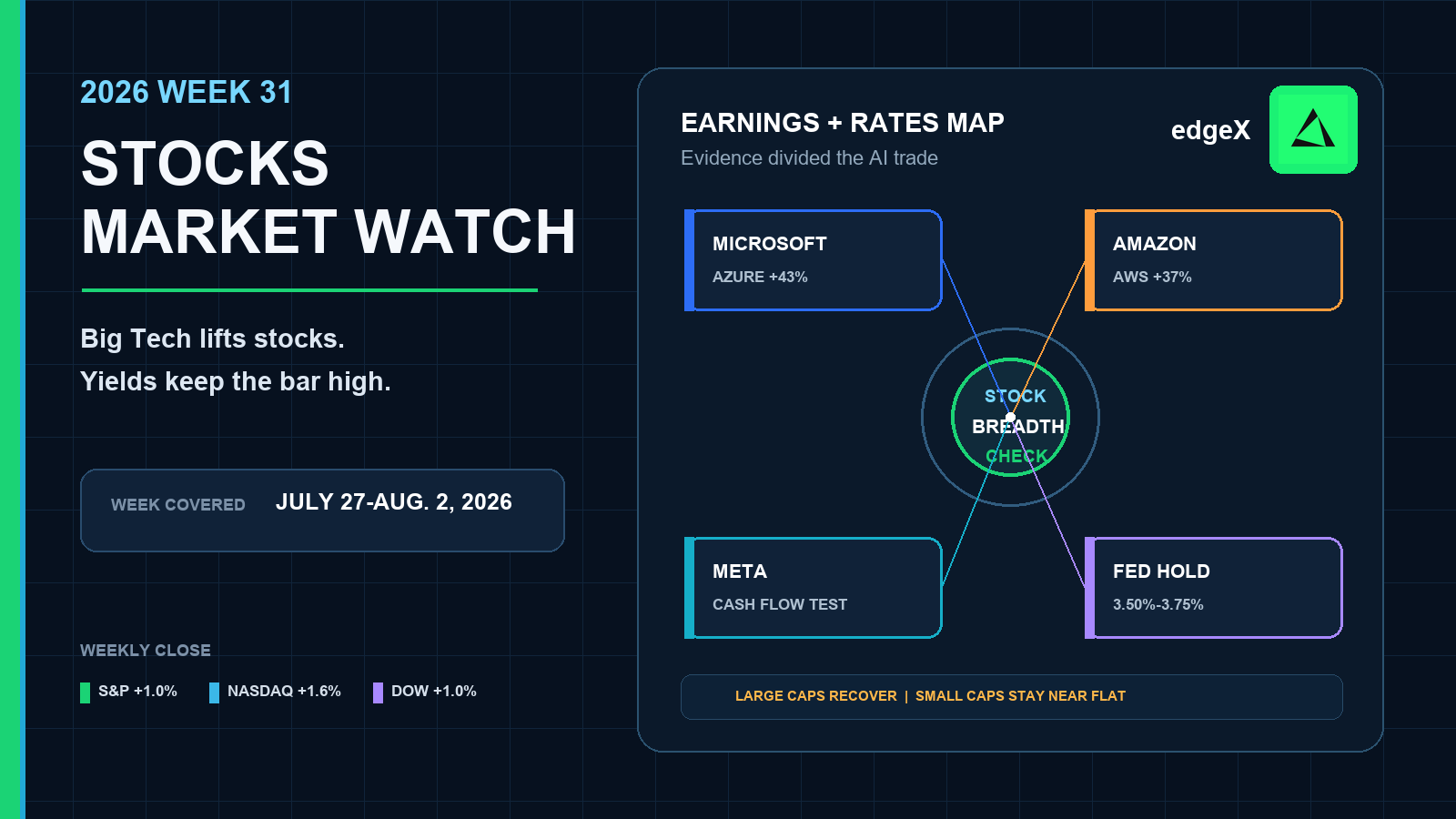
- •Microsoft reported fiscal Q4 revenue of $90.0 billion with Azure and other cloud-services revenue growing 43%, providing strong evidence that AI infrastructure spending is translating into enterprise cloud usage.
- •Amazon's Q2 net sales rose 20% to $200.6 billion with AWS revenue up 37%, but trailing 12-month free cash flow swung to a $7.6 billion outflow due to surging AI-related capital expenditures.
- •The Federal Reserve held its target rate at 3.50%-3.75% on July 29 in a 9-3 vote, with three FOMC members dissenting in favor of a quarter-point increase, an historically uncommon level of division.
- •Second-quarter real GDP grew at a 1.5% annualized rate, down from 2.1% in Q1, while real final sales to private domestic purchasers rose 3.9%, indicating underlying demand was stronger than the headline figure suggested.
- •The Russell 2000 gained less than 0.1% for the week, failing to confirm the large-cap rally and raising questions about whether market gains can broaden beyond a handful of mega-cap technology and platform stocks.
A Rebound With Conditions Attached
Wall Street ended Week 31 higher after two weeks of weakness, but the path mattered more than the green index numbers. AP's final July 31 market recap showed the S&P 500 up 1.0% for the week, the Dow up 1.0%, the Nasdaq up 1.6%, and the Russell 2000 up less than 0.1%. Friday itself supplied the finishing push as Amazon jumped and the Nasdaq gained 1.0%.
That was a recovery, not a clean all-clear. The Russell's near-flat result showed that the rebound remained concentrated in large companies. LPL Research's July 31 snapshot, taken at 2:56 p.m. ET, also captured an unusual sector split: consumer discretionary gained 8.39% and communication services rose 4.93%, while information technology fell 0.45%. The market rewarded selected platform companies without lifting the technology sector as a whole.
Week 31 therefore answered one question and opened another. AI demand was real enough to support exceptional cloud growth at Microsoft and Amazon. The harder question was whether the return on that spending would be broad, predictable, and fast enough to support elevated valuations across the entire AI complex.
The index gain hid a narrower argument
The week's leadership was built around evidence, not simply exposure. Amazon's AWS acceleration and Microsoft's Azure growth reassured investors that infrastructure investment could produce revenue. Meta's report delivered powerful top-line growth but also showed the strain from legal charges, severance, capital expenditure, and minimal free cash flow. Apple posted record June-quarter revenue, yet a less compelling forward signal weighed on the shares Friday.
That dispersion is healthy in one sense: the market was distinguishing between business outcomes. It is also a warning against reading a 1.6% Nasdaq gain as a universal endorsement of AI spending. The winners showed operating proof. The laggards reminded investors that a good theme cannot protect every margin, cash-flow statement, or valuation.
Week 31 Stock-Market Dashboard
| Signal | Week 31 Result | Investor Meaning |
|---|---|---|
| S&P 500 | +1.0% for the week; Friday close 7,489.72 | Large caps recovered, but the move depended heavily on earnings leadership. |
| Nasdaq Composite | +1.6%; Friday close 25,373.85 | Cloud and platform strength repaired part of the prior technology selloff. |
| Dow Jones Industrial Average | +1.0%; Friday close 52,485.03 | Broader blue-chip participation helped the rebound look less one-dimensional. |
| Russell 2000 | Up less than 0.1%; Friday close 2,931.34 | Small caps did not confirm the large-cap rally. |
| Fed decision | Held at 3.50%-3.75%, 9-3 vote | Three hike dissents and higher long yields kept the valuation debate alive. |
| Q2 real GDP | +1.5% annualized | Growth slowed from Q1, but private domestic demand was stronger than the headline. |
| June PCE inflation | -0.1% monthly; +3.7% yearly | Monthly relief coexisted with inflation still well above the Fed's goal. |
| Employment Cost Index | +0.9% quarterly; +3.4% yearly | Labor costs were cooling only gradually, limiting the case for easy policy. |
The index figures are final Friday data from AP. The sector figures used elsewhere come from LPL's late-Friday snapshot and are identified as such because its table was published before the closing bell. Keeping those timestamps separate avoids turning a useful intraday sector read into a false closing figure.
The Fed Hold Did Not Calm the Bond Market
The Federal Reserve held the federal funds target range at 3.50%-3.75% on July 29. The decision was notable because Beth Hammack, Neel Kashkari, and Lorie Logan preferred a quarter-point increase. A three-dissent vote for tighter policy made the hold look less comfortable than the unchanged rate alone suggested.
For stocks, the signal arrived through Treasury yields. LPL reported that longer-term yields moved meaningfully higher after the meeting as investors struggled with the Fed's reaction function. That matters because a company can deliver good earnings and still face a lower valuation multiple when the discount rate rises. The pressure is strongest where expected cash flows sit far in the future.
The Fed's statement described activity as expanding at a solid pace and inflation as elevated, with energy-related supply shocks part of the problem. That combination left investors without an easy policy narrative. The economy was not weak enough to force support, and inflation was not contained enough to remove hike risk.
Higher yields changed how earnings were priced
The rate backdrop explains why Week 31 was not a simple earnings celebration. Investors were willing to pay for measurable cloud growth, advertising strength, and consumer demand. They were less willing to pay for spending plans that required years of trust. Higher yields compress the time the market is prepared to wait for a return.
This creates a sharper divide within technology. Profitable platforms with accelerating revenue can defend investment. Suppliers can benefit when hyperscalers keep building. Companies with weaker monetization, thinner cash conversion, or ambitious guidance face a tougher test. In that environment, AI remains the growth engine, but the bond market decides how expensive that engine can be.
Microsoft, Meta, Amazon, and Apple Split the AI Trade
Microsoft's fiscal fourth-quarter release supplied some of the week's strongest evidence. Revenue rose 18% to $90.0 billion, Microsoft Cloud revenue reached $59.3 billion, and Azure and other cloud-services revenue grew 43%. Those numbers supported the view that AI infrastructure demand was feeding directly into cloud usage and enterprise spending.
Amazon's second-quarter results reinforced that message. Net sales rose 20% to $200.6 billion, AWS sales increased 37% to $42.2 billion, and operating income reached $27.5 billion. The counterweight was capital intensity: trailing 12-month free cash flow moved to a $7.6 billion outflow as property and equipment purchases rose sharply, primarily for AI.
Meta's second-quarter release showed why revenue growth alone was not enough. Revenue increased 28% to $60.8 billion, but costs and expenses rose 55%, operating margin fell to 31% from 43%, and free cash flow was only $784 million. Legal charges and severance contributed to the pressure, while capital expenditure reached $31.08 billion.
Apple reported record June-quarter revenue of $109.4 billion, up 16%, with diluted EPS up 29% to $2.02. The quarter confirmed resilience across iPhone, Mac, and Services, although AP reported that the shares fell Friday after investors found the upcoming revenue-growth outlook less convincing.
Capex stopped being an abstract promise
Together, the four reports changed the AI conversation from ambition to conversion. Microsoft and Amazon showed rapid cloud growth. Meta showed that fast revenue growth can coexist with weaker profit and cash-flow quality. Apple showed that record current performance does not guarantee a favorable reaction when the next-quarter message disappoints.
The lesson is not that capex is good or bad. It is that investors now want a visible chain from data-center spending to usage, revenue, margins, and free cash flow. A supplier may benefit from rising budgets even when the buyer's shares struggle. A platform may post excellent growth but still fall if spending accelerates faster than confidence in returns.
Growth Slowed, but Private Demand Held Up
The BEA's advance second-quarter GDP estimate showed real GDP rising at a 1.5% annualized rate, down from 2.1% in the first quarter. The headline looked soft, but real final sales to private domestic purchasers rose 3.9%. Consumer spending and investment therefore gave the equity market a firmer demand signal than the GDP headline alone implied.
The inflation picture was less comfortable. The June personal income and outlays report showed PCE prices down 0.1% from May and core prices up 0.1%. Yet headline PCE was still 3.7% higher than a year earlier and core PCE was up 3.3%. Personal spending rose 0.3%, while the saving rate stood at 2.7%.
That mix helps explain why consumer-facing leaders could rally while bonds remained uneasy. Households were still spending, but the savings cushion was thin and inflation remained elevated. Strong consumption supports revenue today; persistent prices and low saving can weaken the durability of that support.
Labor Costs Kept the Soft-Landing Bar High
The Employment Cost Index rose 0.9% in the three months through June and 3.4% over the year. Wages and salaries also increased 0.9% during the quarter. The data did not signal a wage-price spiral, but it did not give the Fed a decisive reason to relax.
For companies, labor costs sit directly between revenue growth and margin delivery. A resilient consumer can help sales, while persistent compensation pressure raises operating costs. Businesses with pricing power, automation gains, or high incremental margins can absorb that tension more easily. Labor-intensive companies with weak pricing power cannot.
Sector Breadth Exposed the Week's Fault Lines
LPL's 2:56 p.m. Friday sector snapshot showed consumer discretionary up 8.39%, communication services up 4.93%, consumer staples up 1.33%, and financials up 1.24%. Utilities fell 3.75%, real estate declined 1.95%, materials lost 1.46%, industrials fell 1.42%, and information technology slipped 0.45%.
The result was not a classic lower-yield growth rally. Rate-sensitive utilities and real estate weakened as long yields rose. Consumer discretionary surged because Amazon's earnings had enormous sector weight. Communication services benefited from platform strength even as Meta's own cash-flow profile drew scrutiny. Technology's decline showed that chip and software enthusiasm remained selective.
Small-cap weakness completed the picture. The Russell 2000 barely moved for the week and fell 0.5% Friday. A durable broadening usually needs smaller companies to participate because they are more exposed to financing costs and domestic demand. Week 31 did not provide that confirmation.
What the Week Changed for Investors
The bullish reading is that the market absorbed a divided Fed, higher long yields, slowing headline GDP, and mixed corporate guidance, yet still finished higher. Cloud demand accelerated, private domestic demand held up, and the largest indexes recovered. That is evidence of resilience.
The cautious reading is that the rebound depended on a narrow set of earnings winners. Inflation remained above target, labor costs stayed firm, the saving rate was low, and small caps did not join. If yields keep rising, even strong AI revenue may not protect every premium valuation.
The next test is breadth. Investors should watch whether gains spread from Amazon, Microsoft, and selected platforms into semiconductors, software, industrials, financials, and smaller companies. They should also watch whether free cash flow improves as AI investment scales. Revenue growth can defend a thesis; cash conversion determines how long the market will finance it.
Trade Stocks Without the TradFi Gatekeeping
The stock market moves fast. Your trading infrastructure should too.
As RWA markets mature and tokenized stocks become a serious alternative to tradFi access points, more traders are asking the same question: why settle for a centralized platform that controls your assets, demands KYC, and keeps your trading fees?
edgeX Exchange offers a different answer. Built on EDGE chain and settling on Ethereum via Arbitrum, edgeX is a decentralized perpetual futures platform where you can trade stocks with high leverage without handing over your identity or your keys.
Here's what sets it apart:
- True self-custody: Users control their private keys at all times. Withdrawals require no platform approval.
- Institutional-grade liquidity: $10 million depth within a one-basis-point spread, with sub-0.1-basis-point slippage on trades over $100,000.
- CEX-level speed: The order book processes up to 200,000 orders per second with sub-10 millisecond matching latency.
- No KYC required: Sign up and start trading without the friction of traditional onboarding.
- 100% trading fee rewards: Every fee you pay comes back to you through the Trade to Own program.
- USDC-backed settlement: USDC is designed by Circle to be redeemable 1:1 for U.S. dollars, giving traders a familiar stablecoin base.
Whether you're rotating out of tradFi equities, exploring RWA perpetuals, or simply looking for a smarter way to trade stocks on-chain, edgeX delivers the execution quality of a top-tier exchange with the security guarantees of decentralized infrastructure.
Available on iOS and Android, edgeX is built so your edge goes wherever you do. Start trading on edgeX.
Frequently Asked Questions
How did U.S. stocks perform in Week 31 of 2026?
AP's final Friday recap showed the S&P 500 and Dow each rising 1.0%, the Nasdaq gaining 1.6%, and the Russell 2000 finishing up less than 0.1% for the week.
What did the Federal Reserve decide on July 29?
The Fed held the federal funds target range at 3.50%-3.75% by a 9-3 vote. Three officials preferred a quarter-point increase, keeping inflation and rate risk central to equity valuations.
Which Big Tech earnings mattered most?
Microsoft and Amazon delivered strong cloud growth, supporting the AI monetization case. Meta's revenue grew rapidly, but elevated expenses and weak free cash flow highlighted the cost side of AI investment. Apple reported record June-quarter results, but its forward outlook disappointed investors.
Why did the Russell 2000 lag?
Smaller companies are generally more sensitive to financing costs and domestic economic conditions. Higher long-term yields and an uncertain Fed path made it harder for small caps to confirm the large-cap rebound.
What should stock investors watch after Week 31?
The most important signals are market breadth, long-term Treasury yields, AI capex-to-revenue conversion, free cash flow, and whether small caps begin participating in gains.

