Fully Driverless Robotaxis Begin Test Rides in Zagreb
Key Takeaways
- •The Zagreb trial is limited to invited passengers and does not constitute a broad public launch of driverless commercial rides.
- •The vehicles use Pony.ai’s autonomous-driving technology with nine lidar units, 14 cameras and four millimeter-wave radars.
- •Verne’s existing commercial robotaxi service, launched in April, continues to operate with human safety monitors and can be booked through Uber.
- •Pony.ai operates fully driverless commercial services in four Chinese cities and plans to deploy more than 4,000 robotaxis outside China.
- •The project’s next stage depends partly on an assessment of its EU funding conditions and the results of the invited-passenger phase.
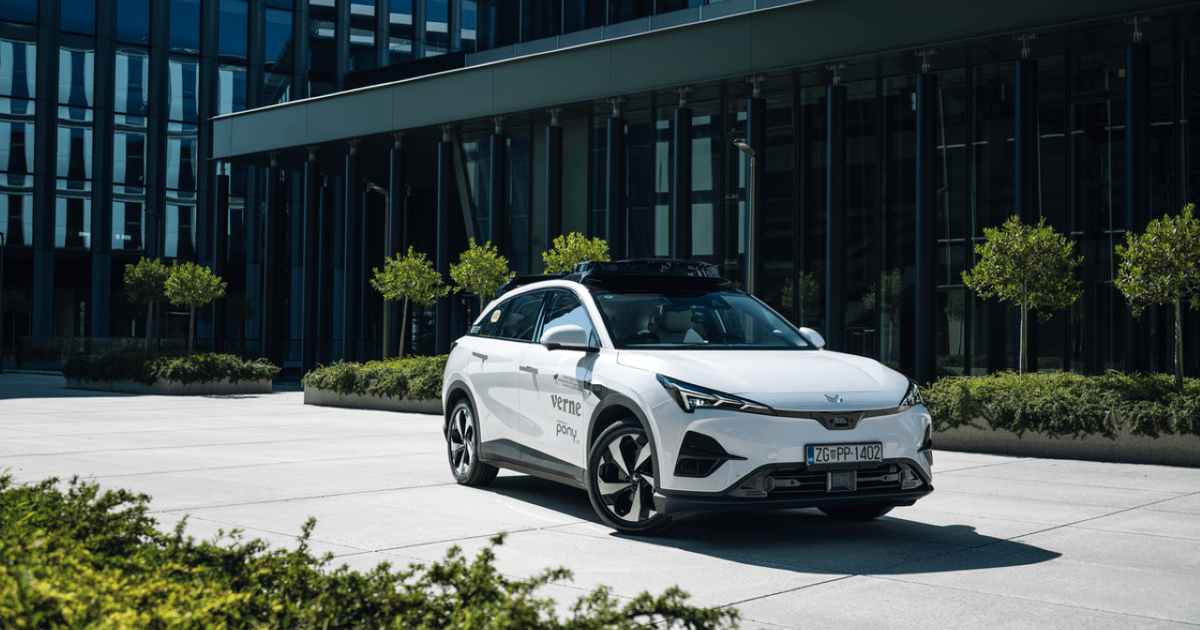
Croatian autonomous mobility company Verne and Chinese driverless-platform provider Pony.ai have begun offering fully driverless robotaxi test rides in Zagreb, marking what the companies describe as the first trial of its kind in Europe.
The program, announced on September 14, 2026, is the first time passengers in a European robotaxi trial will travel without a human safety monitor behind the steering wheel. That distinguishes the Zagreb service from the robotaxi program being tested in London by Uber and Wayve, where a human supervisor remains present at all times.
The vehicles are based on BAIC’s Arcfox Alpha T5, an electric SUV. During this phase, the front passenger seat has been removed to create a more open cabin, increase luggage capacity and provide space for a large display. A central console between the rear seats contains a touchscreen for managing the ride.
The interior is “designed not as a concept for the distant future, but as something that can work in real service,” allowing riders to use their time in a way “that is more productive, more enjoyable, and more relaxing,” Verne CEO Marko Pejković said in a statement.
The initial driverless robotaxis will operate on a 13.6-mile route connecting a major business district with Zagreb’s Franjo Tuđman airport. The driverless stage will be available to invited passengers and will run alongside Verne’s commercial service, which launched in April and continues to use human safety monitors. That service can be booked through Uber. The limited access means the Zagreb program is a test deployment rather than a full public launch of driverless commercial rides.
According to Verne, its fleet has so far traveled more than 124,274 miles and completed several thousand passenger rides in Zagreb.
Both the driverless vehicles and the taxis accompanied by human monitors use Pony.ai’s seventh-generation autonomous-driving system. The platform combines artificial intelligence with 360-degree sensor coverage, including nine lidar units, 14 cameras and four millimeter-wave radars.
Pony.ai’s technology is already used extensively in China, where the company operates fully driverless commercial services in four cities. Pony.ai recently announced plans to deploy more than 4,000 robotaxis outside China as part of its international expansion.
The Zagreb milestone follows reports that the project will be assessed to determine whether it has met the conditions attached to its funding. Verne received about $103 million in European Union backing through Croatia’s National Recovery and Resilience Plan. The assessment and the results of the invited-passenger phase will be relevant to the project’s next stage, although no broader rollout has been announced here.
The project represents a significant step for Verne and Pony.ai, as well as for the deployment of self-driving taxis in Europe. Source: AI Business

