Vangrid Presents DePIN Network for Mobile Spatial Data and USDC Bounties
Key Takeaways
- •Vangrid states it has raised $9 million in funding with backers including HashKey Capital, Animoca Brands, and Crypto.com Capital.
- •Participants record 30–60-second video orbits of public spaces using mobile devices, with a stated daily reward of +50 PTC and a 1.5x Grid Operator multiplier.
- •The bounty marketplace reports more than $705,805 in USDC settled on Base across 1,058 bounties, with individual tasks advertised at $100 to more than $600.
- •The project argues that embodied AI, robotics, and world models require dense real-world 3D spatial ground truth that text data, satellite imagery, and street-view fleets cannot provide.
- •Vangrid remains pre-TGE with an anticipated $VAN token and an active $100,000 Rewards Program, while its funding, settlement, and reward claims have not been independently verified.
Vangrid Presents DePIN Network for Mobile Spatial Data and USDC Bounties
Vangrid (@vangrid_io) presents itself as a decentralized physical infrastructure network (DePIN) focused on physical-AI spatial ground truth, robotics, and world-model data. Its ecosystem includes Base for settlement and automated USDC bounties through x402, Robinhood Chain for Vangrid Agents soulbound NFT minting (Chain ID: 4663), and Arc Network.
The project states that it has raised $9,000,000, led by HashKey Capital, Animoca Brands, Crypto.com Capital, and other tier-1 institutional funds. Its incentive systems include PTC points for contribution tracking and community rankings, a $100,000 Rewards Program, USDC bounties on Base, a Grid Operator 1.5x multiplier, and a Vangrid Agents NFT boost. Vangrid is described as pre-TGE, with an active points ledger, live USDC cashflow payouts, and an anticipated $VAN token. A connected wallet displayed in the source material is 0x8edc...3274.
Scope and disclosure
Vangrid’s interfaces and marketing materials describe points, bounties, NFTs, token-related plans, technical workflows, and performance figures. These claims were not independently tested or verified by aicryptocore. Rewards, bounty availability, token allocations, eligibility, NFT value, smart-contract outcomes, taxes, and token prices are not guaranteed. Participation may involve transaction fees, volatility, privacy, legal, and smart-contract risks.
The source article includes a referral code, and the publisher or author may receive referral commissions. Vangrid’s displayed workflows should not be treated as independently verified evidence of completed uploads, bounty submissions, USDC settlements, NFT mints, autonomous agents, escrow mechanics, cryptographic validation, or automatic payout releases.
Vangrid’s interfaces describe a mobile spatial-data contribution and bounty program. Prospective participants should review eligibility requirements and terms, treat rewards and future token-related claims as unverified, and risk only funds or time they can afford to lose.
Physical-AI spatial data thesis
The article frames the artificial-intelligence industry as facing what frontier researchers often call the “Text Data Wall.” Large language models such as GPT-4, Claude, and Gemini have consumed much of the digitized human text available on the public web, but text alone cannot teach an autonomous machine to walk down uneven concrete stairs, steer a delivery vehicle around an unmapped construction curb, or guide a drone along an unrailed coastal quay.
The source argues that Embodied AI, robotics, and world models require continuous, dense, real-world 3D spatial ground truth. Commercial satellite constellations provide relatively infrequent overhead imagery and cannot capture sidewalks, overhangs, vertical clearances, or changing urban obstacles. Corporate street-view fleets are described as expensive, slow to refresh, and legally restricted from entering pedestrian spaces.
Vangrid says it addresses this spatial-data bottleneck through a decentralized, crowdsourced physical-intelligence infrastructure network. Human operators use mobile cameras and sensor telemetry, including IMU, GPS, and gyroscope data, to capture public environments. The project says its reconstruction pipeline converts raw video into 3D Gaussian Splatting and Neural Radiance Fields (NeRFs) for use by robotics companies, autonomous-logistics operators, critical-infrastructure monitors, and sovereign-defense developers.
The source describes two participation tracks. The first consists of community contributions, including social quests, mobile uploads through a stated daily reward of +50 PTC, milestones at 5, 10, and 50 videos, and a Grid Operator 1.5x multiplier. It is presented as a way to qualify for a future $VAN token-generation event and the $100,000 Rewards Program.
The second is a bounty marketplace at where, according to the project’s description, autonomous AI agents and enterprise buyers can post onchain bounties funded and settled in USDC on Base through HTTP 402 protocols. The source reports more than $705,805.00 settled to date, while noting that the displayed claims were not independently verified.
Project-stated participation features
Vangrid presents itself as a DePIN protocol offering both points-based participation and bounties. The source identifies the following project-stated features:
-
Physical AI and robotics data: Vangrid says it is collecting granular information about sidewalks, curbstones, storefronts, and architectural pathways for Physical AI, humanoid robotics, autonomous drones, and industrial inspection. The article references Tesla Optimus, Figure, and Boston Dynamics as examples of humanoid-robotics efforts, but does not establish a commercial relationship between those companies and Vangrid.
-
USDC settlements: The source states that more than $705,805.00 in USDC has been settled to video contributors on Base and that individual verified bounties may range from $100 to more than $600. These are project or interface claims and were not independently verified.
-
Institutional funding: Vangrid states that it completed a $9.0 million funding round co-led by HashKey Capital, Animoca Brands, and Crypto.com Capital.
-
Mobile participation: The project says participants do not need proprietary hardware such as $500 dashcams or miners. It describes 30–60-second video uploads through a mobile browser or Android application, +50 PTC daily submissions, milestone rewards, and the Grid Operator 1.5x multiplier.
-
Vangrid Agents NFT: The source describes a Vangrid Agents identity NFT on Robinhood Chain with a stated mint price of about $0.90. Any booster role, snapshot eligibility, or future allocation remains project-stated and is not guaranteed.
-
Pre-TGE status: Vangrid is described as operating an active $100,000 Rewards Program before the launch of its native $VAN token. The source says $VAN has been referenced in institutional research and whitepaper materials but has not launched.
Interfaces and workflows described by Vangrid
The following sections report interfaces and workflows displayed by Vangrid. They are not independent confirmations that any particular upload, bounty submission, settlement, or mint was completed.
Vangrid Hub onboarding
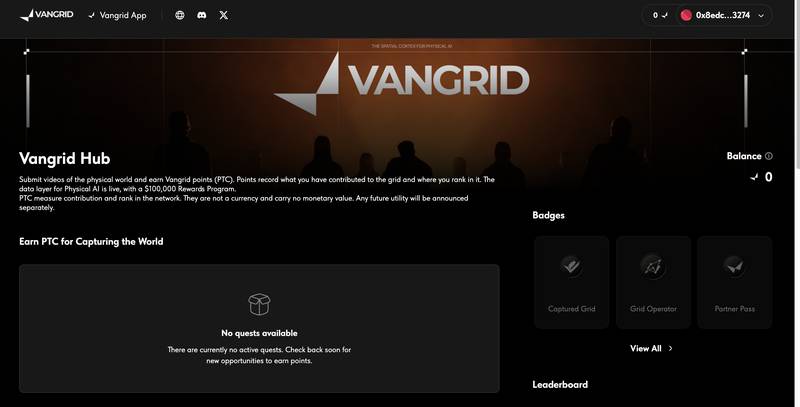
The Vangrid Hub loyalty portal is available at The source says its navigation bar displayed an authenticated EVM wallet, 0x8edc...3274, a balance of 0 PTC, and the following statement:
“Submit videos of the physical world and earn Vangrid points (PTC). Points record what you have contributed to the grid and where you rank in it. The data layer for Physical AI is live, with a $100,000 Rewards Program.”
The displayed badge categories were Captured Grid, Grid Operator, and Partner Pass. The source says that connecting an EVM address registers the wallet in Vangrid’s spatial-contribution database and links it to capture submissions, quests, and leaderboard rankings. It further describes the address as a persistent onchain identifier for the Rewards Program and possible future $VAN distributions, although those outcomes are not guaranteed.
Vangrid is described as using a Web3 loyalty stack built with Next.js and Snag Solutions. The source says off-chain spatial validations, capture streaks, and social verifications are cryptographically attested and associated with a non-custodial address without requiring KYC or personal-data disclosure. This architectural description was not independently tested.
The displayed onboarding process involved visiting the Hub, selecting an EVM provider such as MetaMask, Rabby, or Rainbow, signing a standard greeting message, checking the displayed public address, and reviewing the PTC ledger and Rewards Program terms.
Badges and the Grid Operator multiplier
The Hub’s badge module reportedly includes Captured Grid after an initial spatial submission, Grid Operator with an ongoing 1.5x contribution multiplier, and Partner Pass as an ecosystem-integration tier. The source says the Grid Operator status represents a 50% increase in point yields and is reached through video submissions and quest verification.
Vangrid’s stated rationale is that milestone-based verification can discourage automated spam and support quality-weighted scoring, since poor spatial data could affect machine-learning models. The source recommends reviewing badge status, completing an initial mobile upload, meeting the stated milestones, and monitoring the profile to confirm whether the multiplier is reflected in rankings. The stated multiplier is 1.5x on daily captures and quest completions.
Mobile spatial capture
The capture gateway is The source says the site displayed the message: “MOBILE EXPERIENCE ONLY, Vangrid is designed for mobile devices. Please open this app on your phone for the best experience., VANGRID.” Users are directed to open the site on a smartphone or obtain the Vangrid Android application from the official site.
The project describes a mobile sensor-fusion system that combines camera footage, gyroscope telemetry, GPS localization, and IMU data. It says operators should record 30–60-second continuous orbits of public spaces or physical features such as sidewalks, plazas, exterior facades, curbs, staircases, public sculptures, or storefronts. The stated reward is +50 PTC for a valid daily submission, with milestone thresholds at 5, 10, and 50 videos.
The source describes entering an early invite code, such as GRID-01, when prompted, authenticating a wallet, recording a smooth orbit, and uploading it daily. It advises maintaining steady camera movement, using adequate lighting, and avoiding private property, moving vehicles, and identifiable faces. These instructions do not constitute a guarantee of acceptance or payment.
Bounties and onchain settlement
The bounty marketplace is available at The source reports displayed metrics of $705,805.00 in total settlements, $1,300.00 in escrow locked, 1,058 settled bounties, and 29 bulk orders. Its banner stated:
“3D capture bounties on Base or Arc. Operators film an orbit; you accept a preview; reconstruction can take over an hour… Paid in USDC on Base or Arc via x402, no account.”
The interface reportedly allows users to filter by Base or Arc and by Open or Accepted status, inspect geographic requirements and capture areas, and review a buyer escrow address and stated bounty value. The source gives a typical range of $100 to $600 or more in USDC per task. It identifies Base and Arc as settlement networks and USDC as the settlement asset.
The source specifically cautions that the interface’s x402 description is not independent evidence that autonomous agents, escrow arrangements, cryptographic validation, or automatic payment release operate as displayed. It also characterizes bounty income as immediate and non-speculative, but that characterization is a project-related claim and is not a guarantee of payment.
Example bounty
The source describes live bounty #1111 as “200 m2 unrailed quay edge near Exeter.” It displayed a $600.00 USDC payout funded by buyer 0x086e...99b4 on Base, an acceptance timestamp of 2026-11-03 00:36:33 UTC, status ACCEPTED, and network tag BASE.
The stated workflow was to select an open task, verify its area and filming constraints, travel to the designated site, record overlapping orbits, submit the raw footage through data.vangrid.io, and wait for reconstruction and buyer or algorithm acceptance before claiming USDC on Base. Vangrid’s interface reportedly says reconstruction using NeRF or 3D Gaussian Splatting can take more than an hour. The reconstruction method, timing, validation standards, and payment workflow were not independently tested.
Vangrid Agents NFT
The source links to the OpenSea collection at It reports that the collection is deployed on Robinhood Chain, was created by DEPLOY_WALLET, and displayed 2,641 items minted, 1,065 unique owners representing 40.3%, total volume of $2,350.71, and a Public Stage mint price of $0.90 with a limit of five per wallet.
The collection is described as consisting of soulbound identity tokens. Vangrid’s stated purpose is to use the tokens as onchain credentials and to apply a multiplier to community loyalty points, with possible future retroactive allocations. These benefits are not guaranteed.
The source gives Robinhood Chain details of Chain ID 4663 and RPC The stated process is to add the network, hold sufficient Robinhood Chain ETH for gas and the $0.90 mint fee, visit the verified OpenSea collection, choose up to five NFTs, and confirm the transaction. The reported supply status was open edition, with more than 2,641 minted across 1,065 holders.
The article describes the use of Robinhood Chain for identity NFTs and Base for bounty settlement as a multi-chain design. Any eligibility for Robinhood ecosystem incentives or Base grants remains a project-stated possibility, not an established outcome.
Enterprise sectors and architecture
Vangrid’s homepage is The source says the site identifies four enterprise sectors: Embodied AI, Sovereign Defense, Autonomous Logistics, and Critical Infrastructure. Its stated thesis is: “THE SPATIAL CORTEX FOR PHYSICAL AI, BREAKING THROUGH THE TEXT DATA WALL.”
Vangrid says its data layer addresses the limitations of language-only models by supplying dynamic, frequently refreshed information about physical environments. The source identifies 3D Gaussian Splatting, NeRF neural reconstruction, and decentralized IMU telemetry as components of the technology stack. It describes human-collected ground truth in areas that satellite imagery cannot capture as the project’s strategic differentiator.
The source directs readers to Vangrid’s documentation and enterprise portal, its whitepaper specifications on spatial-coordinate registration and cryptographic proof-of-capture, and an onchain Explorer for grid expansion and density heatmaps. It also recommends aligning captures with high-demand areas such as transit hubs, commercial pathways, and industrial facilities. These recommendations and technical claims were not independently verified.
Funding announcement on X
The source identifies the verified Vangrid profile on X as @vangrid_io and reports that it displayed 73.3K followers and a pinned funding announcement stating:
“Vangrid has raised $9M. Thank you to our partners, supporters, and stakeholders for the conviction. LLMs hit the text data wall. The next frontier is Physical AI and autonomous systems are starving for real-world spatial ground truth…”
The official X profile is available at https://x.com/vangrid_io. The source advises users to verify application links and contract addresses through the profile’s verified bio links, follow announcements about bounties, multiplier campaigns, and TGE snapshots, and use official community channels. The funding announcement and its implications for operations, token value, or returns were not independently verified.
The reported backers are HashKey Capital, Animoca Brands, and Crypto.com Capital. The source characterizes the round as a $9,000,000 financing supported by institutional Web3 funds, but does not provide an independent filing or financing document. It also notes that the project-stated comparison matrix in the source is not an independently sourced or tested evaluation of Vangrid or any listed alternative.
Security, privacy, and execution risks
The source recommends limiting recordings to public sidewalks, commercial storefronts, park paths, and civic architectural features. It advises against filming private residential interiors or backyards, identifiable people, or vehicle license plates. Vangrid is said to use automated preprocessing for personally identifiable information, but footage containing conspicuous faces may still be rejected.
Steady, continuous camera movement is recommended because abrupt panning or jerky motion can create photometric inconsistencies that affect 3D reconstruction. Participants should also verify URLs against @vangrid_io to reduce phishing risk.
Vangrid’s Hub documentation reportedly states: “PTC measure contribution and rank in the network. They are not a currency and carry no monetary value. Any future utility will be announced separately.” The source notes that community members may expect PTC to convert into $VAN at a TGE, but says no such conversion should be assumed. It also states that Base bounty interactions may involve transaction fees typically ranging from $0.001 to $0.02, while minting a Vangrid Agents NFT costs $0.90 plus Robinhood Chain gas.
Project-stated operational checklist
The source’s checklist consists of visiting to monitor PTC and quests; opening on a smartphone and submitting one video orbit for the stated +50 PTC daily reward; tracking 5-, 10-, and 50-video milestones; checking for local bounties advertised at $100 to more than $600 in USDC on Base; considering a Vangrid Agents NFT mint on Robinhood Chain through OpenSea for $0.90; and sharing a referral link for stated tier-based commissions from active contributors.
The article was compiled for research archiving on 03 November 2026. Its technical, commercial, funding, reward, settlement, and token-related statements remain project-stated unless independently verified.

