USPS Parcel Surcharge and Stamp Price Hikes Lift Quarterly Revenue to Nearly $20 Billion
Key Takeaways
- •USPS generated $19.9 billion in operating revenue for the quarter ended June 30, a 6.1% increase attributed to higher stamp prices and a new 8% parcel surcharge.
- •The agency reduced its net loss by 18.2% year over year to $2.5 billion, while recording a controllable loss of $1.04 billion.
- •Postmaster General Steiner stated that the Postal Regulatory Commission's annual price increase cap cost USPS $700 million in lost revenue and called on Congress for structural reform including the elimination of unfunded mandates.
- •Cash-conservation measures, including deferred payments to pension and retirement funds, extended the agency's liquidity runway to at least August 2027, pulling back from the previously cited 2031 deadline.
- •Parcel shipping revenue grew 7.7% despite a 3.4% decline in parcel volume, while operating expenses rose 2% due to higher retiree health payments, wage increases, and fuel costs.
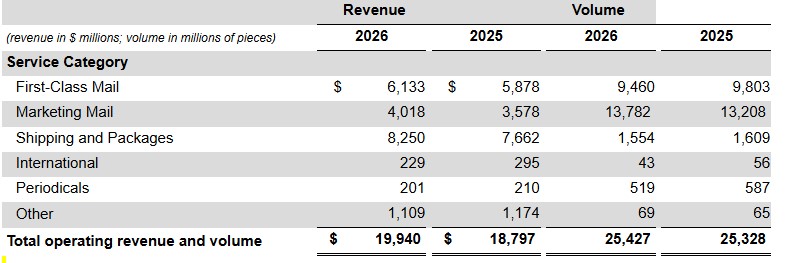
The U.S. Postal Service reported on Friday that an 8% parcel surcharge introduced in April, combined with higher stamp prices, helped push overall revenue to nearly $20 billion for the fiscal third quarter. Postmaster General David Steiner used the occasion to criticize regulators for restricting more frequent price increases that he argues are essential to restoring the organization's financial health.
The national postal operator narrowed its net loss by 18.2%, or $584 million, to $2.5 billion year over year. The controllable loss — which excludes mandated obligations outside management's control — stood at $1.04 billion.
Operating revenue for the three months ended June 30 reached $19.9 billion, representing a 6.1% increase compared with the same period a year earlier. The Postal Service attributed the improvement to stamp price increases for First-Class and marketing mail, along with the new parcel fees, which are scheduled to expire on Jan. 17. The expiration will be closely watched by competitors such as UPS, FedEx, and Amazon's in-house logistics network, all of which vie for a share of the e-commerce delivery market that USPS has used to offset declining letter mail. Those gains were partially offset by declining mail and package volumes.
Steiner also credited the stronger results to network optimization that has improved service levels while reducing work hours, as well as a decrease in workers' compensation costs, even as overall expenses rose. The integration of distribution centers, technology, and equipment is proceeding without the disruptions that plagued similar efforts in the past, he noted.
Liquidity Outlook Extends to August 2027
Cash-conservation measures — including deferring payments to employee pension and retirement funds — have provided the Postal Service with sufficient liquidity to continue operating through at least August 2027. That timeline marks a pullback from the 2031 liquidity cliff Steiner outlined in testimony to Congress in June.
Nevertheless, Steiner reiterated that the quasi-public agency requires legislative and regulatory reforms granting it the freedom to operate like a private enterprise and to shed onerous statutory obligations tied to managing pension and retirement funds.
The universal mail coverage mandate remains a major structural impediment. Under U.S. law, USPS must deliver to every address six days a week — an obligation shared by national postal operators in most developed economies, though few face as large or as sprawling a delivery network. Mail volumes have plunged more than 50% since 2007, even as the number of delivery points continues to grow. Last year, USPS added 1.8 million new stops to its route network, further driving up delivery costs. The combination of added workload and reduced mail volume has caused the average number of pieces delivered per stop to fall from 5.5 in 2007 to 2.4 pieces in 2025.
Steiner Calls on Congress for Structural Reform
Steiner called on Congress to provide temporary investments and eliminate unfunded mandates so the agency can maintain current service levels. Absent congressional support for growth, he warned, the Postal Service would need to consider reducing service levels, closing thousands of post offices, and raising prices simply to break even. Lawmakers have grappled with postal reform for more than a decade; a 2022 law restructuring retiree health benefit pre-funding provided temporary relief but did not address the core cost-revenue imbalance that Steiner now says demands action.
"The bottom line is that we need to fix the business model that has produced the 17-year-long imbalance in costs and revenue," Steiner said. "As we reduce costs and improve revenue, we believe we will become more profitable, and the appropriation could be reduced."
Steiner said the Postal Regulatory Commission's decision to cap price increases at once per year cost the Postal Service $700 million in foregone revenue. The organization has since filed a request to raise stamp rates in January under a different methodology that it says would generate additional funds.
Improving revenue through more aggressive pricing on letters and bulk mail has been a key priority for Steiner.
"Use of our pricing authority is absolutely necessary to improve our financial sustainability, and we need to be given more flexibility if we are expected to cover our costs," he said. "Obviously, we would like to both grow volumes and grow revenue, but if we can only do one, we want to do it in a way that maximizes total revenue. That is what all companies do — from airlines to grocery stores, they apply revenue management principles to maximize profitability. Thus far, applying those basic principles has favored raising prices even though there has been a modest decrease in volumes."
"All of the statistics and results show that we have yet to cross the point that we should be changing our pricing strategy, and that we have more price to take in the marketplace. It would be financially irresponsible of us not to do so," Steiner said in remarks to the board of governors.
Parcel Revenue Rises Despite Volume Decline
The 8% parcel surcharge lifted parcel shipping revenue by 7.7% despite a 3.4% drop in volume. For the first nine months of the fiscal year, parcel volume was down 6.2% to 4.9 billion pieces.
Operating expenses climbed 2%, driven by higher retiree health benefit payments, wage increases, and fuel cost increases tied to the start of the Iran war.

