Private NFP Growth Deceleration: July Payrolls Come In Well Below Consensus
Key Takeaways
- •Private-sector Non-Farm Payrolls grew by only 30,000, sharply below the Bloomberg consensus forecast of 78,000.
- •The reported gain falls well beneath the 70,000–100,000 monthly range economists deem necessary to absorb new labor force entrants and hold unemployment steady.
- •The substantially lower-than-expected figure points to weakening demand for labor among private employers.
- •Sustained softness in private payrolls could enter Federal Reserve policy discussions given its dual mandate of maximum employment and stable prices.
- •The Bureau of Labor Statistics' initial payroll estimates are subject to revision, so the size of the hiring deceleration may change in subsequent reports.
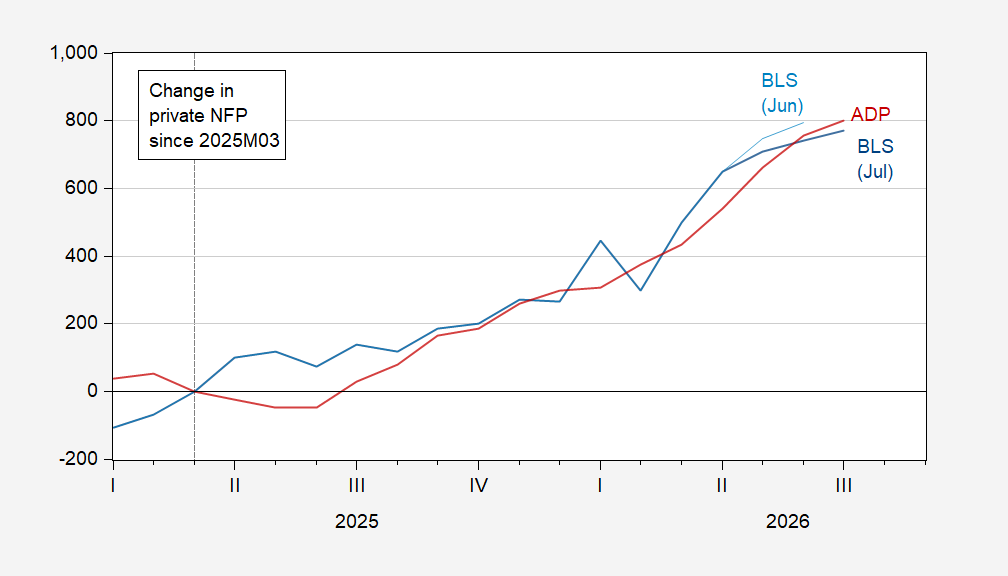
Private sector Non-Farm Payroll (NFP) growth decelerated notably, with the reported figure of +30K falling significantly below the Bloomberg consensus estimate of +78K.
The data point to a marked slowdown in private-sector hiring. Private NFP measures the net change in employment across all non-government (private) payrolls in the United States and is a closely watched component of the broader Employment Situation report released monthly by the U.S. Bureau of Labor Statistics (BLS). Economists generally consider monthly payroll growth in the range of roughly 70,000–100,000 as the level needed to absorb new labor force entrants and hold the unemployment rate approximately steady, placing a +30K print well below that benchmark.
A reading of +30K against a +78K consensus indicates that private employers added far fewer jobs than market participants anticipated, suggesting a cooling in labor demand. The Bloomberg consensus represents the median forecast compiled from surveys of professional economists prior to the release.
The broader NFP report, which includes government employment in addition to private-sector payrolls, is one of the most consequential economic indicators for financial markets, influencing expectations around Federal Reserve monetary policy, interest rate decisions, and broader macroeconomic sentiment. Under its statutory dual mandate, the Federal Reserve targets both stable prices and maximum employment, meaning sustained softness in private-sector payrolls can factor into policy deliberations about the appropriate stance of interest rates.
It is also worth noting that initial BLS payroll estimates are subject to revision in subsequent monthly reports, so the magnitude of the reported slowdown may be refined as updated data arrives.
Source: Econbrowser

