Nigeria's USPF opens ₦10 million Changemaker Challenge for startups tackling rural connectivity gaps
Key Takeaways
- •The USPF Changemaker Challenge, launched on 2 November 2026 by the Universal Service Provision Fund and Ubulu Africa, accepts free applications until 11:59 PM WAT on 15 November 2026.
- •A 2024 USPF ICT gap study identified 87 clusters across Nigeria with little or no telecommunications access, home to an estimated 23.37 million people.
- •Eligible applicants must be Nigerian-based teams or early-stage startups of two to five members, all aged 18 or older, addressing problem statements in financial inclusion, agriculture, healthcare, education, or clean and affordable energy.
- •Following initial screening, 50 teams will advance to Regional Demo Days across Nigeria's six geopolitical zones, with 37 places guaranteed—one for each state and the FCT—alongside 13 merit-based selections.
- •Six finalists, one per geopolitical zone, will enter a four-week venture incubation programme, and the top three teams will share the ₦10 million prize pool.
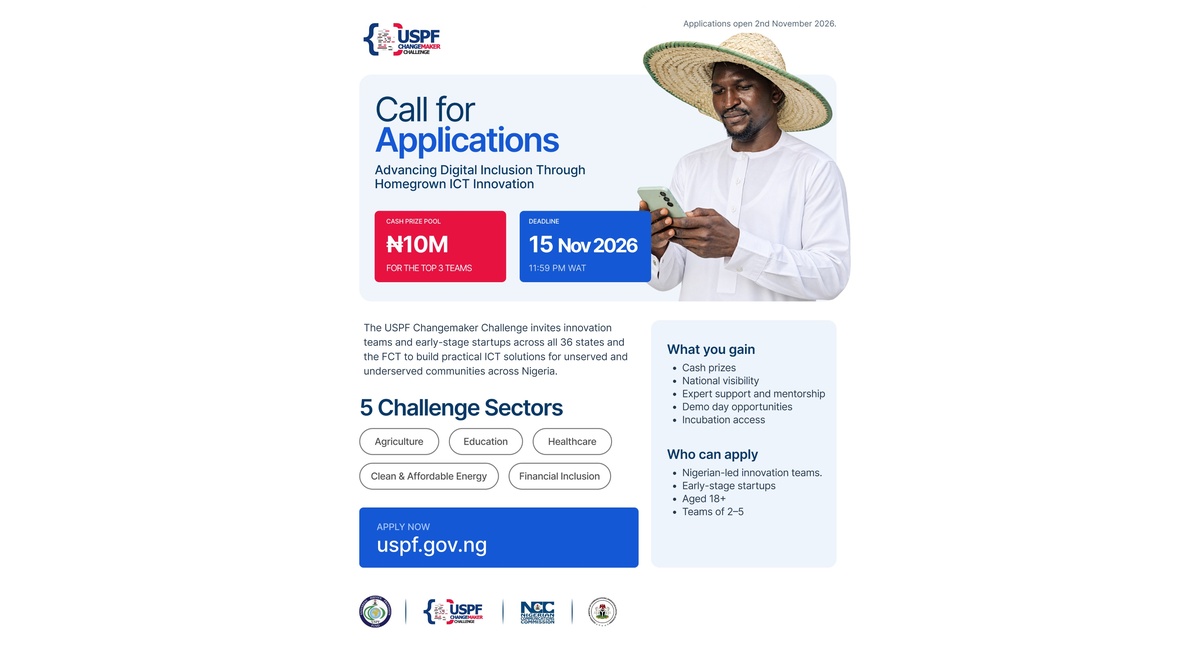
Early-stage founders and innovation teams building practical technological solutions for Nigeria's excluded communities have until Sunday, 15 November 2026, to enter the USPF Changemaker Challenge, which carries a ₦10 million prize pool alongside venture incubation support.
The nationwide competition was launched on 2 November 2026 by the Universal Service Provision Fund (USPF), a federal agency, together with implementing partner Ubulu Africa. It seeks homegrown ICT solutions capable of operating where traditional commercial infrastructure falls short, particularly in rural communities.
Why the agency is funding grassroots innovators
The rationale behind the challenge is visible in Nigeria's connectivity deficit. While venture-backed startups in Lagos routinely build polished applications for urban users who already juggle multiple banking apps and fibre internet, millions of citizens outside the major commercial hubs remain locked out of the digital economy.
A 2024 ICT gap study conducted by the USPF identified 87 distinct clusters across Nigeria with little or no access to telecommunications services. An estimated 23.37 million people live in those clusters, cut off from basic digital rails. Independent data from GSMA Intelligence indicates that while Nigeria's physical coverage gap sits between 7 and 9 per cent of the population, the usage gap in rural corridors exceeds 50 per cent.
Even where faint 2G carrier signals reach the edges of those 87 clusters, high handset costs, erratic power supply, and prohibitive data pricing leave entire communities practically offline. For builders entering the challenge, the task is therefore not simply designing for low bandwidth — it is engineering solutions that keep working when connectivity fails altogether.
The thesis driving the Changemaker Challenge holds that developers sitting in capital cities rarely grasp the daily operational realities of an off-grid clinic or a rural smallholder farm. The people best positioned to engineer resilient tools for these markets, the organisers argue, are Nigerians who experience those bottlenecks firsthand.
"Innovation should not be limited by geography," said Dr Odiong Akpan, Chief Executive Officer at Ubulu Africa. "Through the USPF Changemaker Challenge, we want to reach innovators across Nigeria who understand the challenges facing unserved and underserved communities and have practical solutions to address them. We encourage teams with promising ICT-enabled solutions to apply and take advantage of this opportunity to demonstrate their ideas and access support to develop them further."
Five priority sectors
Rather than running an open-ended pitch competition for generic software, the challenge requires early-stage startups and innovation teams to address published problem statements across five foundational sectors:
- Financial Inclusion — expanding reliable access to money and financial services for unbanked rural populations.
- Agriculture — digital tools that resolve farm-level productivity, supply chain, or market-access bottlenecks.
- Healthcare — practical ICT interventions designed for communities lacking basic clinical infrastructure.
- Education — learning tools built to function where bandwidth and classroom resources are scarce.
- Clean and Affordable Energy — systems that tackle the power deficit choking rural commerce and connectivity.
Of the five, the energy category speaks most directly to the access barriers outlined earlier: erratic power supply is one of the reasons communities on the edges of those 87 clusters stay practically offline even when a faint 2G signal reaches them.
A pipeline built for geographic spread
National innovation calls often suffer from a centralisation bias in which teams from Abuja and Lagos sweep the shortlist. The USPF and Ubulu Africa have structured the screening pipeline to prevent that capture and enforce genuine geographic distribution.
Following the initial screening, 50 teams will advance to live Regional Demo Days hosted across each of Nigeria's six geopolitical zones. That cohort guarantees representation for one team from each of the 36 states and the Federal Capital Territory (FCT) — 37 guaranteed places — alongside 13 additional teams selected purely on merit, completing the field of 50.
From the regional showcases, six finalists — one representing each geopolitical zone — will advance to the National Demo Day. All six national finalists will enter a four-week venture incubation programme to harden their products for deployment, while the top three teams will share the ₦10 million prize pool.
Eligibility and application details
To qualify, applicants must be Nigerian-based innovation teams or early-stage startups comprising between two and five members, all aged 18 or older.
Judges will not be grading teams on vanity projections. Entries will be assessed strictly on three criteria: a clear ICT component, direct alignment with one of the published problem statements, and credible evidence that the solution can work for the people it is meant to serve.
The application is free, and the full eligibility criteria alongside the application form are live at uspf.gov.ng until 11:59 PM WAT on 15 November 2026. Once applications close, the milestones to watch run from initial screening through the Regional Demo Days in each of the six geopolitical zones to the National Demo Day, the four-week incubation programme for its six finalists, and the ₦10 million prize pool reserved for the top three.

