USDT on TRON vs. Ethereum: Cost, Liquidity, and Risk Trade-Offs for Every Transfer
Key Takeaways
- •USDT exists as separate tokens on TRON and Ethereum with different addresses, fee mechanisms, and technical requirements, despite sharing the same ticker name.
- •Ethereum held approximately 92.06 billion USDT across 15.35 million holder addresses as of July 2026, while TRON hosted about 90.28 billion USDT across more than 75.3 million addresses.
- •TRON reduced its Energy unit price from 210 to 100 sun in August 2025, but final transaction costs still vary based on resource consumption and whether the sender has access to staked or delegated Energy.
- •Tether's first-quarter 2026 attestation reported approximately $183 billion in token-related liabilities and $8.23 billion in excess reserves, with the document prepared by BDO as an attestation rather than a full audit.
- •The T3 Financial Crime Unit, formed by Tether, TRON, and TRM Labs, reported helping freeze over $450 million in assets linked to suspected criminal activity by May 2026, demonstrating that neither network makes USDT censorship-resistant.
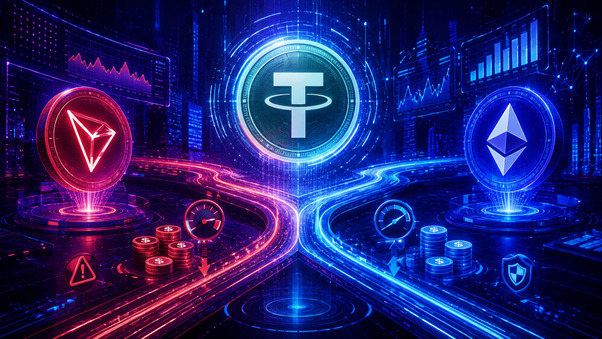
Sending USDT may appear simple, but choosing the network involves more than comparing fees.
The token carries the same name on TRON and Ethereum, yet each version runs on its own blockchain and follows a different set of technical rules. The two networks have different fee models, settlement processes, liquidity profiles, and technical risks. A route that looks cheaper at the outset may cost more once withdrawal fees, future swaps, or a network conversion are included.
USDT is the largest stablecoin by market capitalization, with a combined supply exceeding $182 billion across the two networks alone. That scale means the choice between TRC20 and ERC20 affects everyone from retail remittance senders to institutional treasurers, and the cost of getting it wrong grows with the size of the transfer.
TRON remains a major retail transfer rail for USDT. Ethereum, meanwhile, hosts slightly more USDT and provides access to a much deeper on-chain financial system. Ethereum fees have also fallen considerably, while the cost of a TRON transfer increasingly depends on whether the sender has access to Energy.
The familiar shorthand that TRON is cheap and Ethereum is expensive is no longer sufficient.
The Network Matters More Than the Ticker
USDT keeps the same name on Ethereum and TRON, which makes the two versions easy to confuse. Technically, however, they are separate tokens running on separate blockchains: ERC20 on Ethereum and TRC20 on TRON.
That difference becomes important the moment funds are sent. An ERC20 transfer requires ETH for gas. On TRON, the sender uses Bandwidth and Energy, with TRX burned if the account does not have enough resources available.
The addresses are different as well. Ethereum addresses normally begin with 0x; TRON addresses usually start with T. More importantly, the receiving wallet or platform must support the network being used. The USDT ticker may be correct while the selected route is not.
Switching networks is not part of a standard transfer. Moving USDT from TRON to Ethereum, or in the opposite direction, requires an exchange, swap provider, bridge, or another cross-chain route. That can mean another fee, an extra intermediary, and a longer path before the funds are ready to use.
This same multi-network structure exists for other major stablecoins, including USDC and DAI, but USDT's dominance in transfer volume—particularly on TRON—makes the network-selection question especially consequential for everyday users.
Ethereum Holds More USDT. TRON Reaches More Addresses
As of July 30, 2026, Ethereum hosted approximately 92.06 billion USDT, compared with about 90.28 billion on TRON. Ethereum had roughly 15.35 million holder addresses, while TRON recorded more than 75.3 million.
Addresses are not the same as users. One person may control several wallets, while one exchange address can hold funds for thousands of customers. Still, the difference reflects how the networks are used.
Ethereum's USDT supply is closely connected to exchanges, market makers, DeFi protocols, and institutional activity. TRON's much larger address count reflects its role in wallet-to-wallet transfers and movement between centralized services.
TRON recorded about 2.28 million USDT transfers on July 29, with more than 15.6 million over seven days. These figures include exchange operations, automated activity, treasury movements, and funds transferred more than once. They do not represent consumer payments alone, but they show how central USDT is to the network.
The Cheapest Network Is Not Always Obvious
Ethereum and TRON calculate transaction costs differently.
On Ethereum, an ERC20 transfer consumes gas. The fee depends on the amount of gas used, the current base fee, any priority fee, and the price of ETH. The sender must hold ETH even when transferring USDT.
Ethereum's fee environment has changed. The EIP-1559 upgrade, implemented in August 2021, introduced a base fee mechanism that makes gas costs more predictable during normal network conditions. Layer 2 adoption, increased network capacity, and subsequent protocol upgrades have further reduced pressure on the main chain. During quiet periods, an ERC20 transfer can now cost far less than the several-dollar fees associated with earlier periods of congestion.
TRON uses Bandwidth and Energy. Bandwidth covers the size of the transaction, while Energy pays for smart-contract execution. Users can obtain these resources by staking TRX or receiving delegated resources. Without enough resources, TRX is burned.
The Energy required for a USDT transfer is not always identical. Sending funds to an address with no existing USDT balance may consume more Energy because the contract must create a new storage entry. TRON's Dynamic Energy Model can also raise consumption for heavily used contracts.
As a result, a self-custody wallet without prepared resources may occasionally pay more for a TRC20 transfer than an Ethereum wallet during a period of very low gas prices.
Large exchanges and payment processors operate under different conditions. They can stake TRX, rent Energy, or use delegated resources, reducing their effective cost per transaction. This helps explain why TRC20 withdrawals may remain inexpensive on a platform even when a direct transfer from an individual wallet would cost more.
TRON reduced the Energy unit price from 210 to 100 sun in August 2025. The change lowered the direct burn cost but did not create a fixed transaction fee. The final amount still depends on resource consumption, the sender's account, the recipient's token balance, and the price of TRX.
Network Fees Are Only Part of the Cost
Users often pay more than the underlying blockchain fee.
An exchange may charge a fixed withdrawal fee that does not closely follow current network conditions. A platform can leave its fee unchanged even when Ethereum gas falls or when its own TRON Energy costs are low.
The full cost may include the blockchain fee, a platform withdrawal fee, the cost of acquiring ETH or TRX, a trading spread, a bridge or network-conversion fee, and another transfer if the funds arrive on the wrong network.
Transaction size also matters. A $2 fee represents 10% of a $20 payment but only 0.2% of a $1,000 transfer. For a six-figure treasury movement, liquidity, custody policy, and compatibility with the destination may matter more than a small difference in network fees.
The cheapest route is the one that leaves the recipient with usable USDT without requiring another costly step.
TRON and Ethereum Offer Different Types of Liquidity
Both networks have deep USDT liquidity, but in different forms.
TRON has strong transfer liquidity. Many wallets, merchants, payment companies, and over-the-counter operators support TRC20. When choosing a USDT exchange, users also need to confirm that the service supports the same network as the receiving wallet, since availability and withdrawal fees can differ between TRC20 and ERC20. In markets where users regularly move dollar-linked value between centralized services, TRC20 may be the version counterparties expect.
Ethereum has deeper on-chain trading liquidity. Its USDT can be used across a broader range of decentralized exchanges, lending markets, collateral systems, derivatives platforms, and treasury applications.
In late July 2026, Ethereum recorded approximately $29.22 billion in 30-day decentralized exchange volume, compared with about $1.15 billion on TRON. These figures include all assets traded on each network, not only USDT, but they show the difference in the scale of the surrounding markets.
A TRON wallet may provide better access to centralized payment channels. An Ethereum wallet may offer stronger access to lending, trading, and collateral markets.
Exit liquidity is another issue. A network may contain billions of dollars in USDT without offering a convenient route into local currency. For many users, the most useful network is simply the one supported by their exchange, bank-connected platform, or local over-the-counter desk.
Direct redemption through Tether is not a practical route for most holders. Tether sets a minimum acquisition or redemption amount of $100,000 and charges the greater of $1,000 or 0.1% for redemption. Most users therefore depend on secondary-market liquidity.
Block Time Is Not Settlement Time
TRON produces a block approximately every three seconds. Ethereum uses 12-second slots. A transaction can therefore appear on TRON sooner when both networks are operating normally.
First inclusion is not the same as finality.
TRON generally considers a block solidified after at least 19 of its 27 active Super Representatives have built on that block or a later one. This usually places the solidified chain about a minute behind the latest block.
Ethereum reaches full economic finality later, typically in around 13 to 15 minutes. Wallets and services often act before full finality once they consider the confirmation risk acceptable.
The recipient may still wait longer on either network. Exchanges set their own confirmation requirements and may delay deposits for maintenance, compliance checks, or internal risk controls.
The comparison is therefore not simply three seconds versus 12 seconds. Those figures describe block production, not the point at which the recipient can trade, withdraw, or spend the funds.
The Wrong Network Can Be the Most Expensive Error
USDT uses the same ticker across several blockchains, which can make different versions appear interchangeable.
A sender can hold genuine USDT and copy the correct destination provided by the recipient, yet still choose a network the receiving platform does not support.
Recovery may sometimes be possible in a self-custody setting if the recipient controls the relevant private key. When the address belongs to an exchange or payment service, recovery depends on the platform's policy and technical capabilities. It is never guaranteed.
The intended use of the funds also matters. A business may accept TRC20 because customers prefer it, then need ERC20 USDT for an Ethereum lending market. The first transfer may be inexpensive, but changing networks adds another transaction, fee, and risk.
An exchange introduces custody and withdrawal risk. A bridge adds smart-contract, validator, and liquidity risk. A swap adds execution and counterparty risk.
A cheap transfer can become expensive when the USDT arrives on the wrong network for what happens next.
The Issuer Risk Remains the Same
Choosing between Ethereum and TRON changes network-level risks. It does not remove exposure to Tether.
This distinction also matters when considering Tether as an investment. USDT is designed to maintain a dollar-linked value rather than appreciate like a conventional crypto asset, so its long-term outlook depends more on peg stability, reserves, redemption conditions, and counterparty risk than on price growth.
Both versions of USDT depend on the same issuer, reserve structure, redemption rules, banking relationships, and administrative controls. Stablecoin issuers globally face increasing regulatory attention. The European Union's Markets in Crypto-Assets (MiCA) regulation, in effect since 2024, imposes specific reserve, transparency, and operational requirements on token issuers operating in the bloc, and other jurisdictions are developing comparable frameworks. These developments shape the environment in which Tether and its competitors operate, regardless of which blockchain carries the tokens.
Tether's first-quarter 2026 attestation reported approximately $183 billion in token-related liabilities and $8.23 billion in excess reserves as of March 31. The document was an attestation prepared by BDO, not a full audit of the company.
Tether can also freeze tokens and blacklist addresses. This applies to USDT regardless of the network on which it circulates.
Enforcement has become particularly visible on TRON. In May 2026, the T3 Financial Crime Unit, created by Tether, TRON, and TRM Labs, reported that it had helped freeze more than $450 million in assets linked to suspected criminal activity.
Neither network makes USDT censorship-resistant. A blockchain may continue operating while a specific token balance remains frozen by the issuer.
The Best Network Depends on the Next Step
TRON remains a practical route for frequent wallet-to-wallet USDT transfers. It has broad exchange support, a large holder base, short block intervals, and a resource system that can reduce costs for users and businesses that manage Energy efficiently.
Ethereum offers broader access to decentralized trading, lending, collateral, and treasury infrastructure. Falling mainnet fees have also weakened the assumption that ERC20 is always the more expensive option.
Neither network is better in every situation. Both networks continue to evolve—TRON adjusting its Energy economics, Ethereum rolling out protocol upgrades and expanding Layer 2 capacity—so the cost and capability trade-offs described here may shift again. Users who transfer USDT regularly should recheck current conditions rather than relying on assumptions from an earlier period.
TRON may be the practical choice for a small payment to a recipient who already uses TRC20. ERC20 may be more suitable when the funds are intended for Ethereum DeFi. For an exchange deposit, the platform's withdrawal fee, supported networks, and confirmation policy may matter more than the underlying blockchain.
The network selector determines more than the fee. It affects where the USDT can move next, what asset is required to pay for the transfer, how the recipient can use the funds, and whether an error can be recovered.
The useful question is not whether TRON or Ethereum is cheaper in isolation. It is which route produces the lowest total cost and leaves the recipient with the most usable USDT after the transfer.
Disclaimer: This article is for informational purposes only and does not constitute financial or investment advice. Cryptocurrency and digital asset markets carry significant risk. Always do your own research before making decisions.

