US Treasury Sells 30-Year Bonds at High Yield of 5.216%
Key Takeaways
- •The US Treasury's 30-year bond auction cleared at a high yield of 5.216%, four tenths of a basis point above the prevailing when-issued level of 5.212%.
- •The auction's positive tail of 0.4 basis points, compared to an average of -0.2 basis points, signals softer demand at the clearing yield than is typical.
- •The bid-to-cover ratio of 2.39x fell slightly below the recent average of 2.43x, indicating marginally lower overall auction demand.
- •Both domestic and international bidder participation came in just below their historical averages at 21.6% and 66.8%, respectively.
- •Primary dealers absorbed 11.6% of the offering, above their average share of 10.6%, suggesting end-investor demand was insufficient to fully clear the auction at prevailing yields.
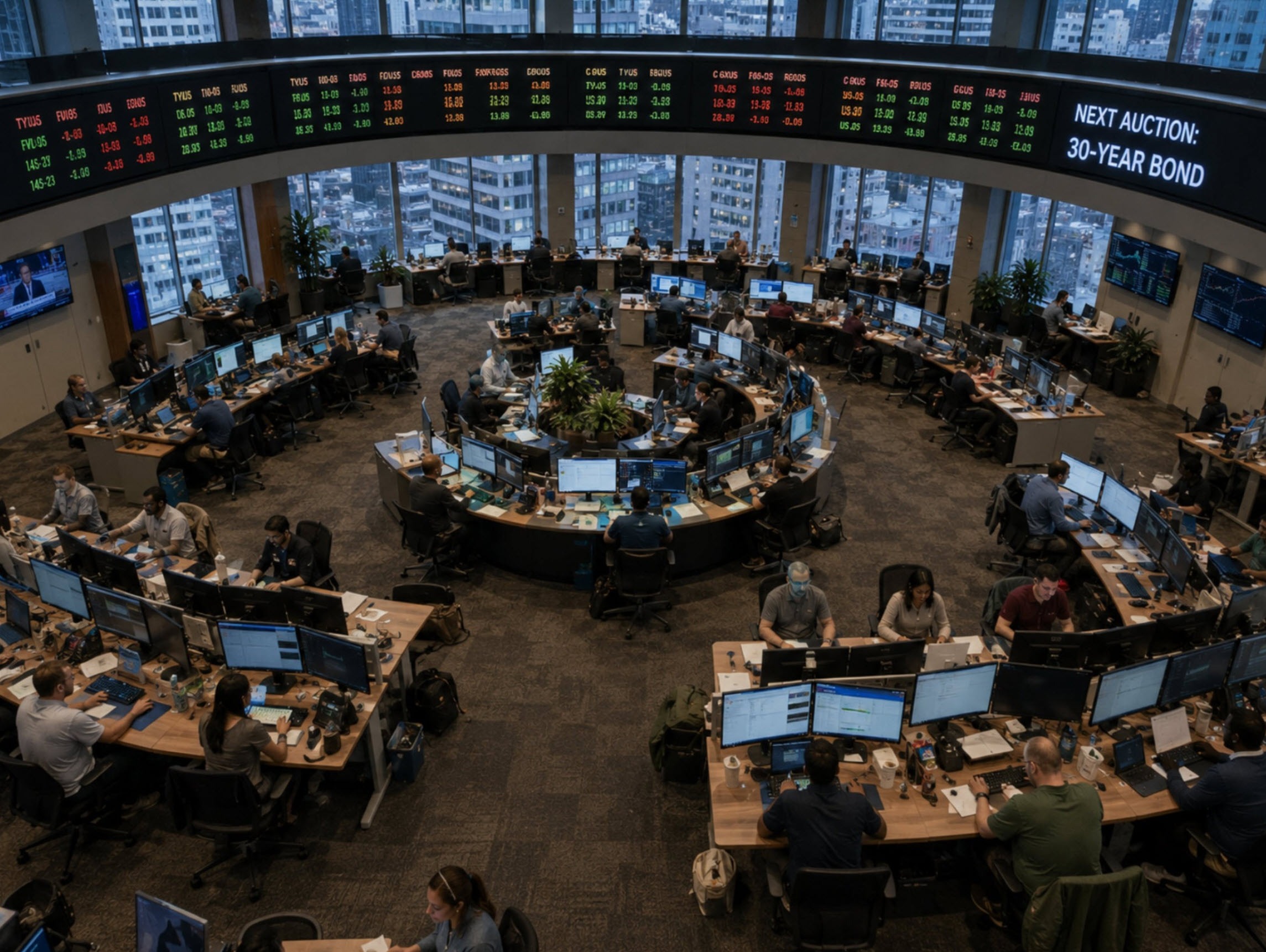
The US Treasury conducted its 30-year bond auction — the longest-duration benchmark Treasury security and a key barometer of investor appetite for long-term US government debt — awarding a high yield of 5.216%. The when-issued (WI) level at the time of the auction stood at 5.212%.
Auction Results
| Metric | Result | Average |
|---|---|---|
| High Yield | 5.216% | — |
| WI Level at Auction | 5.212% | — |
| Tail | +0.4 bps | -0.2 bps |
| Bid-to-Cover Ratio | 2.39x | 2.43x |
| Directs (Domestic) | 21.6% | 22.5% |
| Indirects (International) | 66.8% | 67.0% |
| Dealers | 11.6% | 10.6% |
Auction Grade: C-
Analysis of Demand
The auction produced a tail of 0.4 basis points above the WI level, compared to an average tail of -0.2 basis points. A positive tail indicates that the highest accepted yield was higher than the prevailing market yield at the time of the auction, suggesting softer demand at the clearing price.
The bid-to-cover ratio came in at 2.39x, just below the recent average of 2.43x. This metric measures total bids received relative to the amount of debt offered for sale and serves as a broad indicator of auction demand.
By bidder category, direct bidders — typically domestic institutions such as investment funds, pension funds, and insurance companies — took down 21.6% of the offering, slightly below their average allocation of 22.5%. Indirect bidders, which include foreign central banks and international investors and are submitted through primary dealers or the Federal Reserve Bank of New York, accounted for 66.8% of the auction, marginally below their average of 67.0%. Indirect bidder participation is closely tracked by market participants as a proxy for foreign demand for US debt, a metric of particular interest given the growing stock of outstanding Treasury securities.
With demand from both directs and indirects running slightly below their respective averages, primary dealers — the financial institutions required to bid at Treasury auctions and absorb any unsold portion — were left with 11.6% of the issue, above their average share of 10.6%. Dealers serve as a residual buyer of last resort in Treasury auctions, and an above-average takedown can signal that end-investor demand was insufficient to fully clear the auction at prevailing yields.
Treasury auction results are monitored in real time by fixed-income markets as a direct read on the cost of government borrowing and investor willingness to hold long-duration assets, which carry heightened sensitivity to interest-rate and inflation risk.
Source: Investinglive

