Cyclically Adjusted US Budget Balance Improves Through 2025Q3 — Until IEEPA Tariff Revenue Is Excluded
Key Takeaways
- •The federal structural budget balance improved through 2025Q3, but excluding revenue from the IEEPA tariffs significantly worsens the picture.
- •Courts found the IEEPA tariffs unlawful, and it remains unresolved whether collected duties must be refunded to importers, with refunds in principle beginning in 2026Q1.
- •The CBO estimates the FY2027 cyclically adjusted balance at -5.8% of potential GDP.
- •Large structural deficits, unlike cyclical ones, do not shrink with economic recovery and weigh on the equilibrium real interest rate, supporting expectations of elevated real rates.
- •The fiscal outlook remains uncertain due to the ongoing war, potential tariff refunds, and legal challenges to newly announced tariffs.
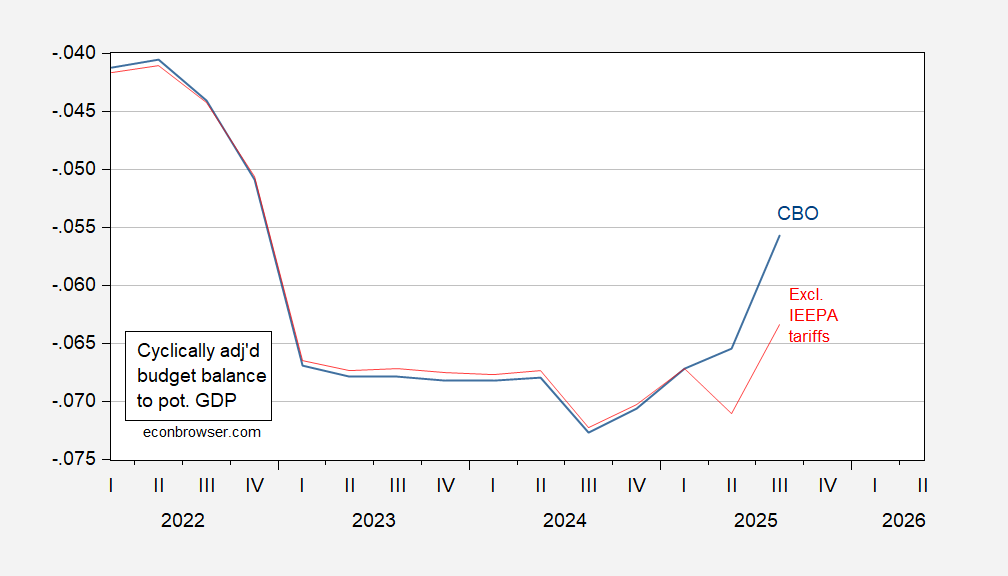
The federal budget balance excluding automatic stabilizers was improving through 2025Q3 — but once the revenue associated with the illegal IEEPA tariffs is stripped out, the picture changes considerably.
Figure 1 shows the federal budget balance excluding automatic stabilizers (blue) and excluding IEEPA tariffs (red), as a share of potential GDP. The cyclically adjusted — or structural — balance is a standard fiscal yardstick because it strips out swings in revenue and spending that follow the business cycle, giving a cleaner read on the underlying fiscal stance. The calculation assumes that amounts above Q1 tariff revenue are IEEPA-related tariff revenue. Source: CBO, Effect of Automatic Stabilizers (August 2025) and author's calculations.
The author presents a budget balance adjusted to exclude customs revenue associated with the IEEPA tariffs — described as a guesstimate — because those collections are in principle supposed to be fully refunded starting in 2026Q1, which falls after the sample shown, as CBO only provides projections through Q3. The tariffs were imposed under the International Emergency Economic Powers Act, a 1977 statute the executive branch had not previously used to levy tariffs; courts found the resulting duties unlawful, and the refund question — whether collected duties must be repaid to importers — remains unresolved, which is what makes excluding this revenue informative for gauging the durable fiscal position.
The CBO estimates the FY2027 cyclically adjusted balance relative to potential GDP at -5.8%. The author notes that this single statistic is a key reason to expect real rates to remain elevated. Large structural deficits of this kind, unlike cyclical ones, do not shrink as the economy recovers, which is why they weigh on estimates of the equilibrium real interest rate.
It remains unclear how the ongoing war, tariff refunds, and legal challenges to the newly announced tariffs will affect the cyclically adjusted balance, as all of these issues are in a state of flux.
Regarding customs revenue, the scale of the uncertainty can be seen in Paweł Skrzypczyński's calculations of gross revenue, net revenue, and refunds: Source: Paweł Skrzypczyński.

