U.S. rail traffic accelerates as steel-driven metals shipments surge in latest AAR data
Key Takeaways
- •U.S. railroads moved 525,099 carloads and intermodal units in the week ending August 15, up 2.4% from a year earlier.
- •Metallic minerals and ores rose 19.2% and led eight of the 10 carload commodity groups higher.
- •Forest products increased 10.5% year over year, even though July housing starts declined from both the prior month and the prior year.
- •Motor vehicles and parts fell 13.2% for the week, while coal carloads dropped 5.7%.
- •For the first 32 weeks of 2026, U.S. rail traffic increased 3.3% from a year earlier, and North American combined traffic was up 2.9% year to date.
U.S. railroad traffic gained ground in the latest weekly reading from the Association of American Railroads (AAR), with stronger output from steelmakers giving shipments a notable lift. The AAR's weekly figures are among the timeliest barometers of U.S. goods movement: carloads track industrial and commodity production, while intermodal containers and trailers are closely tied to consumer spending and import flows.
For the week ending August 15, U.S. railroads handled 525,099 carloads and intermodal units, an increase of 2.4% from the same week a year earlier. Commodity freight totaled 233,261 carloads, up 1.9%, while intermodal volume of 291,838 containers and trailers improved 2.7% compared with 2025.
Metallic minerals and ores paced the gains, leading eight of 10 carload commodity groups higher with a 19.2% jump. The sector has benefited from 50% Section 232 tariffs — levied under the Trade Expansion Act of 1962 provision that authorizes import restrictions on national-security grounds, with the steel rate raised from 25% to 50% in June 2025 — and tightened enforcement, which have squeezed foreign supply and redirected demand to domestic mills. Those mills are running at higher utilization and adding capacity, while steady infrastructure-linked demand and stronger domestic pricing reinforce the effect.
Forest products posted a bounceback week, rising 10.5% year over year. The improvement came even as July housing starts fell 12.4% from June and 13.5% from July 2025; building permits, by contrast, increased 5% from June and 3.1% for the year.
Not every category advanced. Motor vehicles and parts dropped 13.2% for the week, and coal carloads weakened 5.7% year over year. Coal has long been the single largest source of U.S. railcarloads, though the segment has faced a multiyear demand slide as electric utilities shift generation toward natural gas and renewables.
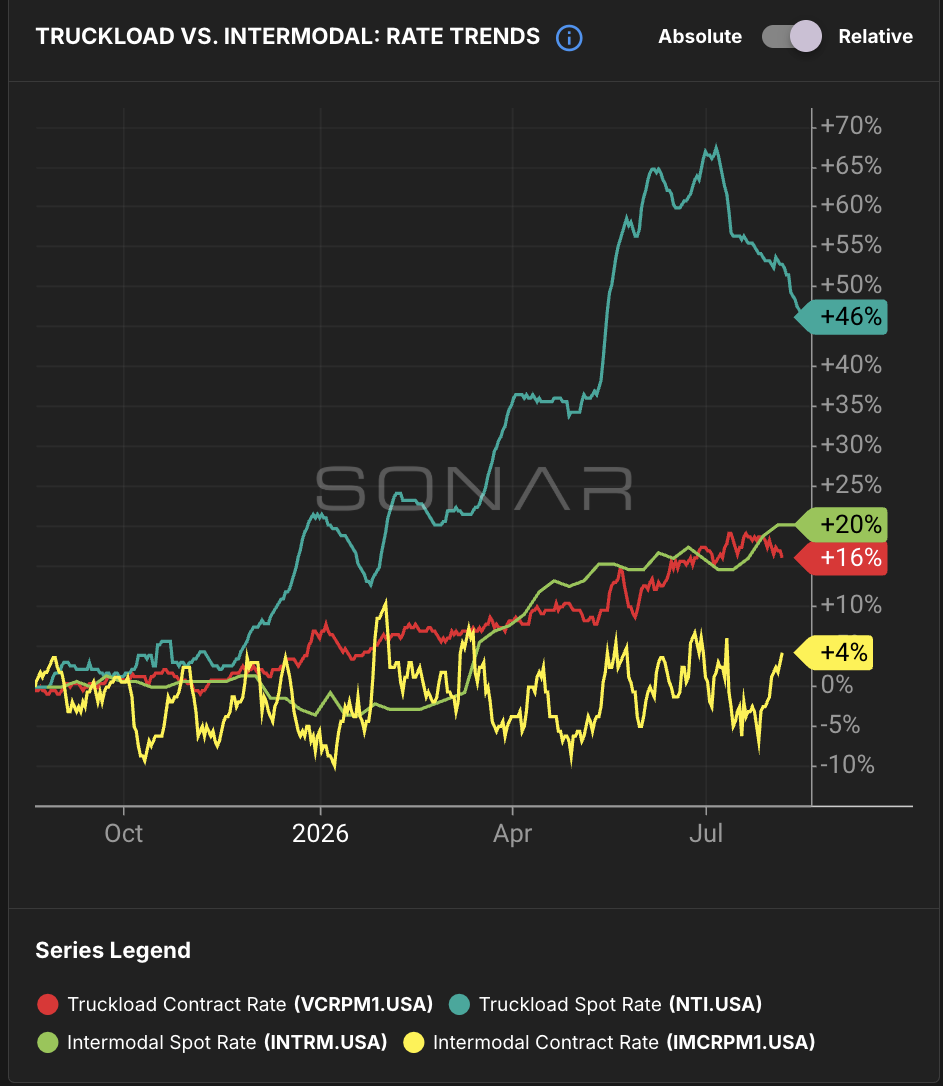
Cumulative figures for the first 32 weeks of 2026 show U.S. railroads hauled 7,276,025 carloads, up 2.7%, along with 9,005,409 intermodal units, ahead 3.8%. Total combined U.S. traffic for the period grew 3.3% to 16,281,434 carloads and intermodal units from a year earlier. The sector continues to benefit from import traffic buoyed by resilient consumer demand, as well as ongoing conversions of truckload freight amid upward rate movement in that market. Intermodal volumes typically build through late summer and early autumn as retailers restock ahead of the holiday season, so the weekly readings in the weeks ahead will offer a timely read on whether that seasonal pattern holds.
North American volume for the week, reported across nine U.S., Canadian and Mexican railroads, totaled 335,920 carloads, up 4.7%, and 383,904 intermodal units, up 5.1% against year-ago levels. Total combined traffic was 4.9% higher at 719,824 carloads and intermodal units. For the year to date, North American volume of 22,343,160 carloads and intermodal units stands 2.9% above 2025.
