Ex-Trump Security Official Asks 'Are We Really Back to Love Letters?' as Trump Shrinks South Korea War Games
Key Takeaways
- •Trump said the annual military exercises with South Korea will be much smaller than before because he considers them unnecessary.
- •The U.S.–South Korea drills are described as a core part of deterrence on the Korean Peninsula, where about 28,500 American troops are stationed.
- •Trump previously suspended several major joint drills after his 2018 summit with Kim Jong Un, but the exercises were later restored and expanded.
- •The 2019 Hanoi summit ended without a deal, and North Korea subsequently accelerated its missile program.
- •The article says Kim Jong Un now has roughly 60 nuclear weapons and capabilities that can reach the United States.
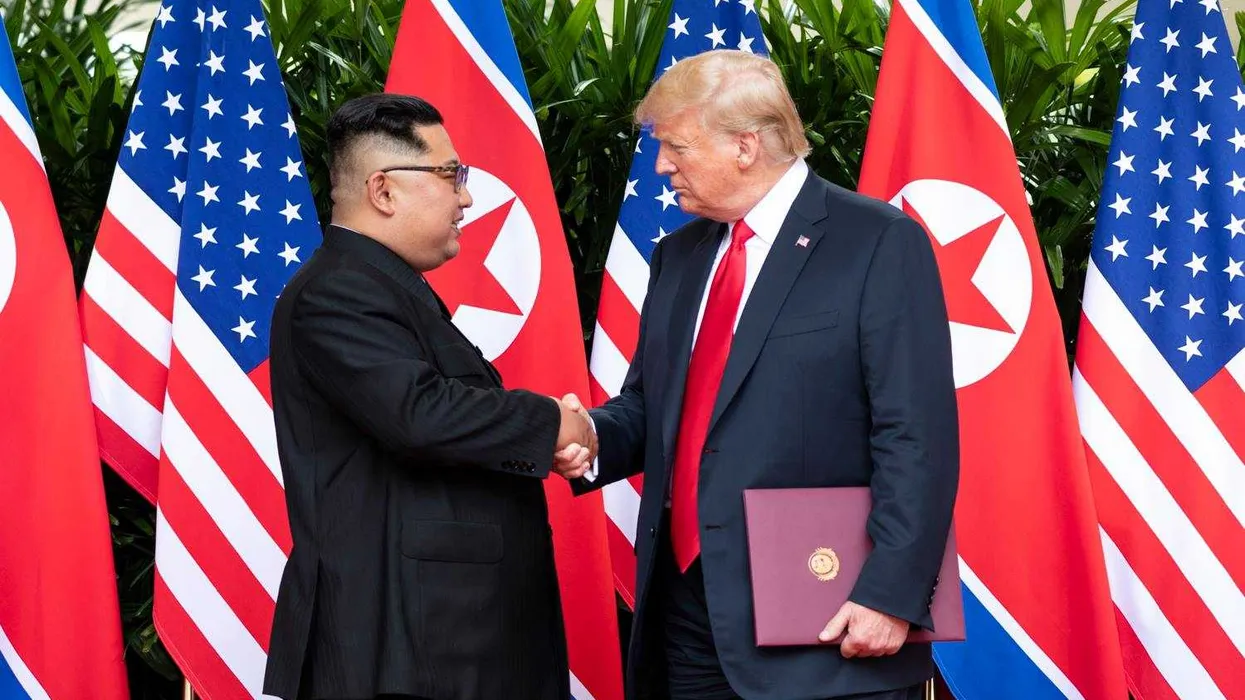
Olivia Troye, a former national-security official under President Donald Trump who publicly warned about threats during his first administration, is sounding the alarm again — this time over the president's latest move concerning the Korean Peninsula.
Troye, who worked on national security and homeland security issues at the Department of Defense and the National Counterterrorism Center, was responding to Trump's announcement that annual war games with South Korea will be significantly smaller than in previous years. Trump said he considers the exercises unnecessary given his positive relationship with North Korean leader Kim Jong Un.
The drills, which pair computer-simulated command training with live field exercises, are a cornerstone of the U.S.–South Korea alliance, which has deterred renewed conflict on the peninsula since the 1950–53 Korean War ended in an armistice rather than a peace treaty. About 28,500 American troops are stationed in South Korea, and North Korea has long denounced the joint exercises as rehearsals for invasion. Trump scaled the war games back once before: after his 2018 Singapore summit with Kim, he suspended several major joint drills, calling them “very provocative” and costly, before they were later restored and expanded.
Troye said she could recall the first Trump administration, “when the White House feared North Korea could directly threaten the homeland. I watched countless hours go into preparing and protecting Americans.”
During his first term, Trump frequently threatened Kim on social media, warning that the North Korean leader would face “fire and fury like the world has never seen.” He insulted Kim as “Little Rocket Man” and declared that the U.S. military was “locked and loaded” for a full conflict with North Korea. In his 2017 speech to the United Nations, Trump threatened to “totally destroy” North Korea if it ever threatened the U.S. or its allies.
Then, as Trump described it, “we fell in love,” as the two leaders exchanged “love letters.” Those letters were obtained by Bob Woodward for his book on Trump, and CNN published two of them, showing Kim's affinity for referring to Trump as “Your Excellency.”
The diplomatic effort failed — the leaders' 2019 summit in Hanoi broke down without a deal amid disputes over sanctions relief and the pace of denuclearization — and North Korea accelerated its missile program. Today, Kim has roughly 60 nuclear weapons and weapons that can reach the United States.
“Now Trump is cutting military exercises with South Korea while boasting about Kim Jong Un,” Troye noted — prompting her to ask: “Are we really back to love letters?”
Writing for the New York Times this week, David E. Sanger and Anton Troianovski reported that as Trump continues to lose his war with Iran, he is turning instead to “a familiar foe,” North Korea. Still, the report explained, “analysts see little hope of quickly dismantling that country's growing nuclear arsenal.”
It is an odd contrast, said Robert Litwak, a scholar at George Washington University who writes about nuclear programs in Iran and North Korea.
“We're at war with Iran, a nuclear-threshold state,” Litwak said. “But with North Korea, we are placating a dictator who can target the U.S. homeland with nuclear weapons.”

