US Navy Prepares for Extended Carrier Deployments as Markets Cut Odds of Iranian Airspace Closure
Key Takeaways
- •The Chief of Naval Operations and the Master Chief Petty Officer of the Navy announced that the U.S. Navy is preparing for extended aircraft carrier deployments in response to the ongoing conflict with Iran.
- •Stretching carrier deployments beyond the typical six-to-seven-month rotation compresses the maintenance availability and home-dwell time that shipyards and crews depend on between voyages.
- •The probability of a full Iranian airspace closure by August 31 fell to 1.8%, down from 2% a day earlier and 6% a week before.
- •The prediction market for an airspace closure by December 31 declined to 17.5% from 28% within the past 24 hours.
- •Market participants view continued U.S. military readiness and the lack of a diplomatic resolution as factors reducing the likelihood of a complete Iranian airspace shutdown.
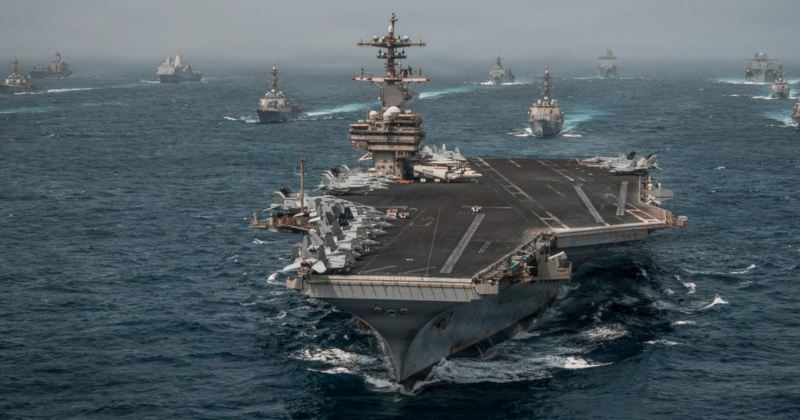
The U.S. Navy is preparing for extended aircraft carrier deployments in response to ongoing conflicts with Iran, according to recent announcements by the Chief of Naval Operations (CNO) and the Master Chief Petty Officer of the Navy (MCPON). The operational adaptation comes amid sustained military operations following the U.S.-Iran war that erupted earlier this year and marks a shift in how the Navy plans to sustain its presence in the region.
The Navy's plans suggest a commitment to protracted, high-intensity operations, which may involve keeping multiple carriers in the Middle East for extended periods. Carrier deployments are normally built around a rotation cycle of roughly six to seven months, and stretching them beyond that rhythm compresses the maintenance availabilities and home-dwell time that shipyards and crews rely on between voyages, a sustainment challenge the Navy has contended with in earlier periods of high operational tempo. The strategic decision aligns with a posture of escalation rather than routine deterrence, indicating the continued volatility of the geopolitical situation in the region. Taken together, the announcements point to heightened military readiness and the potential for further escalation in the U.S.-Iran conflict.
Prediction Markets Price In Continued Conflict
The implications of the development are also reflected in prediction markets, particularly those concerning the likelihood of Iran implementing a full closure of its airspace. Iranian airspace sits along one of the main overflight corridors linking Europe with the Gulf, South Asia, and points east, and international airlines have rerouted around the country during previous periods of regional tension, adding distance and flight time to long-haul routes. Current market pricing suggests that the probability of such a closure by August 31 has decreased further. The extended deployments are being interpreted as a sign of ongoing conflict rather than resolution, a reading consistent with continued hostilities and one that has reduced expectations of a full airspace shutdown.
The market for a full Iranian airspace closure by August 31 has seen its YES probability decline to 1.8%, down from 2% yesterday and significantly lower than 6% a week ago. Similarly, the market for a closure by December 31 has dropped to 17.5% from 28% just 24 hours ago. Current probabilities for an airspace closure by August 31, September 30, and December 31 have all decreased, reflecting reduced market expectations for such an event. Because a closure by December 31 logically includes closure by the earlier dates, the December contract's implied probability cannot fall below the August figure, and the wide gap between 17.5% and 1.8% underscores how little near-term closure risk traders currently price in. Market participants view the continued military readiness and the lack of a diplomatic resolution as factors lowering the likelihood of a complete airspace closure.
Indicators to Watch
Changes in military and diplomatic activity between the United States and Iran could influence the likelihood of an airspace closure. Key indicators include official statements from the Civil Aviation Organization of Iran and any significant developments in U.S.-Iran relations. A shift toward de-escalation, or conversely new military actions, could significantly affect market perceptions and pricing. As the August 31 deadline approaches, any last-minute developments could alter current market trajectories.

