A 'Geologic Freak' Called Smackover May End America's Lithium Dependence on China—and Big Oil Is Already There
Key Takeaways
- •Global lithium demand has climbed more than 400% this decade, exceeding 1.5 million metric tons annually, and could approach 4 million tons by 2035, driven by electric vehicles, energy storage, and robotics.
- •The Smackover Formation's underground brine aquifer holds unusually high lithium concentrations, and Standard Lithium estimates its lands alone could support more than 150,000 tons of annual production.
- •Standard Lithium's South West Arkansas Project, backed by a $225 million Department of Energy grant, Equinor as a 45% joint venture partner, and offtake agreements with Trafigura and LG Energy Solution, is slated to begin construction in the first quarter of 2027.
- •EnergyX signed a 10-year offtake agreement with Trafigura in October covering 100,000 tons and nearly $2 billion in lifetime value, which the company calls the largest direct lithium extraction offtake in history.
- •Direct lithium extraction, which reinjects more than 90% of brine underground and reduces extraction time from roughly two years to two days, remains unproven at commercial scale and faces risks from Chinese price manipulation and the elimination of U.S. EV tax credits.
Global lithium demand has climbed more than 400% in this decade alone, surpassing 1.5 million metric tons a year, and could approach 4 million tons by 2035. Batteries for electric vehicles, utility-scale and data center energy storage, and an emerging robotics industry are all driving that growth. Yet the United States produces little more than 1% of the world's lithium, most of it from Albemarle's Silver Peak mine in Nevada, and the world relies primarily on China for refining—as it does for many other critical minerals and rare earths.
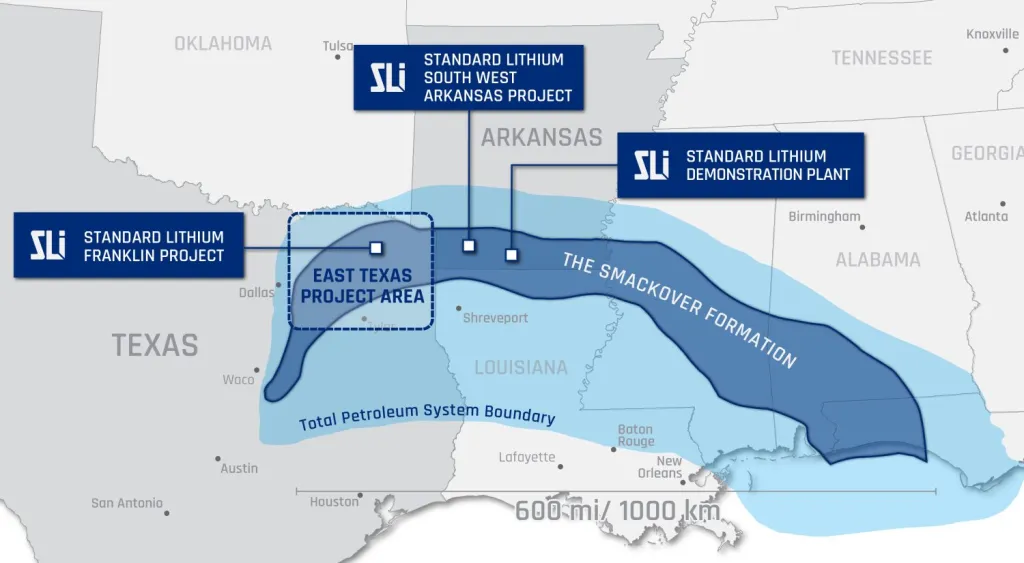
That could be about to change. Roughly 1,500 miles from Silver Peak lies the oddly named Smackover Formation in southern Arkansas and East Texas, where crude oil was discovered a century ago. Today, industry is fixated on the formation's massive underground aquifer and its unusually large lithium concentrations. Early French settlers called the area "Sumac Couvert," meaning "covered in sumac bushes," and the name evolved into Smackover.
"It's a geologic freak with its very high lithium concentrations," Standard Lithium CEO David Park told Fortune. "We believe that our lands alone have the potential for over 150,000 tons per year of production."
The contenders
Standard Lithium is the standard-bearer for the Smackover, the region with the most potential to turn the U.S. into a major lithium player. It is slated to authorize its South West Arkansas Project (SWA) late this year and start construction on the first 22,500-ton phase in the first quarter of 2027.
Its brash challenger is Austin, Texas-based EnergyX—short for Energy Exploration Technologies—led by Elon Musk acolyte Teague Egan, 38. EnergyX could break ground on its 15,000-ton Project Lonestar commercial facility by the end of 2027; a 250-ton pilot plant—a small-scale facility built to prove the technology before full commercial construction—came online earlier this year.
Big Oil is following. ExxonMobil established its position three years ago and now holds more than 400,000 net acres (a measure of a company's own share of leased acreage), the largest in the formation, and plans to start building a pilot project there next year. Chevron also bought heavily, announcing a 125,000-acre position last year.
The U.S. lacks the traditional resources of leading producers Australia, Chile, Argentina, and China: it has few open-pit, hard-rock deposits or economically viable evaporation ponds, such as Silver Lake. That is why Exxon and Chevron have bought in—the Smackover instead calls for newer direct lithium extraction (DLE) technology. Operators drill wells much as oil and gas producers do, pump out the brine, process and refine the lithium, and return more than 90% of the brine underground. No hydraulic fracturing, or fracking, is needed, limiting any seismicity concerns.
Evaporation ponds can take two years to extract lithium; DLE needs only about two days, though most of its costs come up front in facility and well construction.
"You extract the lithium, and then you reinject the remainder of the brine so that it leaves the ecosystem the same as it was before," EnergyX's Egan told Fortune. "There are no huge pits or huge ponds. It takes basically one-hundredth of the land footprint."
Making the business case
Max Yerrill, a critical minerals analyst at BMO Capital Markets, is both skeptical and optimistic. DLE remains unproven at commercial scale—no first commercial plant is operating yet—and must compete in a global market vulnerable to Chinese price manipulation. The Trump administration has also eliminated EV tax credits, weakening the domestic market.
Regardless, Yerrill said, "I think DLE is the only way. It's more out of necessity. The geology is what the geology is in a particular region."
"In theory, there are huge amounts of lithium in the Smackover. It's yet to be proven if it's economic to do so," he said. "But I think it makes sense. You're not planning for one year out. These are 25-year projects. You have to look way down the road."
Even in a bad year, he added, lithium is a market growing at close to 20% or more annually.
The nascent self-driving vehicle and robotaxi industry is being built almost entirely on EVs. Tesla said this week it is discontinuing the costly Cybertruck to make way for the self-driving Cybercab, while Waymo, Avride, and Zoox are all betting on robotaxis. Egan sees them daily. "Living in Austin is seeing the future, and that is only going to spread."
Egan emphasized that lithium is now about far more than cars, medical devices, and electronics such as mobile phones. Utility-scale battery storage is the biggest growth area in the U.S. right now.
"Batteries are the future, and lithium batteries have the most robust infrastructure, and that's what we need for robotics," Egan said. "That's what we need for grid storage, for energy resiliency, for data center backup, and redundancy. It's what we need for everything."
The U.S. buildout
Like rare earths, lithium is not actually rare. The challenge is economically extracting its nearly invisible ions from brine. Lithium does not exist as a shiny metal in nature; it typically sits in salty brine aquifers or is locked inside off-white or pinkish rock ore.
China is not the top lithium miner, but it is the top refiner and battery manufacturer. Smackover projects build refining on site, so the lithium does not have to go to China for processing—and U.S. battery manufacturing is rising alongside.
"It's critically important to bypass the Chinese bottleneck," said Park of Standard Lithium. "We've seen them weaponize other critical minerals. We're strategically exposed. If they want to cut us off, they can."
The challenge, Park said, is assembling the financing and customer contracts—long-term purchase commitments known as offtake agreements—needed to start construction. In the past, China has used price dumping to keep potential competitors from getting off the ground. For Standard Lithium's SWA Project, that work is already done.
"I feel very good about things," Park said. "It's taken longer than I would have liked, but there were a lot of people to convince along the way."
That included both the Biden and Trump administrations in a lithium industry with bipartisan support, even though many Republicans oppose EV subsidies. Biden's Department of Energy gave SWA a $225 million grant, and the Trump administration fast-tracked project permitting. Norway oil and gas giant Equinor is also a 45% joint venture partner, and major offtake agreements are signed with global commodity trader Trafigura and battery manufacturer LG Energy Solution, which is growing its U.S. operations.
Once SWA's first phase is complete, Standard Lithium plans to double capacity to 45,000 tons a year. It is also advancing the Franklin Project in East Texas, sized for up to 70,000 tons, plus two more East Texas facilities. "As we move into East Texas, the lithium concentrations get higher," Park said. "Arkansas is more advanced technically and from a regulatory perspective than East Texas, but East Texas is catching up quickly."
In October, EnergyX signed a 10-year offtake deal with Trafigura covering its Project Lonestar, near Texarkana, and its Project Black Giant in Chile, reflecting a growth strategy focused on the U.S. and South America. Egan said the deal spans 100,000 tons and nearly $2 billion in lifetime value, calling it the largest DLE offtake in history. Trafigura will take 30% of Lonestar's output, so more dealmaking remains.
"This will cause a lot more dominoes to fall, and I'm excited for the next three to six months," Egan said. He plans to expand Project Lonestar from 15,000 to 50,000 tons by 2031.
With most critical minerals attention on rare earths and tungsten, Egan said he wants lithium to become an "unsexy commodity" like copper. "We want to be in an unsexy business that just produces a white powder that's used in batteries."
Big Oil and big goals
Lithium Americas may lead the U.S. lithium industry with Thacker Pass in Nevada, a 40,000-ton open-pit clay mine that could be completed by the end of 2027 and eventually reach 160,000 tons—far larger than Silver Peak. But analysts said the Smackover has more potential, because few places share its geology.
Exxon made waves in 2023 when it disclosed a 120,000-acre position—now much larger—in southern Arkansas, and Egan said that pushed a risk-averse industry toward DLE. He would even like the oil majors to move faster.
"They're waiting for EnergyX or Standard Lithium to go build the first commercial plant and see it proven commercially. That kind of sucks because you would want those companies to make investments into the industry and push the innovation forward and help us."
Exxon told Fortune it plans to start building its Pine pilot project in Arkansas next year. Its acreage is at least triple that of Chevron or Standard Lithium. The company has drilled exploration and appraisal wells—wells drilled to confirm the size and quality of an underground resource—and is developing its technology at a Houston pilot plant.
"The Smackover has the potential to become a significant source of domestically produced lithium, and ExxonMobil is uniquely positioned to help unlock it," Exxon said in a statement.
Slower U.S. EV sales, Park said, do not reflect the rest of the world, where Chinese EV makers such as BYD are surging globally—and the U.S. is recovering, helped by record-high fuel prices from the Iran war. "Demand is not the constraint at this point. The real question is, will supply be able to keep up?" Park said.
He credited the Trump administration for helping get SWA started but said it could do more. "The administration may have thought they could focus on rare earths and deprioritize lithium a little bit," Park said. "I think what they're realizing right now is the industry could use another little shot, another catalyst."
Regardless, Standard Lithium is just about to commence construction on the first major Smackover project. "We're near the finish line or, I should say, we're near the starting line."
This story was originally featured on Fortune.com.

