Economic Policy Uncertainty and Trade Policy Uncertainty Indexes Update Through Yesterday
Key Takeaways
- •Econbrowser published its latest update on U.S. economic policy uncertainty indicators, covering data through the previous day.
- •The Economic Policy Uncertainty Index, created by Scott Baker, Nicholas Bloom, and Steven Davis, measures policy uncertainty by counting newspaper articles containing terms related to the economy, policy, and uncertainty.
- •A companion Trade Policy Uncertainty index applies the same news-based methodology specifically to trade policy coverage.
- •Research associated with the index authors has linked elevated policy uncertainty to delayed investment and hiring decisions by firms.
- •Because the daily series are volatile, seven-day centered moving averages are typically used to smooth fluctuations and reveal underlying trends.
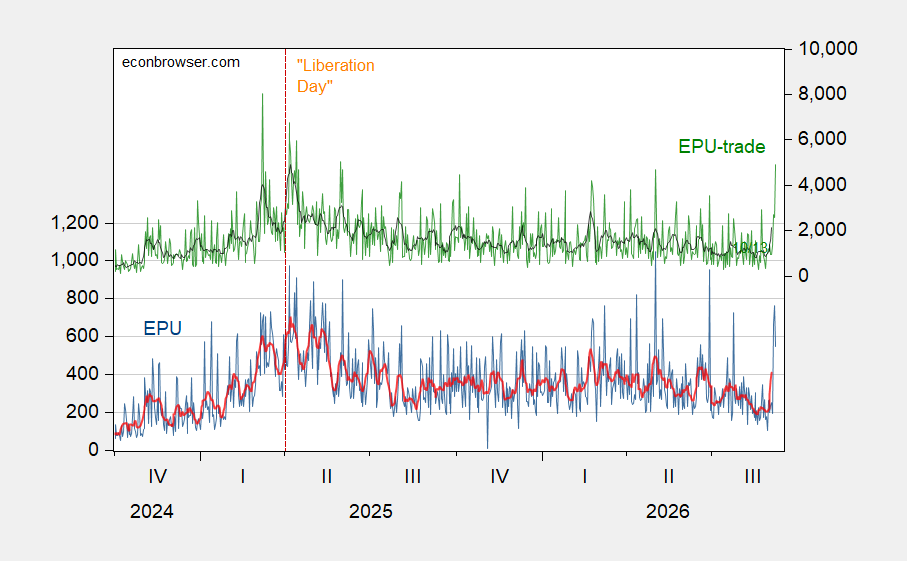
Econbrowser has published its latest update on U.S. economic policy uncertainty (EPU) indicators, covering data through yesterday.
Figure 1: EPU (blue, left scale), 7-day centered moving average (red, left scale), EPU-trade policy (green, right scale), 7-day centered moving average (black, right scale). Source: policyuncertainty.com.
The chart draws on the Economic Policy Uncertainty Index developed by economists Scott Baker, Nicholas Bloom, and Steven Davis, which tracks policy-related uncertainty by measuring the frequency of newspaper articles containing terms related to the economy, policy, and uncertainty. A companion series, the Trade Policy Uncertainty index, applies a similar methodology to news coverage specifically concerning trade policy.
These indexes are widely used in academic and policy research as real-time gauges of uncertainty, and research associated with the index authors has linked elevated policy uncertainty to effects such as delayed investment and hiring decisions by firms. Because the series are built from daily news coverage, they can move quickly around major policy announcements, which is why analysts often watch the trade-specific series during periods of active tariff or trade negotiation news.
Both daily indexes are maintained by the researchers at policyuncertainty.com. Because the daily series can be volatile, seven-day centered moving averages are typically used to smooth short-term fluctuations and highlight underlying trends.
The underlying data are available at policyuncertainty.com, and the original post appears at Econbrowser.
