U.S. Debt Interest Payments Hit $3 Billion a Day in Fiscal 2026, Outpacing Federal Spending, Revenue, and GDP Growth
Key Takeaways
- •The federal deficit reached $1.99 trillion in fiscal 2026, 12% wider than fiscal 2025, as spending grew 6% to $7.4 trillion while revenue rose only 3% to $5.4 trillion.
- •Net interest payments climbed 8% to $1.05 trillion in fiscal 2026, equal to roughly $2.9 billion per day and 3.2% of GDP, surpassing the record share set in 1991.
- •Interest on the national debt is now the third-largest federal expenditure after Social Security and Medicare, exceeding both defense spending and Medicaid.
- •More than $10 trillion of publicly held debt, about one-third of the total, matures within the next 12 months and must be refinanced at rates above Congressional Budget Office projections, with the 10-year Treasury yield now exceeding 5%.
- •CBO Director Phillip Swagel estimated that stabilizing the debt would require nominal GDP growth of 7%–8% or real growth of 5%–6%, more than double the current 2.2% pace, making growth alone an implausible solution.
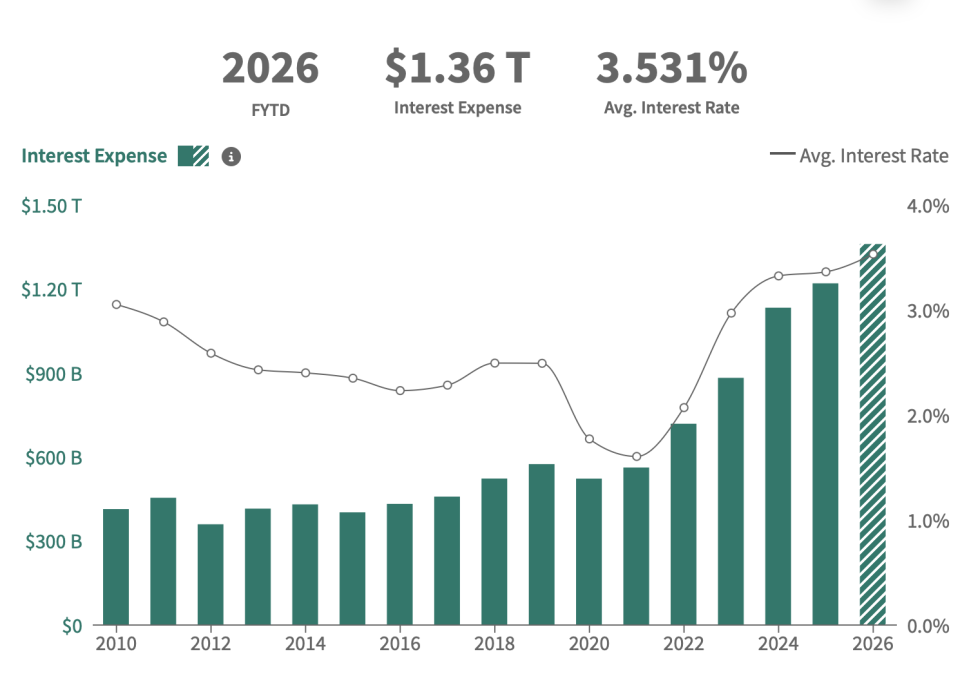
The U.S. federal government's 2026 fiscal year, which ended last month, closed with another stark warning about the country's debt trajectory: interest payments on the national debt have reached roughly $2.9 billion a day and are now growing faster than federal spending, revenue, or the economy itself.
According to Treasury Department data released Friday, the federal budget deficit widened to $1.99 trillion in fiscal 2026 — 12% larger than the $1.78 trillion gap recorded in fiscal 2025. Revenue rose 3% to $5.4 trillion, lagging a 6% increase in spending to $7.4 trillion.
Social Security and Medicare remained the government's largest line items, but interest payments on the national debt ranked third, surpassing both defense spending and Medicaid.
Interest Costs Outpacing the Economy
Gross interest costs for fiscal 2026 totaled $1.36 trillion at an average interest rate of 3.53%, Treasury data show — more than double the rate in 2021, just before the Federal Reserve embarked on an aggressive tightening cycle to rein in inflation. Net interest payments, which exclude interest credited to government accounts such as federal trust funds, rose 8% to $1.05 trillion, outpacing increases in total spending, revenue, and GDP. The increase exceeds real GDP growth of about 2 as well as nominal GDP growth of about 6%. For scale: net interest now exceeds half of the fiscal 2026 deficit.
Fiscal 2026's net interest costs translate to about $2.9 billion a day, and the Peter G. Peterson Foundation estimates they represent 3.2% of GDP, breaking the previous record set in 1991.
With gross U.S. debt at $40 trillion, publicly held debt at 100% of GDP, and borrowing costs climbing, interest payments are projected to be the fastest-growing portion of the federal budget in the coming years. At the same time, the debt burden is increasingly exposed to market volatility that threatens to make interest costs even steeper.
Rolling Over Debt at Higher Rates
Treasury Secretary Scott Bessent has been issuing more short-term debt to finance the deficit while retiring long-term obligations. About one-third of publicly held debt — more than $10 trillion — is now due to mature within the next 12 months, meaning the federal government must roll it over at today's higher rates. Treasury's quarterly refunding announcements, which set out its planned issuance of bills, notes, and bonds, are the scheduled checkpoints where any adjustment to that short-term-heavy strategy will be disclosed.
The interest bill is also outstripping official projections. In February, the Congressional Budget Office projected that annual debt interest expenses would reach $2.1 trillion by 2036. But then President Donald Trump launched the Iran war, which sent oil prices and bond yields soaring. The 10-year Treasury yield is now above 5%, well past the CBO's forecasts of 4.1% this year, 4.2% in 2027, 4.3% from 2028 to 2031, and 4.4% from 2032 to 2036. The CBO's next round of long-term projections will show whether those rate assumptions are revised toward current market levels.
If bond yields remain about 1 percentage point above the CBO's estimates, interest costs will surge to $2.8 trillion, or 5.9% of GDP, by the end of the decade, according to the Committee for a Responsible Federal Budget (CRFB).
“Higher interest begets more debt, and greater debt begets higher rates and higher interest. Eventually, the whole thing could come crashing down,” CRFB President Maya MacGuineas said last month. “That's why Washington needs a fiscal intervention now, before it's too late. The President, the Treasury Secretary, and Congressional leadership need to understand the severity of this issue. There are no easy fixes, and we can't just wish this problem away.”
The Growth Debate
So far, there is little sign of willingness in Washington to tackle spending or revenue. Trump has called for a $5,000 “dividend” check to Americans if Republicans win the midterm elections and is already handing out “rebates” to millions of Medicare and Affordable Care Act enrollees.
Bessent, meanwhile, has argued that heating up the economy further can get the debt under control. “With 3% growth, we grow our way out of this,” he said at Southern Methodist University last month. “We'll get to the other side of this Iran conflict, and the underlying economy is very, very strong, and I think reaccelerating.”
But CBO Director Phillip Swagel said last week that faster economic growth is unlikely to keep U.S. debt in check. While stronger growth will help by bringing in more revenue for the federal government, it is not that simple: federal spending also boosts growth, which lifts wages that in turn affect outlays on Social Security benefits, he pointed out. A robust economy also tends to send interest rates higher, which adds to debt interest costs.
Assuming interest rates of 4% to 5%, Swagel estimated that nominal GDP growth would have to reach 7%–8%, and real GDP growth 5%–6%, in order to stabilize the debt. That is more than double the latest real GDP pace of 2.2% in the second quarter, while even bullish Wall Street forecasts put full-year GDP growth at 2.5%.
“So growth will help, but it's probably not plausible that growth alone will stabilize our fiscal trajectory,” he said. “So then we're left with changes in revenues and changes in spending, and those are political choices.”
This story was originally featured on Fortune.com.

