Ukraine’s Caspian Sea Strike on Iranian Ship Points to Expanding U.S.-Iran War Fronts
Key Takeaways
- •Zelensky said Ukraine attacked a Caspian Sea cargo ship carrying military supplies between Iran and Russia.
- •Ukraine accused Russia of providing Iran with satellite imagery of Gulf states and U.S. bases connected to Iranian strikes.
- •The Caspian Sea has drawn attention because it is a Russia-Iran supply corridor outside the Gulf shipping routes central to the U.S.-Iran confrontation.
- •U.S.-Iran diplomacy is continuing after nearly two weeks of daily attacks ended on Friday.
- •Analysts cited in the article said Iran could respond by targeting Ukraine-linked vessels or infrastructure, or by recognizing Crimea and the Donbas as Russian territory.
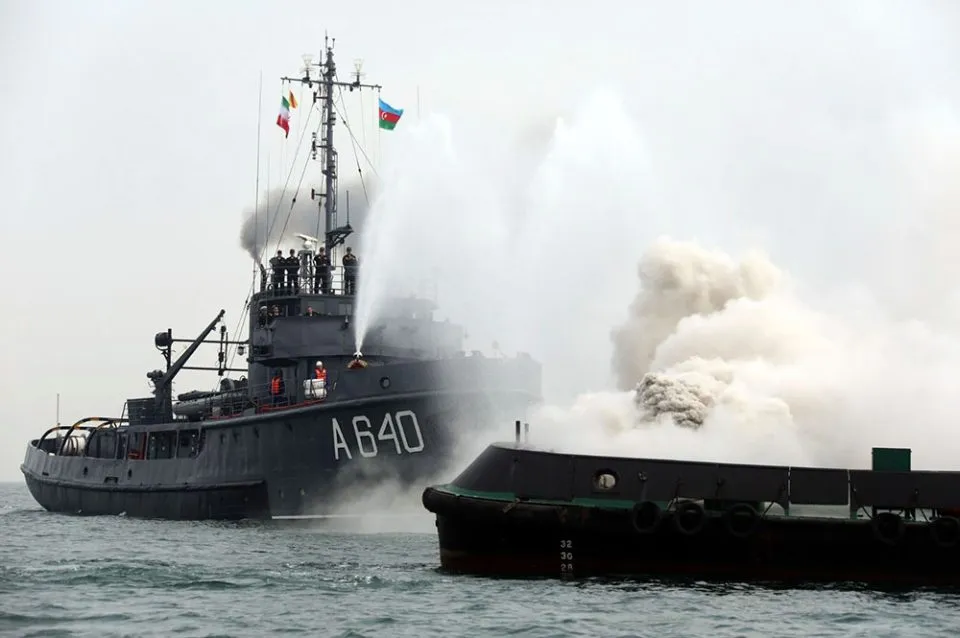
The United States and Iran have stopped their daily attacks on each other for now, but the conflict has not been frozen. Other forces are widening the battlefield, with Ukraine signaling that the Caspian Sea may become another point of pressure on Tehran.
On Saturday, President Volodymyr Zelensky said Ukraine had attacked a cargo ship in the Caspian Sea that was transporting military supplies between Iran and Russia. He also instructed Ukraine’s intelligence service to release information on Russian assistance to Iran, including satellite imagery of Gulf states and U.S. bases in the region.
“These images subsequently appear in Iran. At the same time, there is a clear correlation between Russia’s satellite imagery of these sites and Iranian strikes — both before the attacks, in preparation for them, and afterward, to assess the damage inflicted,” Zelensky posted on X.
Iran has maintained that it is not involved in Russia’s war against Ukraine, although Kyiv has said Tehran is supplying drones to Moscow. The Islamic republic also called on European countries to hold Ukraine accountable.
The Ukrainian strike led to speculation in Tehran that the operation was intended as a warning that Iran’s Caspian coast is vulnerable and could be used as leverage in negotiations with Washington, according to the Financial Times.
The Caspian Sea is landlocked and bordered by Iran and Russia as well as Azerbaijan, Kazakhstan, and Turkmenistan, making it separate from the Gulf shipping routes that have dominated the U.S.-Iran confrontation. That geography helps explain why any attack there would draw attention: it points to pressure on a corridor linked to Russia-Iran military cooperation rather than only to the maritime routes around the Arabian Peninsula.
The episode comes as diplomacy between the U.S. and Iran continues after the collapse of their memorandum of understanding, which was followed by nearly two weeks of daily attacks that ended on Friday.
Separately, Oman and Iran are holding talks over the Strait of Hormuz. Sources told the Associated Press that negotiators are discussing a deal centered on Iran managing vessel transit with fewer restrictions on ships.
Although the Caspian Sea is more than 600 miles from the front line in Russia’s war, Ukraine has developed long-range drones capable of striking deep inside Russian territory. After damaging Russia’s oil infrastructure and contributing to a nationwide fuel shortage, that capability could become an important factor in the U.S.-Iran war.
Hamidreza Azizi, an Iran expert at the SWP Berlin think tank, outlined several possible interpretations of Ukraine’s attack on the Iranian ship.
One interpretation is that Ukraine is seeking to show its value as a partner to the U.S., which supplies Kyiv with critical weapons, including Patriot air-defense interceptors. Azizi said on X that the operation could not have taken place without approval from Washington and other Western partners.
Another view is that Israel and the U.S. asked Ukraine to exert pressure on Iran because of concerns that direct attacks by either country on Iranian infrastructure could trigger retaliation against regional economic assets.
A third interpretation is that Ukraine’s strike was a response to threats by Houthi rebels against shipping in the Bab el-Mandeb Strait, which Saudi Arabia has used to export oil while bypassing the Strait of Hormuz.
The Bab el-Mandeb Strait, located at the southern end of the Arabian Peninsula, is a major maritime chokepoint linking the Red Sea with the Gulf of Aden. The Iran-backed Houthis struck two Saudi oil tankers in the Red Sea this past week, prompting Saudi Arabia to attack the Yemeni port city of Hodeida.
“In other words, the Caspian front, together with the Indian Ocean — where the United States has imposed a maritime blockade on Iran — is now intended to complete a ring of economic and military pressure around the country,” Azizi wrote on X.
Azizi added that Iran is also concerned that Ukrainian intelligence services may support ethnic insurgent groups against Tehran, similar to Kyiv’s approach in Syria against the Assad regime.
In response to Ukraine’s role, Iran could carry out direct attacks against Ukraine-linked vessels in other sea lanes or against Ukrainian infrastructure. Tehran could also recognize Crimea and the Donbas as Russian territory.
“In any case, what is clear is that Iran’s war is becoming increasingly intertwined with two other conflicts: the Saudi-Houthi confrontation and the Russia-Ukraine war,” Azizi warned. “With each passing day, the war is evolving into an increasingly complex, multidimensional, and international conflict.”
Ukraine already has a role in the Middle East. In March, it signed a security agreement with Saudi Arabia to provide the kingdom with expertise Kyiv has developed in defending against Iranian-designed drones supplied to Russia. Zelensky also visited the United Arab Emirates and Qatar to pursue similar agreements.
The Caspian Sea, which has become a key supply route amid the U.S. naval blockade, had already seen fighting earlier in the Iran war. Amid reports that Russia was providing Tehran with ammunition, drones, and other weapons, Israel attacked the Iranian port of Bandar-e Anzali on the Caspian Sea, according to the Wall Street Journal.
University of Pittsburgh political science professor William Spaniel said in March that the blurring of battle lines had “effectively merged the Russia-Ukraine war and the Iran war into a single conflict.”
“We are still not at a true world war as there is no one actor fighting on two fronts simultaneously like the United States during World War II,” Spaniel added in a video on his YouTube channel. “But it is further connecting the battlefield outcomes, and it will have longer-lasting implications for how the battle lines are divided.”
This story was originally featured on Fortune.com.

