UK Inflation Accelerates to 2.9% on Energy Costs as Bank of England Faces Difficult Rate Choice
Key Takeaways
- •Headline inflation remained above the Bank of England’s 2% target despite matching market expectations.
- •Core inflation held at 2.6%, while services inflation was unchanged at 3.4%, indicating limited domestic price acceleration.
- •Average earnings growth slowed to 3.9% in July from 4.2% previously, and unemployment benefit claims rose by 27,800 in August.
- •The Bank of England is widely expected to keep interest rates unchanged and focus on its policy guidance and voting split.
- •GBP/USD briefly rose to about 1.3495 after the release before retreating toward 1.3480, indicating a limited market response.
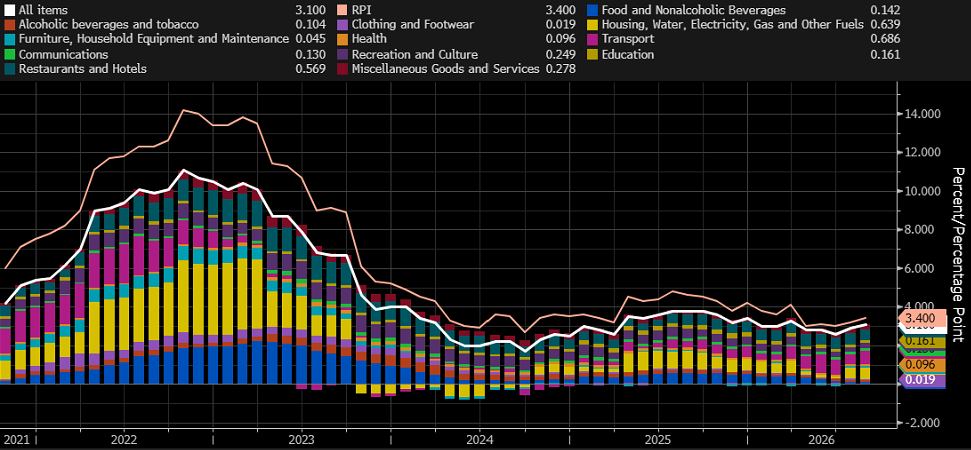
UK consumer price inflation accelerated to 2.9% year-on-year in August, up from 2.6%, with energy prices driving the increase, while core and services inflation held steady. The reading arrived a day before the Bank of England's latest policy announcement, where the central bank is widely expected to leave interest rates unchanged. Combined with slowing wage growth and a sharp rise in unemployment benefit claims, the data underline the difficult balance the Bank of England faces between persistent price pressures and a softening labour market.
Energy Costs Push Headline Inflation Higher
UK consumer price inflation rose from 2.6% to 2.9% year-on-year in August, in line with market expectations. Core inflation, which strips out volatile food and energy prices, delivered a slightly stronger reading, holding at 2.6% against expectations for a decline to 2.5%. The figures confirm that price pressures in the British economy remain relatively persistent — and leave inflation clearly above the Bank of England's 2% target, the level policymakers regard as consistent with price stability.
The increase in headline inflation was driven mainly by energy prices, including more expensive fuel. That dynamic carries added significance given the continued rise in global oil prices: following the Houthis' advance in Yemen, crude oil is moving towards USD 110 per barrel, increasing the risk that UK inflation will remain above the Bank of England's target for longer.
Domestic Price Pressures Remain Contained
For the Bank of England, indicators of domestic price pressure are more important than the headline CPI figure alone. Core inflation held at 2.6%, while services inflation — widely viewed as a gauge of domestically generated price pressure — was unchanged at 3.4%, a slightly better outcome than some forecasts, which had pointed to an increase to 3.5%. Airfares also had a smaller impact than expected: prices rose 6.2% compared with July, but this was not enough to push services inflation higher.
Taken together, the data suggest that rising energy costs have not yet generated significant second-round effects. In other words, higher fuel and energy prices are not visibly spreading into wages or other service-sector categories.
The Labour Market Is Losing Momentum
The latest labour market figures provide a similarly mixed picture. Average weekly earnings increased by 3.9% year-on-year in July, in line with forecasts but below the previous month's growth rate of 4.2%. Regular pay growth, excluding bonuses, remained at 3.5%.
The unemployment rate was unchanged at 4.9%, slightly better than the 5.0% expected by economists. However, the number of people claiming unemployment-related benefits increased by 27,800 in August, considerably more than the forecast rise of 8,300, after claims had declined by 11,800 in the previous month. Because the claimant count is compiled from administrative records and published monthly, it is often read as a timelier signal of weakening labour demand than the survey-based unemployment rate.
The UK economy is therefore sending conflicting signals. Better-than-expected July growth data indicate that economic activity remains resilient, but weaker wage growth and the sharp increase in benefit claims point to a fragile labour market.
No Clear Case for an Immediate Rate Hike
The Bank of England must balance the risk of persistent inflation against the possibility of further weakness in employment and economic growth. More expensive energy supports maintaining a restrictive policy stance, but stable services inflation and slowing wage growth reduce the need for an immediate rate increase.
Today's inflation report is unlikely to materially change expectations ahead of tomorrow's decision. The Bank of England is widely expected to keep interest rates unchanged, with markets focused primarily on the voting split of the rate-setting Monetary Policy Committee and the guidance concerning future meetings.
The shift in market pricing has been substantial. At the end of June, markets were pricing in slightly more than one rate hike by the middle of next year; they now expect around four increases. The analysis attributes this move to higher energy prices and the more hawkish stance adopted by major central banks: the European Central Bank has delivered a more restrictive message, the Reserve Bank of Australia is moving towards another increase, and the Federal Reserve and the Bank of Japan may also tighten policy.
Market Expectations May Be Too Aggressive
According to the MarketPulse analysis, four Bank of England rate hikes still appear to be an aggressive scenario. The latest inflation figures do not provide a clear justification for starting a rapid tightening cycle: headline inflation has moved closer to 3%, but services inflation has not accelerated and wage pressures are gradually easing.
The forthcoming debate over the UK budget creates an additional source of uncertainty. Any renewed fiscal tightening could weaken economic activity and reduce the Bank of England's room to raise interest rates. In the months ahead, the central question is whether energy-driven price pressure stays contained, as August's data suggest, or begins to surface in wages and services — the development that would most directly shape the committee's next moves.
Limited Market Reaction
GBP/USD initially rose to around 1.3495 following the CPI release before retreating towards 1.3480. The limited reaction suggests that the data have not fundamentally altered the outlook for UK monetary policy. If the Bank of England fails to validate the market's hawkish expectations, investors may their bets on future rate hikes, creating downside risk for sterling.
Since July 2025, GBP/USD has been trading within a broad consolidation range between 1.37–1.38 and 1.30–1.3160. The US dollar has been strengthening again since 26 August this year, although the scale of the decline in the currency pair remains limited for now. The long-term trend remains upward, with no clear signs of a reversal at this stage.
This article is based on analysis originally published by OANDA MarketPulse. Opinions expressed in the original analysis are the author's and do not necessarily reflect those of OANDA Business Information & Services, Inc. or any of its affiliates, subsidiaries, officers or directors. The original publication is for informational and educational purposes only.

