Paraguay's Ueno Bank Collapse Sparks Bitcoin Curiosity
Key Takeaways
- •Ueno Bank, formerly the bank with the largest customer base in Paraguay, collapsed on November 3, 2026, directly affecting three million customers, more than 60% of adults in the country.
- •The collapse prompted the impeachment of former President Santiago Peña, who held a 1.5% stake in Ueno, along with the resignations of former central bank chief Carlos Carvallo and Attorney General Emiliano Rolón under political pressure.
- •Peña has been moved to Viñas Cué military prison, where he faces criminal charges linked to the bank, while large depositors and the social security fund Instituto de Previsión Social have yet to be reimbursed.
- •About 1.8 million retail customers have received full or partial reimbursements, but outstanding reimbursements and pending criminal cases remain the central unresolved issues in the aftermath.
- •Demand for the stablecoin USDT surged during the first week after the failure, and Bitcoin educators in Paraguay report growing openness to Bitcoin as a savings asset and hedge without counterparty risk.
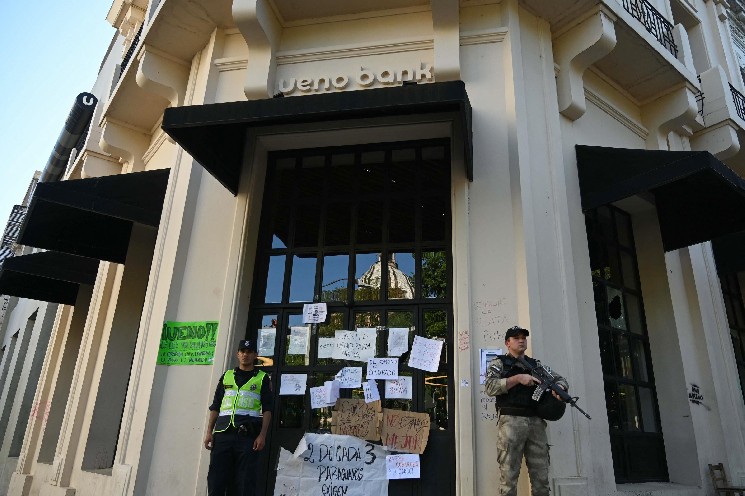
Paraguay's Ueno Bank Collapse Sparks Bitcoin Curiosity
Ueno Bank — formerly the bank with the largest customer base in Paraguay — collapsed on November 3, 2026, directly affecting three million customers, more than 60% of adults in the country.
The failure was so far-reaching and devastating that it triggered immediate political consequences. Santiago Peña, the former president of Paraguay, who held a 1.5% stake in Ueno, was impeached. Carlos Carvallo, the former chief of the Central Bank of Paraguay, and Emiliano Rolón, Paraguay's Attorney General, both resigned under political pressure.
In the aftermath of the crisis, some Paraguayans have begun to look at Bitcoin as an alternative to the traditional banking system.
The Difference Between Bitcoin and Money in a Bank Account
"There's a fundamental difference between owning money and having a claim against a financial institution," Lorena Almada — a native Paraguayan, Bitcoin educator, and founder of Bitcoin Paraguay — said in an interview.
Ueno's depositors are now living that distinction firsthand: their account balances existed as claims on the bank, and with the institution collapsed, access to those funds has depended on an ongoing reimbursement process rather than on money they hold and control directly.
Almada has spent the past five years educating Paraguayans about Bitcoin. Her goal is for people in the country to understand Bitcoin beyond its investment potential. She teaches that it is an asset without counterparty risk — one that enables financial autonomy.
"For years, I've been explaining concepts like self-custody, financial sovereignty, and the importance of being able to control your own money," Almada said. "Now, these concepts are becoming much more tangible to people."
Expanding on that point, she noted that because nearly all Paraguayans were either affected by the Ueno Bank failure or know someone who was, many are now questioning the country's broader monetary and financial systems.
"The Ueno Bank failure became a national conversation because this wasn't just about one bank," Almada said. "It raised much bigger questions about institutional trust, financial oversight, and people's ability to control their own money."
Paraguayans Fight for Justice and Look for Alternatives
Sofia B., a native Paraguayan event organizer and marketer who has arranged various Bitcoin events in her home country, attended the protests that shook the nation in the wake of Ueno's collapse. She described it as inspiring to see so many Paraguayans in the streets demanding justice for what had happened.
"Many young people got involved to show that we would not let them get away with stealing money from so many Paraguayans," B. said in an interview. "They wanted to apply pressure for a quick resolution, to help everyone get their money back, and to not let the powers that be walk away with no consequences."
Thus far, justice has only partially been served. Former President Peña was recently moved from a comfortable suite into Viñas Cué military prison, where he will remain while he faces criminal charges linked to Ueno. While 1.8 million retail customers have received full or partial reimbursements, customers who held larger deposits at the bank — as well as entities such as the Instituto de Previsión Social (IPS), Paraguay's social security and pension fund — have yet to be reimbursed.
Those outstanding reimbursements and the pending criminal cases remain the central unresolved threads as the aftermath continues to unfold.
As Paraguayans wait for Peña and other government and central bank officials to face criminal charges, some are searching for alternatives to a traditional financial system that many feel has betrayed them. According to B., Bitcoin is one of those alternatives.
"Bitcoin adoption in Paraguay has been growing slowly and steadily," B. said. "But this break in trust has brought about a sense of 'Okay, now what?' and it is opening the minds of Paraguayans of all ages to alternatives like Bitcoin."
The Alternatives: Bitcoin and Stablecoins
Not all Paraguayans searching for alternatives are turning to Bitcoin right away. In the wake of the crisis, many have gravitated toward stablecoins — an alternative that still carries counterparty risk — such as $USDT, the US dollar-pegged stablecoin issued by Tether.
"There was a huge demand for $USDT during the first week of Ueno failing," B. said. "It's the most adopted stablecoin here."
Gabriel Palma — a Colombian currently living in Paraguay, Educator Trainer Lead at My First Bitcoin, and Almada's spouse — explained on a recent episode of the New Renaissance Capital podcast that $USDT is "extremely accessible" in Paraguay. He noted that even to acquire bitcoin in the country, users often need to trade through $USDT, whether via major crypto exchanges like Binance or peer-to-peer marketplaces.
Almada observed that Paraguayans are likely opting for $USDT over Bitcoin for the time being because it is more familiar to them.
"Bitcoin's volatility can be intimidating, particularly for someone who has just experienced financial losses," Almada said. "But I believe that once people start asking questions about who controls their money, how the financial system works, and what alternatives exist, Bitcoin becomes a much more natural part of the conversation."
Ready and Willing to Talk Bitcoin — With Empathy
Palma spends his days educating people about Bitcoin and training other Bitcoin educators. While he is eager to teach more Paraguayans about Bitcoin in the wake of the crisis, he recognizes that right now, being understanding matters more than being pushy.
"We have to be empathetic," Palma said. "People don't want to hear 'You shouldn't have [had your money in Ueno]; you should have had it in bitcoin.' The damage is done. Their money is frozen."
His plan is simply to remain available and present for people during this time of need. He anticipates that a moment will come in the near future when Paraguayans have the headspace to reflect on and react to what happened.
"Let's be with the people throughout this crisis, but let's be there for them when they start looking for answers, for explanations, and hopefully for solutions," Palma said.
Palma sees Bitcoin as one of those solutions, though he believes Paraguayans will need to reach that conclusion on their own. Both he and Almada also emphasized that Paraguayans do not have to start using bitcoin as everyday money for it to hold value for them. They can view it simply as an asset to hedge against the risk of another failure like Ueno's, as well as a savings asset.
Palma is optimistic that many Paraguayans will come to see Bitcoin in that light. In his experience, Paraguayans have been notably open-minded about learning about Bitcoin.
"When I first got to Paraguay and [was] introduced to the Bitcoin community here, I was very, very happy to learn that Paraguayans in general are very curious when you talk to them about Bitcoin," Palma said. "So, I'm hopeful that this crisis brings more people out of the woodwork and [that they] come to learn about Bitcoin."
This article is based on reporting originally published by Forbes.

