Six Crew Missing After Tug Capsizes While Assisting Containership Off Busan
Key Takeaways
- •The tug TNS Catcher capsized at about 1.29pm roughly 9 km east of Oryukdo while assisting the berthing of the MSC Ikaria VI, a 5,576 teu Liberia-flagged containership.
- •One Indonesian seafarer was rescued, a South Korean crewmember later died in hospital, and six of the eight people on board remain missing.
- •Investigators believe towline tension during a starboard turn may have caused the capsizing, and a collision with the containership has been ruled out.
- •The tug sank to a depth of about 87 m, 6.5 km east of Songjeong Port, where poor visibility has hindered a Navy ROV search.
- •The coast guard has expanded the search area to 66 km by 40 km with 24 vessels and seven aircraft, while a 41-member investigation team has secured AIS, VDR and CCTV data.
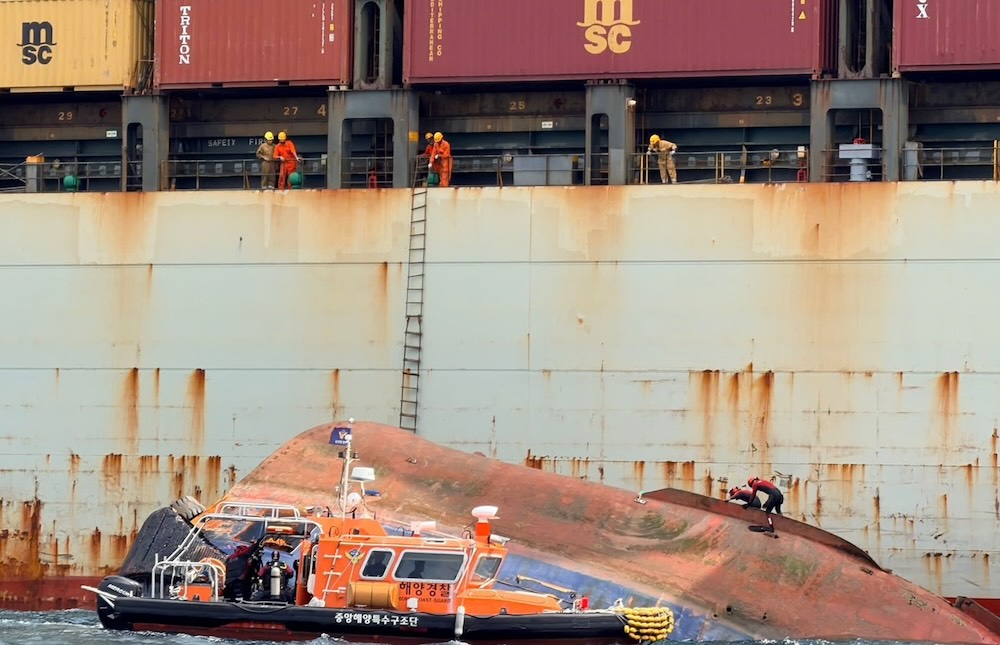
One seafarer has died and six remain missing after the tug TNS Catcher capsized while assisting a containership off Busan yesterday.
The 286-tonne tug overturned at approximately 1.29pm about 9 km east of Oryukdo. At the time, it was one of three tugs working to manoeuvre the MSC Ikaria VI, a 5,576 teu, Liberia-flagged containership. Busan is South Korea's largest port and one of the busiest container gateways in the world, and tug-assisted berthing and unberthing of large vessels is routine, high-coordination work there.
Of the eight people on board, one Indonesian crewmember was rescued. A South Korean seafarer was recovered unconscious and later died in hospital, while the six others remain unaccounted for.
Investigators now believe TNS Catcher may have been overwhelmed by towline tension while changing course. Towline interaction is a recognised hazard in tug operations: if a tug is dragged by its line at an unfavourable angle or speed relative to the assisted ship, it can be pulled over or girled, and capsizing can occur within seconds, leaving little time for crew to escape.
According to the Busan Coast Guard, two tugs were pulling from either side of the containership's bow while a third pushed from the stern. TNS Catcher, positioned at the starboard bow, was turning to starboard when it rolled sharply to port and capsized.
Officials believe the vessel's speed and timing may have been mismatched during the manoeuvre, although it has not yet been confirmed whether the tug became snagged on the towline. A collision with the containership has been ruled out.
CCTV footage from the containership shows TNS Catcher beginning the turn before rolling over.
The tug subsequently sank and has been located at a depth of approximately 87 m, 6.5 km east of Songjeong Port. Poor underwater visibility has hampered a Navy remotely operated vehicle (ROV) search. At such depths, survival prospects for anyone trapped depend heavily on whether crew reached the surface or an air pocket, and diving operations themselves face significant technical limits.
The coast guard has expanded the search area to 66 km by 40 km, deploying 24 vessels and seven aircraft. The wide expansion of the search grid indicates authorities are working on the assumption that any missing crew who escaped the wreck may have drifted considerable distance.
A 41-strong investigation team has secured AIS, VDR and CCTV data as authorities work to establish the exact cause of the accident. The findings are likely to draw attention to communication and speed coordination between pilots, ship crews and tug masters during assisted manoeuvres, an area regularly examined in past tug casualty investigations worldwide.
Source: Splash247

