Xi Jinping Takes Center Stage Over Trump at Historic 'G3' Summit, Former U.S. Official Warns
Key Takeaways
- •Julian Gewirtz, a former National Security Council senior director for China under the Biden administration, said the summit photograph depicted a China-centered world order with Xi presiding at the center and Trump and Putin flanking him.
- •Gewirtz acknowledged that Xi's central seat reflected his role as host and that a seating arrangement alone does not create a new world order.
- •The Shenzhen meeting, convened on the sidelines of the 21-member APEC forum, was the first-ever face-to-face gathering of the heads of state of the United States, China, and Russia.
- •Trump promoted the summit as an opportunity to discuss the U.S. war with Iran and to pursue an unprecedented three-way nuclear arms agreement, as earlier U.S.-Russian arms reductions from SALT to New START were negotiated bilaterally.
- •The Wall Street Journal characterized the trilateral summit as the latest sign of the end of the U.S.-dominated world and warned that the emerging order could prove less stable.
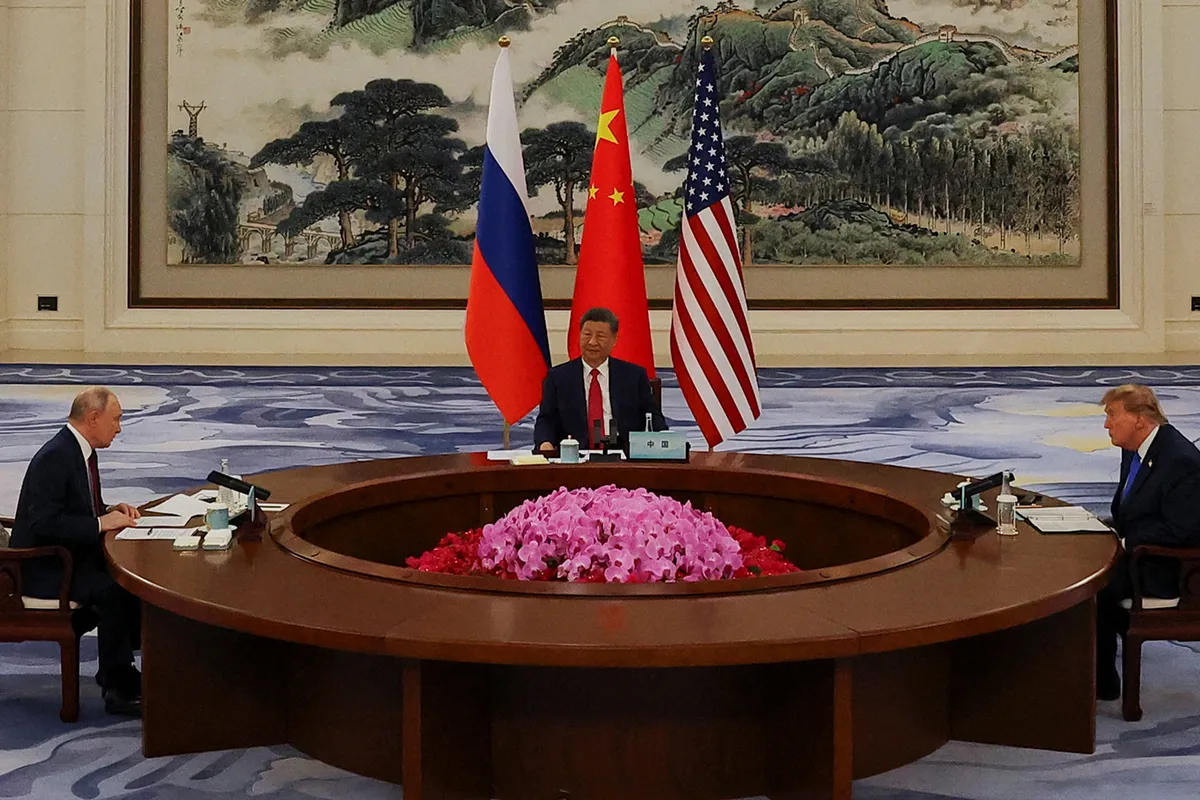
Chinese President Xi Jinping has positioned himself at the center of a would-be new world order — and pushed President Donald Trump into a secondary role — at Thursday's historic trilateral summit with Russian President Vladimir Putin, according to a former senior U.S. official on China affairs.
Julian Gewirtz, who served as senior director for China at the National Security Council and as coordinator for China at the State Department during the Biden administration, focused on a photograph from the trilateral meeting in Shenzhen, a major technology and manufacturing hub in southern China.
“A stunning image of a China-centered order: a would-be G3 with Xi presiding,” Gewirtz wrote on X. “The staging makes the hierarchy unmistakable. Xi faces the camera at the center, with Trump and Putin flanking him. The American president appears as one of two guests in a world convened by Beijing.”
“There's nothing equilateral about this triangle,” he added. “Xi has put himself at the apex.”
Gewirtz acknowledged that Xi, as the meeting's host, naturally occupied the central seat, and that a seating arrangement alone does not create a new world order. Even so, he argued that the photograph offered a striking visual of the international order Beijing wants the world to see.
The scene was one Gewirtz had anticipated. In his newsletter ahead of the summit, he wrote that Xi would have the chance to present himself as “the pivot player in international politics,” seated beside his closest partner, Putin, while negotiating with “a remarkably friendly American leader.”
“Trump may imagine himself to be the central figure in this meeting, but I doubt much of the world will see it that way,” he said.
The gathering, held on the sidelines of the annual Asia-Pacific Economic Cooperation (APEC) summit — a 21-member forum for economies across the Pacific Rim — was the first-ever face-to-face meeting of the heads of state of the three countries. Gewirtz pointed to reporting from The Wall Street Journal describing the trilateral summit as the latest sign of the end of the U.S.-dominated world — and warning that the emerging order could prove less stable.
At a bilateral meeting with Xi before the three-way talks, Trump described the “very special relationship” between the two leaders as the cornerstone of stability between the United States and China, the Journal reported.
“As long as you and I are in charge of things, we'll never have a problem,” Trump told Xi. “We're never gonna have a problem.”
Trump had promoted the summit as an opportunity for the three leaders to discuss the U.S. war with Iran and his goal of reaching a three-way agreement on their nuclear arms stockpiles — an objective without precedent, as past U.S.-Russian arms reductions from the SALT era to New START were negotiated bilaterally. The White House said the meeting would mark the beginning of a conversation, not a negotiation, a framing that put the emphasis on process over immediate deliverables.
The display was not the first signal Xi has sent about the shifting hierarchy. When Trump visited Beijing in May, Xi told him that visits to his private garden are “extremely rare” — before adding that “Putin has been here.”
This article is based on reporting originally published by Alternet.

