Trump Opens Door to Foreign-Built US Military Ships, Positioning Hanwha as Key Beneficiary
Key Takeaways
- •The presidential memorandum allows foreign shipbuilders to construct up to two US military vessels at their home facilities if they simultaneously invest in American shipyard infrastructure.
- •Under the "Finland Model," eligible companies must build or hold majority stakes in US shipyards, train American workers, license shipbuilding technologies domestically, and use US supply chains.
- •The exemption policy covers three categories of vessels: consolidated cargo replenishment tankers, roll-on/roll-off military transport ships, and surface combat vessels for anti-submarine and surface warfare.
- •Hanwha Group acquired Philly Shipyard in 2024 and has announced plans to invest $5 billion in expanding the Philadelphia facility with additional docks and quays.
- •Hanwha Defense USA has submitted a nonbinding offer of $1.05 billion to $1.2 billion to acquire Austal USA, which operates a major naval shipyard in Mobile, Alabama.
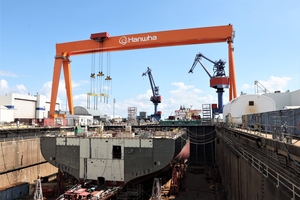
US President Donald Trump has signed a presidential memorandum creating a pathway for foreign companies investing in American shipyards to construct up to two military vessels at their home-country facilities, a move that could significantly advantage South Korea's Hanwha Group in the US naval shipbuilding market.
The memorandum, signed Thursday, aims to rebuild the US Navy and revitalize the domestic shipbuilding industry. It establishes an exemption to longstanding prohibitions on building US military vessels at foreign shipyards — restrictions rooted in US law requiring naval vessels to be constructed domestically, a policy that has shaped American defense procurement for decades. The US shipbuilding industrial base has contracted sharply since the Cold War, and the Navy has faced persistent schedule delays across multiple shipbuilding programs in recent years, intensifying pressure to find ways to accelerate fleet replenishment.
"As foreign shipbuilders make substantial and durable investments into America's shipyards and train an all-American workforce for the jobs they create, they will be temporarily permitted to build up to two ships in their parent shipyards that will be delivered to bridge gaps on a quick turnaround, while additional ships will be built in revitalized American shipyards," the White House stated in an accompanying fact sheet.
Under what the White House has termed the "Finland Model," a foreign shipbuilder may construct up to two vessels at its home shipyard on the condition that it simultaneously builds a new US shipyard or holds ownership or a majority stake in an existing one. All vessels beyond the initial two must be constructed in the United States.
Eligible companies must also hire and train American workers, license shipbuilding technologies to US shipyards, and source components through US supply chains for both the construction and maintenance of the vessels.
The policy applies to three ship classes: consolidated cargo replenishment tankers, roll-on/roll-off vessels for military transport, and surface combat vessels designed for anti-submarine warfare, surface warfare, and convoy escort missions.
The development removes a significant obstacle for Seoul's broader efforts to participate in the revival of the US shipbuilding sector. South Korea has committed to investing $150 billion in US shipbuilding. The initiative also aligns with deepening US–South Korea defense industrial cooperation, which has expanded in recent years through arms sales, joint training, and technology-sharing agreements under the longstanding bilateral security alliance in the Indo-Pacific.
Hanwha Group is widely expected to be a primary beneficiary, as it already satisfies one of the policy's central requirements through its ownership of a shipyard in Philadelphia. Hanwha acquired Philly Shipyard in 2024, providing the company with an established US shipbuilding base. The company subsequently announced plans to invest $5 billion to expand the facility, including the addition of docks and quays to increase production capacity.
Under the new framework, Hanwha could build the first vessels at Hanwha Ocean's shipyard in Geoje, South Gyeongsang Province — one of the world's largest commercial shipbuilding complexes, which has experience constructing naval vessels including AIP-powered submarines and destroyers for the Republic of Korea Navy — before transitioning follow-on production to its US facilities, subject to specific contracts receiving the required national security waiver.
Hanwha is also pursuing a larger US footprint through a proposed acquisition of Austal's US arm. Austal, Australia's largest shipbuilding company, is a major supplier to the US Navy and Coast Guard. Hanwha Defense USA, a subsidiary of Hanwha Aerospace, has submitted a preliminary, nonbinding offer valuing Austal USA at $1.05 billion to $1.2 billion. Austal has granted Hanwha a four-week due diligence period.
If the acquisition is completed, Hanwha would gain control of Austal USA's shipyard in Mobile, Alabama, adding a substantial naval construction base to complement its existing Philadelphia operation.
Source: Korea Herald Business

