Who Will the US Trade With If the Fed Doesn't Lower Rates? A Short List, Census Data Shows
Key Takeaways
- •President Trump suggested countries could face a halt in US trade if the Federal Reserve does not lower interest rates.
- •The proposal conflates monetary policy, set independently by the Fed, with trade policy powers held by the executive and Congress.
- •Based on Census Bureau data through July, only Belgium, the Netherlands, Spain, Egypt, Nigeria, and the UK would remain US trading partners under such a standard.
- •Major US trading partners including the EU collectively, Canada, Mexico, and China would fall outside the short list.
- •The International Emergency Economic Powers Act of 1977 is a possible mechanism, but using it to cut off an allied nation over a Fed rate decision would be unprecedented and likely face litigation.
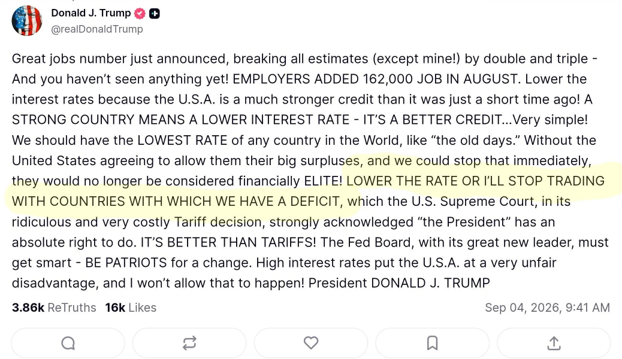
President Trump has suggested that countries could face a halt in trade with the United States if the Federal Reserve does not lower interest rates — at least according to Trump.
The remark blurs two areas that operate under separate legal frameworks: monetary policy, which the Federal Reserve sets independently of the White House under its congressional mandate, and trade policy, which the executive branch shapes through tariffs, negotiations, and statutes delegated by Congress. Linking another country's access to the US market to a domestic interest-rate decision would, if attempted, test the boundaries between those powers.
According to U.S. Census Bureau trade data through July, only a handful of countries would remain as trading partners under such a standard: Belgium, the Netherlands, Spain (although Spain drops out if the European Union as a whole is taken as a single "country"), Egypt, Nigeria, and the United Kingdom. The EU collectively is one of the largest US trading partners, alongside Canada, Mexico, and China — all of which would fall outside the short list.
It is not clear under what legal authority the president would be able to stop all trade with a given country, such as the UK. One possible mechanism raised is the International Emergency Economic Powers Act (IEEPA), a 1977 federal law that grants the president broad authority to regulate commerce after declaring a national emergency with respect to an unusual or extraordinary threat originating outside the United States. IEEPA has historically been used to impose economic sanctions, though using it to cut off all trade with an allied nation would be an unprecedented application. Courts have generally upheld wide executive use of IEEPA in the sanctions context, but its use to terminate trade over a Federal Reserve rate decision would raise novel legal questions that would likely be litigated.
More reporting is available from the New York Times.
