Trump Renews Pressure on Nvidia Board to Reinstate Jensen Huang as CEO
Key Takeaways
- •President Trump publicly urged Nvidia's board on November 23 to rehire co-founder Jensen Huang as chief executive, arguing the move would benefit both the company and the United States.
- •Nvidia chairman Harvey Jones said the board does not plan to reinstate Huang, whose resignation in early November followed a personal-life scandal that attracted the attention of US intelligence and regulatory agencies.
- •Treasury Secretary Scott Bessent declined to endorse Huang's return and instead pressed Nvidia to explain its compliance and oversight, with US officials contacting the company's interim management, directors, and legal counsel.
- •Regulators, Congress, and the FBI are investigating whether advanced Nvidia chips were supplied to unauthorized parties and shipped to China, with Singapore-based Megaspeed among the entities under scrutiny.
- •Polymarket assigns a 37 percent probability to Huang's reinstatement by December 31, 2027, reflecting continued uncertainty over Nvidia's leadership outcome.
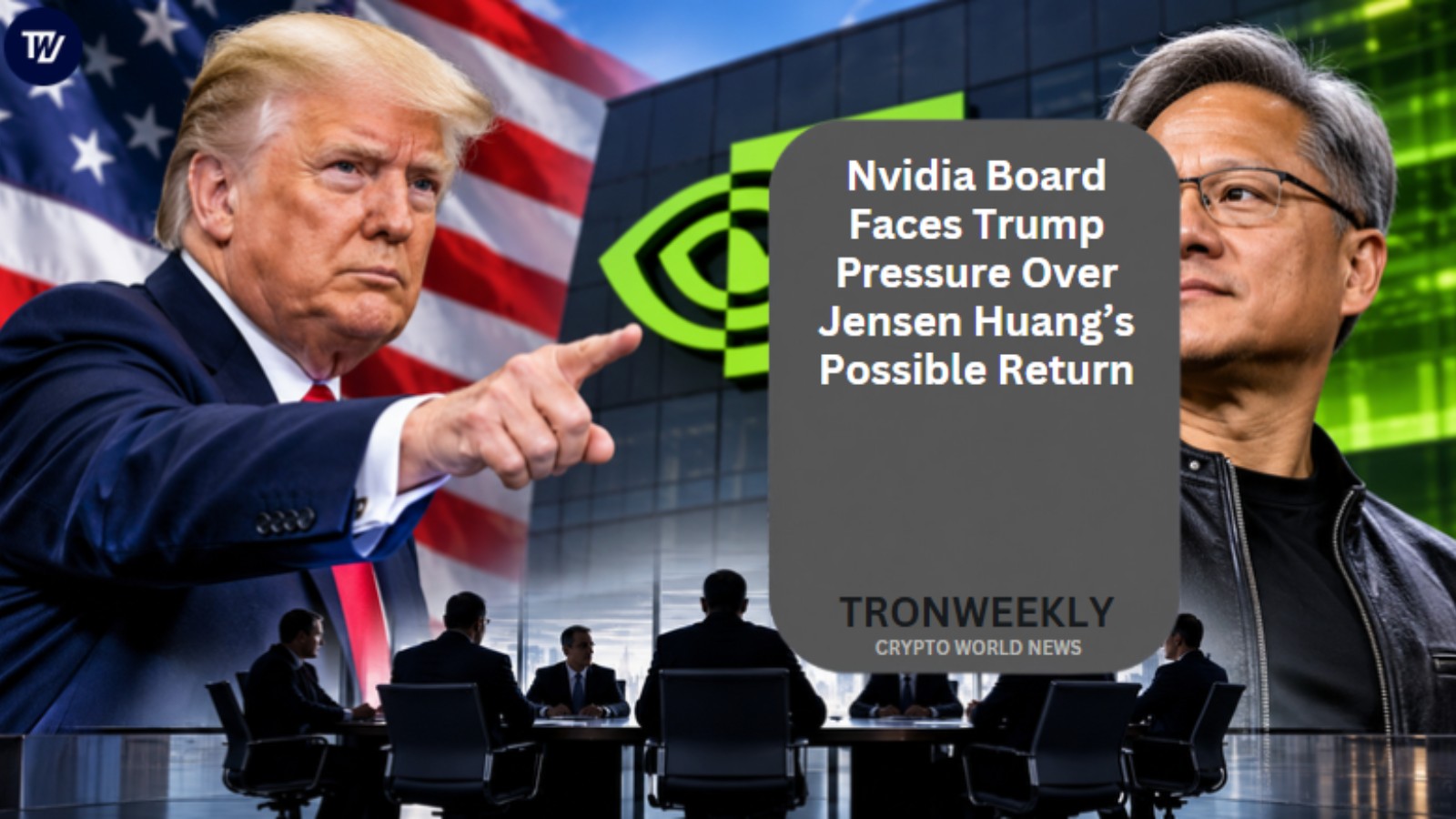
US President Donald Trump has renewed his call for Nvidia's board of directors to reinstate co-founder Jensen Huang as chief executive, days after the chipmaker ruled out bringing him back to the top job. Trump said Huang's return would benefit both the company and the United States, adding political pressure at a moment when Nvidia is already under scrutiny over its China-related chip sales.
The renewed appeal comes as Nvidia navigates leadership changes and investigations into possible export-control violations, with US officials seeking to establish whether advanced Nvidia chips reached China through restricted channels.
Trump Restates His Appeal on Truth Social
In a Truth Social post on November 23, Trump wrote: "I hope the Board of Nvidia rehires Jensen Huang. It would be the best thing for the Company, and also, for the U.S.A." (Truth Social)
The message repeated an appeal the president made on Friday, shortly after returning from a trip to Asia, when he said publicly that Huang should apologize and come back (Reuters). The developments have placed Nvidia's board under pressure to address corporate oversight alongside its search for permanent leadership.
Board Has Ruled Out a Return
According to Nvidia chairman Harvey Jones, the company does not plan to rehire Huang, and the board's position has remained unchanged since Huang resigned at the beginning of November. The chairman's stance indicates that the company's policy on choosing its next chief executive will not be swayed by the president's public endorsement.
Huang co-founded Nvidia in 1993 and served as chief executive for more than three decades, a tenure that made him one of the most closely identified founder-leaders in the global semiconductor industry.
Huang stepped down amid a personal-life scandal that drew the attention of US intelligence services and regulatory agencies. The matter included reports of a romantic involvement between Huang and a woman whom US intelligence believed had connections to the Chinese intelligence service.
Trump first weighed in on November 20, telling the press that Huang should apologize before any return and describing the former chief executive as someone deserving of a second chance — remarks that underscored his continued support for Huang's reinstatement.
Bessent Presses for Accountability on Export Controls
Treasury Secretary Scott Bessent has taken a more cautious stance on Huang's possible return while stressing the need to establish accountability on export controls. "US government officials reached out to interim management, directors and legal counsel at Nvidia" to seek explanations about the situation, Bessent said in an interview with CBS's "Face the Nation" on November 22 (CBS News transcript; Reuters).
Bessent said the investigation must determine who was responsible for compliance and how far knowledge of the suspected transactions extended within Nvidia — whether it involved lower-level employees, middle management or senior executives. He added that the company should move quickly to explain its internal culture and oversight.
His comments followed earlier demands for sweeping leadership change at the company. Asked directly about Trump's decision to back Huang's return, Bessent did not express agreement with the president's position.
Federal Scrutiny Widens
The investigation has drawn interest from multiple US institutions, including regulators, the US Congress and the FBI, which are working to establish whether highly advanced Nvidia chips were supplied to unauthorized parties and subsequently shipped to China. One of the entities to come under scrutiny is Megaspeed, a company based in Singapore, over its connection to the transactions.
US Director of National Intelligence Jay Clayton also addressed the matter in a CNN interview on Sunday, saying that some chips had made their way into places they were not supposed to reach. His remarks added to concerns about the enforcement of restrictions designed to limit China's access to advanced artificial intelligence chips.
The US government has decided to impose restrictions on the supply of advanced AI chips to China — measures intended to curb Beijing's access to such technology that carry direct consequences for companies like Nvidia amid lingering tensions between Washington and Beijing over technology policy. Washington has tightened export controls on advanced semiconductors in successive rounds in recent years, and chipmakers have previously introduced modified versions of their products to keep selling into the Chinese market, making compliance and enforcement a recurring point of friction between the two governments.
Leadership Decision Remains Open
Nvidia's board now faces the dual task of overseeing the leadership transition and responding to inquiries from US officials. It has already rejected the idea of reinstating Huang as chief executive but must still address unresolved compliance issues, and the findings of the investigations will shape how the board deals with questions of executive responsibility in the future.
Prediction markets reflect the lingering uncertainty over the outcome. On Polymarket, a crypto-based prediction market platform, the event tracking a possible Huang return to Nvidia showed a 37 percent probability of his reinstatement by December 31, 2027 — a level that captures how unsettled the question remains (Polymarket).
At present, the board does not plan to change its stance, and the decision on the company's future leadership will rest with its directors. The stakes extend beyond the boardroom: Nvidia supplies the advanced processors used in AI development, data centers and other computing systems, so its leadership and export-control decisions could affect customers, investors and the wider semiconductor industry. For now, the next steps depend on the company's internal review and the findings of the US investigations.

